
The Tuia Mātauranga Pōkai Whenua GeoTour follows the footsteps of early explorers of Aotearoa New Zealand taking you to places where leaders of the past searched for food, resources and ways to adapt and survive in this new land.
Use the Pōkai Whenua GeoTour as your classroom to explore the stories of the past, in the present, to preserve what is unique in Aotearoa New Zealand for the future.
Collect the codewords to get the Geocoin puzzle piece.
To be able to complete this GeoTour and receive your special Geocoin collectable, remember to take a note of the codeword placed in the cache. This will need to be recorded in your passport which can be downloaded here.
|
Te Aroha - The Forgotten Gem
Te Aroha, the mountain, at 952 metres is the tallest peak in the Kaimai ranges. Its name is said to have originated from Te Mamoe, the son of an Arawa chief, who was lost in the wetlands of the Waihou Valley. He climbed to the top of the mountain, and from the summit he was able to identify his home at Maketu. He then declared that the mountain would be called ‘Te Aroha’, meaning ‘the mountain of love’, which stemmed from the deep affection for his land and people that he felt after viewing it from the peak.
Nestled at its base on the Eastern side of the Hauraki plains is Te Aroha, the town, in which just under 5000 people reside. Located in the Waihou river valley, the area was originally very swampy, making it difficult to access. Habitation at first was quite limited but the hot springs found at the base of the mountain, once discovered by Māori and European alike, made it a focal point in the area.
The first inhabitants were the Arawa people, who had initially established themselves in the Bay of Plenty then moved into the Waikato region and settled the area including Te Aroha. Between 1600 and 1650 the Tainui people also moved into the Waikato region, but allowed the Arawa people to keep their land in Te Aroha. As a result of a raid by Ngapuhi in 1815 most of the Arawa were forced to leave the area, although a few remained taking refuge on the mountain and in the extensive swampland where there were pools of hot mineral water. Early Māori knew of the healing properties of the Te Aroha hot springs and they used it especially during the Waikato land wars, when their wounded would retreat to the springs.
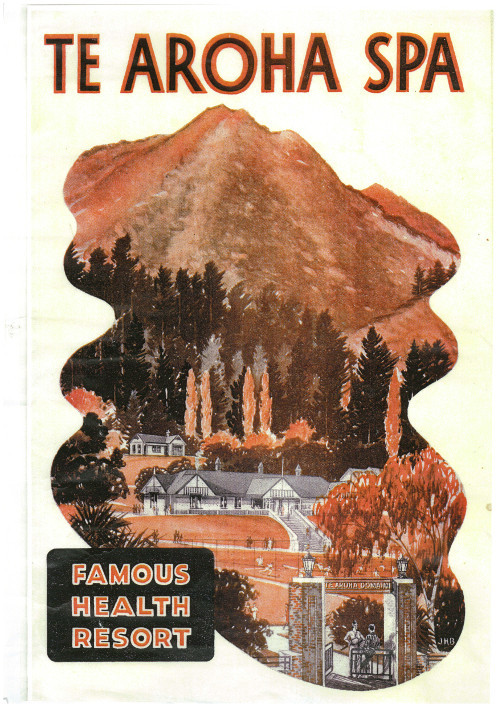 In the 1870s, around the time a gold rush hit the area, the Crown became actively interested in determining the ownership of the land and after a number of land court negotiations, land was awarded to several Māori tribes including a large parcel of land to Te Mōkena Hau, a Ngāti Rāhiri chief who had great influence in the area at the time. Te Mōkena Hau, gifted eight hectares to the Crown in 1882 to set up a hot springs reserve – this land is now the Te Aroha Domain and contains the mineral hot springs that the town became well known for during the next 50 years.
The idea of a health spa being developed at Te Aroha was envisaged as early as the 1870s, when regular excursions began from Thames to Te Aroha by boat so that visitors could take advantage of the springs. The government’s vision was of a colonial version of European spas (health resorts built around natural springs) which were very fashionable and extremely popular in the 19th century. They copied this idea for two reasons: to treat medical problems and to attract tourists.
The first known bathing development of the hot springs was believed to be at the No. 2 bathhouse site when the spring was excavated and a piano case from Mrs.O’Halloran (wife of Captain O’Halloran, landlord of the Hot Springs Hotel) was placed in the hole – this became known as the piano bath.
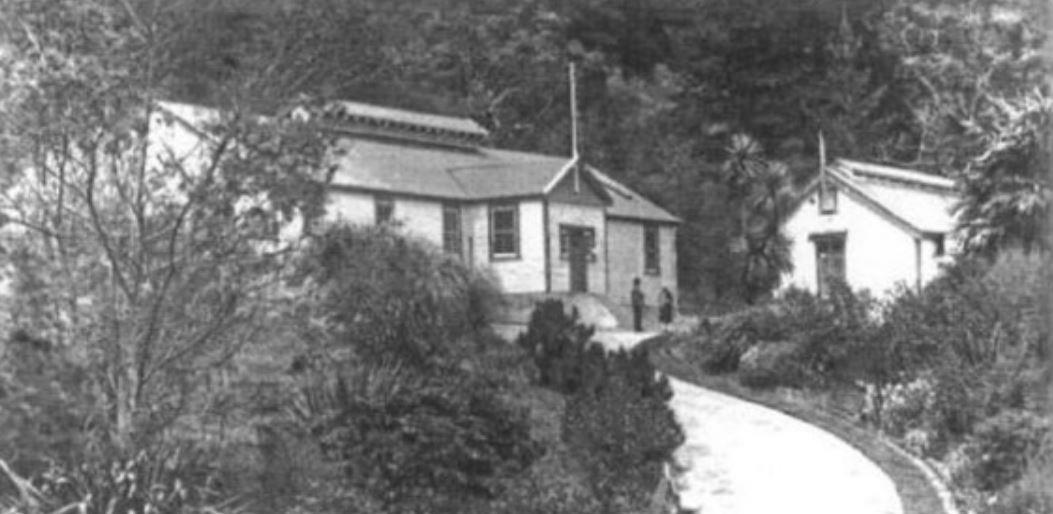
The construction of the first permanent bathhouses began in 1883 and just four years later there were seven bathhouses, a drinking fountain and planting to create a botanical garden. Recreational areas were also developed for outdoor sports. As well as bathhouses, many other springs were developed where one could ‘take the waters’ for different conditions, for example springs No. 20, 21 and 22 were used for anaemia, indigestion and good luck after getting married respectively. Visitors soaked in the pools and enjoyed the tea rooms, bowling greens and beautiful gardens.
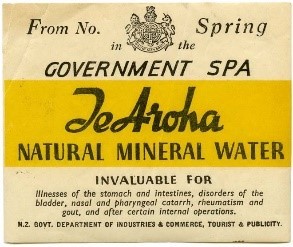 Treatments such as massage, x-ray therapy and even shock therapy were offered. The waters claimed to cure many common ailments such as rheumatism, arthritis and gout. Ingesting the water was believed to be a cure for anaemia and dyspepsia as well as being a good laxative and diuretic. In 1886 water from Springs 8 and 15 was bottled and sold.
The railway from Hamilton to Te Aroha was opened in March 1886 completing the link from Auckland and greatly increasing its accessibility and popularity for visitors. Te Aroha became the most popular spa town in New Zealand with around 30,000 bathers each year in the late 1800s, and the region’s natural hot soda springs were renowned as a cure-all. The town developed rapidly around this increase in visitors who came to “partake of the remedial waters, both by bathing and by bottle”.
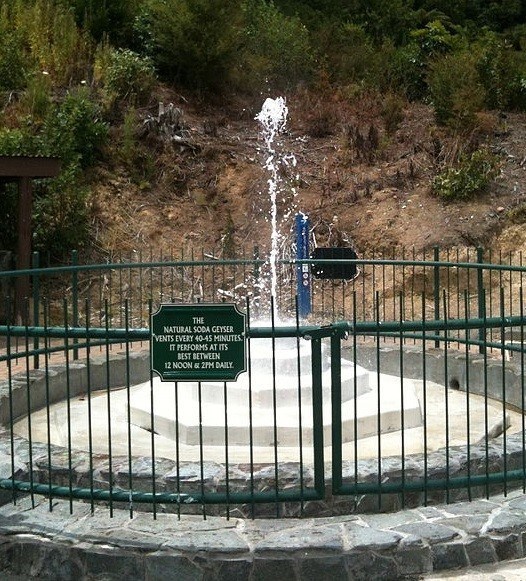
The mineral springs vary in temperature, and some of them are naturally infused with sodium bicarbonate underground, making for natural hot soda springs. To improve access to the soda water, a bore was sunk in the 1930s resulting in the world’s only hot soda water geyser – named the Mōkena Geyser after the Māori chief who gifted the land. Today the Mōkena Geyser erupts approximately every 40 minutes.
From the 1930s increased car ownership and improved roading made Rotorua and beach towns more accessible and the popularity of Te Aroha declined. Many of the spa treatments had also been discredited by that time, leading to a further fall in visitors and the town experienced financial losses. By the 1950s several of the original springs were closed.
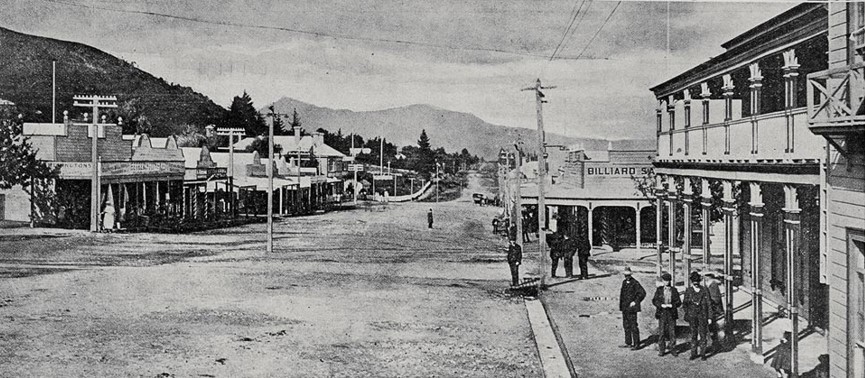
Since then some of the hot pools have been modernised and much work has gone into the Domain. Visiting the area today, with its old bathhouses and formal gardens is like stepping back in time. A museum highlights the history of the area. There are many walking and mountain biking tracks to explore and croquet is still played on the club’s picturesque lawns.
Despite these developments the Domain has still not recaptured the level of activity and significance it held during its heyday as a spa and is now regarded as a ‘forgotten gem’.
The lock code is: 6716
Thanks to the Matamata-Piako District Council for permission to place this cache
References:
• https://www.mpdc.govt.nz/history/te-aroha-history
• https://www.waikatonz.com/destinations/te-aroha/te-aroha-mineral-springs
• https://www.tearohanz.co.nz/see-do/history-of-te-aroha/a-spa-town-is-born
• https://core.ac.uk/download/pdf/44290513.pdf
• https://www.heritage.org.nz/the-list/details/7012