August 26, 2020 marked the 100th Anniversary of the passage of the 19th Amendment, giving women the right to vote.
This simply stated Amendment -- The right of citizens of the United States to vote shall not be denied or abridged by the United States or by any State on account of sex -- required a lengthy and difficult struggle; victory took decades of agitation and protest. Beginning in the mid-19th century, several generations of woman suffrage supporters lectured, wrote, marched, lobbied, and practiced civil disobedience to achieve what many Americans considered a radical change of the Constitution. Few early supporters lived to see final victory in 1920.
Between 1878, when the amendment was first introduced in Congress, and August 18, 1920, when it was ratified, champions of voting rights for women worked tirelessly, using a variety of strategies. 50 years earlier, when Wyoming was still a territory, legislators passed the Wyoming Suffrage Act of 1869. This act gave women in the territory the right to vote. Wyomians then turned their activism towards a national referendum. They persisted and 100 years later we celebrate their sacrifices.
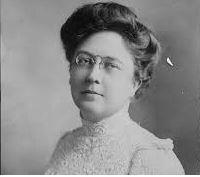
Celebrating Estelle Reel (1862 – 1959), who, in 1894, became the first woman Wyoming voters ever elected to a statewide office -- that of Wyoming Superintendent. At that time, Wyoming and Colorado were the only states where women had full voting rights. Wyoming women had been voting since 1869; Colorado women exercised the franchise for the first time that year.
Reel was born in Illinois in 1862, and came to Cheyenne, Wyo., in 1886 after being educated in Boston, St. Louis and Chicago. Her employment as a teacher in Cheyenne was threatened by criticism from some school board members, but she emphatically let them know that they had no right to dictate where she went to church, bought her clothes or boarded.
Reel performed so well as Wyoming superintendent that after two years in the job, she was being touted in the press as a possible candidate for governor. She quickly tried to squash such speculation. “The idea of a woman running for governor of the state of Wyoming is not worthy of serious consideration,” she wrote to the editor of the New York Sun.(In 1925 Nellie Taylor Ross would go on to become the one and only female Governor of Wyoming.)
Reel's election had already cemented her place in the history of the woman suffrage movement, but her response that a woman could not possibly be a governor wasn't well received by some of the more radical members who wanted no limits on women's aspirations. She wasn't done making history, however. When she left her Wyoming office after three years to become the national superintendent of Indian schools, Reel became the first woman to be confirmed for a federal office by the Senate. But as confounding as it was for her contemporaries, the fact that Wyoming's most successful woman politician of her time wouldn't even consider running for governor was consistent with her lifelong views on the limited role women should play in government.
Reel may have been reticent about pushing for women's suffrage too fast, lest men be offended, but she was no shrinking violet toward males concerning other matters. During a return to Wyoming as head of Indian education, she noted in her journal that a trip to Fort Washakie became a nightmare when the driver of her coach began whipping and swearing at his exhausted team of horses.
“I could not endure seeing the horses abused and told the driver to stop beating them, but he was not inclined to listen to me, and I fiercely turned upon him and threatened to shoot him dead in an instant, and he turned about ten shades redder than his hair and thought some of jumping off the box,” she wrote.
“My companion begged me not to shoot the driver,” she added, “and I finally consented not to, if he behaved himself the rest of the trip.”
Update: Helen Reddy, who popularized the song, "I Am Woman," that this series was based on died on 29 September 2020. RIP Helen.
