Kingley Vale National Nature Reserve
Kingley Vale is a 400-acre national nature reserve known for its ancient yews (some of which are over 1000 years old) and chalk grassland It is also one of the most important archaeological sites in southern England, with 14 scheduled ancient monuments including The Devil's Humps; 4 bronze-age barrows situated on Bow Hill. It is a Site of Special Scientific Interest, a Special Area of Conservation and a Nature Conservation Review site, Grade I. This cache has been placed with the permission of the Kingley Vale NNR manager, who has asked me to remind you that you may encounter grazing livestock roaming free at certain times of year and that your dog MUST be kept on a lead at all times within the reserve.
The Walk
is a circular route of approximately 6 miles from and back to the car park and there's a hill, too (approx 600ft elevation). Please note the 'thorns' attribute on each listing. Some of the hides are off the beaten track, to minimise the possibility of muggling so this probably isn't the walk for shorts and a T shirt!
The Caches
Take your time to enjoy the scenery and surroundings and feel free to leave trackables in any of the small-sized containers. The micro containers will generally be too small and the regular container will (hopefully) be too full of swapsies. For those cachers who use only a smartphone and not a GPSr, I recommend that you download the cache details to an offline list, in advance, as the phone signal can be poor in various locations.
Look out for...
some beautiful views from the high points and try to spot many of the natural species of plants and animals which the nature reserve team are working to conserve and manage. There are different aspects of nature to see at different times of year and each cache will highlight some of the things you can look out for, or some of the rarer species which exist here and which may be more difficult to see.
Bechstein's Bat
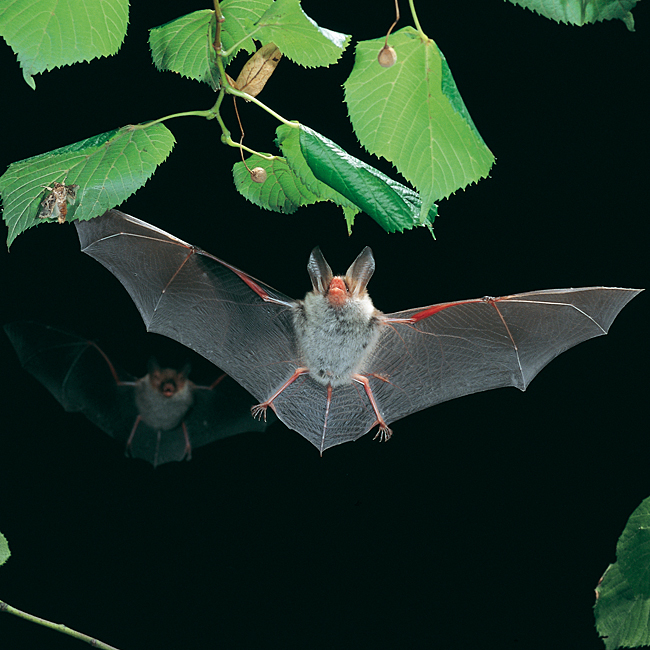
Dietmar Nill, Myotis bechsteinii-flying, CC BY 2.5
Bechstein's bat is a very rare bat that lives in woodland and roosts in old woodpecker holes or tree crevices. It has a pink face, long ears that are clearly separated at the forehead, reddish-brown fur on its back, and a pale grey belly. Bechstein’s bats have very quiet echolocation calls, so are difficult to detect - however one was recorded on the Kingley Vale reserve during the winter of 2020/2021. Of course, all UK bats are nocturnal, so unless you are walking in the reserve at night (and this trail isn't specifically set up for night caching) then you are unlikely to actually see one. However, should you find yourself in the reserve at nightfall, you may encounter other more common species of bats such as the Brown Long-eared bat, Natterer’s bat or the Common Pipistrelle.