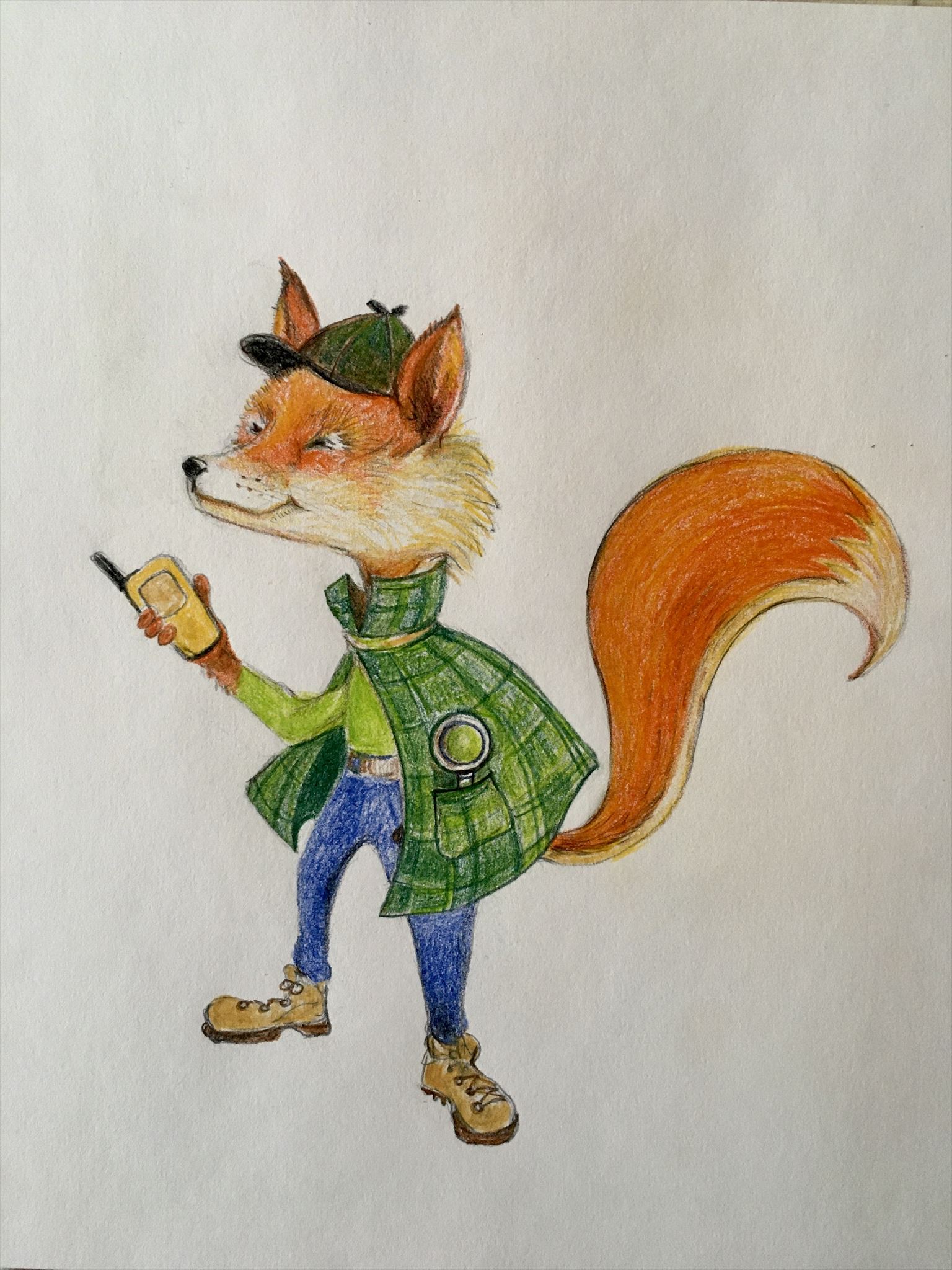
Welcome to Livingston County’s Bicentennial GeoTrail!
My name is Find R. Fox. I’ll be your guide to super-sleuthing the hides at these amazing, historical locations all around our beautiful 200-year-old county!
To make your travel through history a bit easier, imagine yourself in a Time Machine (your best mode of transportation will do). Set the dial (your gps unit) to the first year (coordinates) listed below, check the waypoints for Parking and push the navigate button! Whirl your way there then switch your coordinates as needed to navigate to the geocache to sniff out the container and sign the log sheet. Good Luck & Enjoy the journey!!
This monument is available 24/7. Please note - the Sheriff's Department and Highway Department keep a close eye on this area though. So you may want to consider visiting somewhere between 8 AM to 10 PM.
For more information about the Veterans’ Poppy Monument, please lookup the Virtual cache, GC890TA.
Next, a little background. Young African Americans who aspired to become pilots in the WWII era met with significant obstacles, starting with the widespread (racist) belief that black people could not learn to fly or operate sophisticated aircraft. In September 1940, after many lobbying campaigns by black newspapers and civil rights groups, Roosevelt’s White House responded, announcing that the U.S. Army Air Corps (AAC), a precursor of the U.S. Air Force, would soon begin training black pilots.
For the training site, the War Department chose the Tuskegee Army Air Field in Tuskegee, Alabama, then under construction. Home to the prestigious Tuskegee Institute, founded by Booker T. Washington, it was located in the heart of the Jim Crow South. The Tuskegee Airmen became the first black military aviators in the AAC. The program’s trainees, nearly all of them college graduates or undergraduates, came from all over the country. In addition to some 1,000 pilots, the Tuskegee program trained nearly 14,000 navigators, bombardiers, instructors, aircraft and engine mechanics, control tower operators and other maintenance and support staff.
Now, for the subject of this cache: The U.S. Army recruited this veteran, Wallace Higgins, on Dec. 10, 1943, before he could graduate high school. He reported to Fort Dix, NJ, and then he was sent to Biloxi, Mississippi, for basic training and aptitude testing. It was in the Deep South where he was exposed for the first time to racial segregation and discrimination. He was assigned to Class 44K and trained in pre-flight at Tuskegee Institute. During training, he became seriously ill, and his training was delayed. After recovering, he was reassigned to Class 45A and completed his primary flight training, including solo runs in the PT-17 Stearman. He spent 11 months at Tuskegee before a downturn in the war in Europe resulted in less pilot training at Tuskegee.
Wallace was then transferred to the 1909th Aviation Engineering Battalion and served in Saipan and Okinawa, building roads, airfields, and ammunition storage buildings. He was a sergeant in charge of an all-black, 30-man platoon. While in Okinawa, he was honorably discharged Dec. 5, 1945, but immediately re-enlisted on Dec. 6, 1945.
On March 17, 1947, he received his final honorable discharge as a staff sergeant with Squadron F, 3505th Army Air Force. For his military service, he earned the World War II Victory Medal, Asiatic-Pacific Campaign Medal, American Campaign Medal, and Army Good Conduct Medal.
He was honored at a Veterans Day 2016 ceremony in Geneseo in which the 91-year-old former Alfred University professor received the Congressional Gold Medal collectively awarded to the Tuskegee Airmen during World War II. The ceremony was held at the National Warplane Museum and attended by members of his family, some 200 guests, and a Patriot Guard formation riding motorcycles. His son, Don Higgins, now retired from his position of Livingston County Highway Superintendent, was for many years, one of the Patriot Guard riders.
Sources: Livingston County News
This cache is not at the published coordinates, but they would be a good place for parking.
Let's pretend that your mission is to travel up the path to the poppy field and find the poppy made in honor of both Wallace and Donald, Wallace's brother, by Wallace's son and Donald's nephew, Don. (Three tags on one poppy.)
Take the last 3 digits of the posted North Coordinates, the Latitude, and add the number of A's on JUST Wallace's tag to get the final North coordinates.
Take the last 3 digits of the posted West Coordinates, the Longitude, and subtract the square of the number of G's on JUST Wallace's tag to get the final West coordinates.
Now, go find that cache!
Thanks to Lucky46 for placing this cache!
Thanks to Bill Mann, Deputy County Administrator, for approving the placement of another geocache in this area!
This cache is 1 of 36 caches comprising the Livingston County Bicentennial GeoTrail (LivCo200) placed in the summer of 2021 in honor of Livingston County’s Bicentennial by members of the local geocaching group called the Bee Hive. For more information about Livingston County’s Bicentennial, visit the County Historian’s Bicentennial web page on the Livingston County New York website at https://www.livingstoncounty.us/1115/County-Bicentennial
