This earthcache takes you to some examples of large, old sand dunes inland from the coast, located on Himatangi Block road.
The Manawatu plains are old sea floor which, like many parts of New Zealand, have experienced periods of being both above and below sea level. The plains last became land surface half a million years ago due to changes in sea level and uplift. The source of the sand that has built the dunes on coastal margins goes back further than this - dating back to the end of the last glacial period some 1.4 million years ago. In these cooler times there was less vegetation, allowing wind and water to actively erode the terrain. Add to this reactivated rivers as temperatures warmed up - the rivers of the Manawatu picked up and carried considerable quantities of rocks, soils and silt to the coast and discharged them into a shallowing sea. Wave action then returned these sediments towards the shore.
 Not all the material was derived from the Manawatu. Some has come from South Taranaki and Whanganui - an erosional coastline - and has been transported by onshore drift to reach and become deposited on the beaches of the Manawatu. Other sand building materials have come from the central North Island volcanoes in their construction periods over the last 250,000 years - again transported by rivers and coastal currents to the Manawatu coastline. This accounts for the typically dark, iron sand components in the west coast sands.
The raw materials for the sand dunes have therefore been provided and placed by the action of rivers and waves. The next energy ingredient is wind. The sand that has been brought ashore by swell wave action becomes stranded on the beaches and dries out ready to be blown inland. The prevailing westerly winds have been operating for a long time as carriers of sand back inland. The oldest dunes extend 20km inland and are up to 15,000 years old.
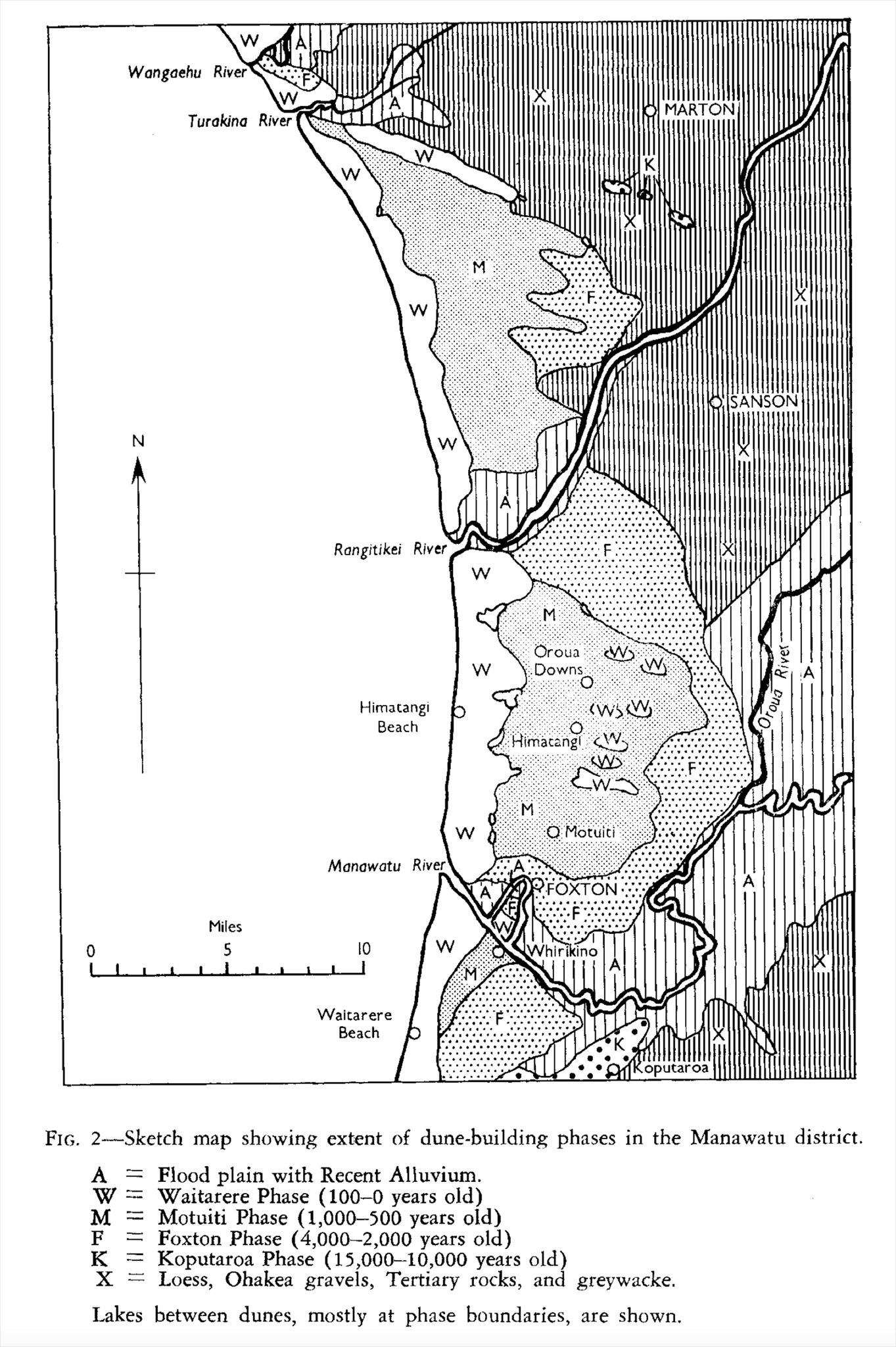
The dunes appear to have formed during four distinct dune-building phases. These in order of increasing age are named Waitarere, Motuiti, Foxton and Koputaroa.
Behind the loose beach foredunes lie the Waitarere phase dunes, a band up to 3km wide, laid by the prevailing westerlies and only up to 100 years old. They are a mixture of bare and vegetated dunes and are distinctively lower, narrower and more closely spaced than those further inland.
The next zone, the Motuiti phase dunes, are 500 to 1,000 years old and are most apparent between the Rangitikei and Manawatu Rivers where they continue inland for many kilometres. These dunes are long and hummocky, lying transverse to the coast in west-northwest parallels, reaching 30m in height. They often feature adjoining downwind tails which give a “hairpin” or “canoe” shape. A line of small lakes lie between the Waitarere and Motuiti dunes between Foxton and Tangimoana, which might mark the position of a previous coastline.
Further inland, the Foxton phase dunes are 2,000 to 4,000 years old. These dunes form a belt 3-6.5 km wide. They have well-defined topsoils and are mainly used for established farmland. It is noticeable that the Manawatu river has acted as a barrier to dune building any further east than this, as the river has simply carried wind-blown sands back out to sea.
The oldest recognised dunes are the Koputaroa Phase, 10,000 to 15,000 years old. They are limited in extent and are best preserved in southern Manawatu, but small outcrops also appear south of Marton. Their topsoils are well developed.
References:
J.D. Cowie Dune-building phases in the Manawatu District, New Zealand (1963)
N.Z. Journal of Geology and Geophysics 6:2, 268-280 Published online 21 Dec 2011
R.G. Heerdegen, Landforms of the Manawatu, Department of Geography, Massey University, Palmerston North, 1972.
B.G.R Saunders and A.G. Anderson Introducing Manawatu, 1964
To claim this earthcache please answer the following questions:
- What is the alignment of the dunes you can see? What has caused this?
- Looking around you, describe the differences you can see between land use, drainage and vegetation on the dunes compared to the flat land between.
- Which dune phase are you looking at here?
- Take a photo of the Manawatu sand dune country here, please include yourself or a personal item to record your visit.
Please send the answers to these questions via Messsages or email.
Do not wait for a reply, you may go ahead and claim the find.