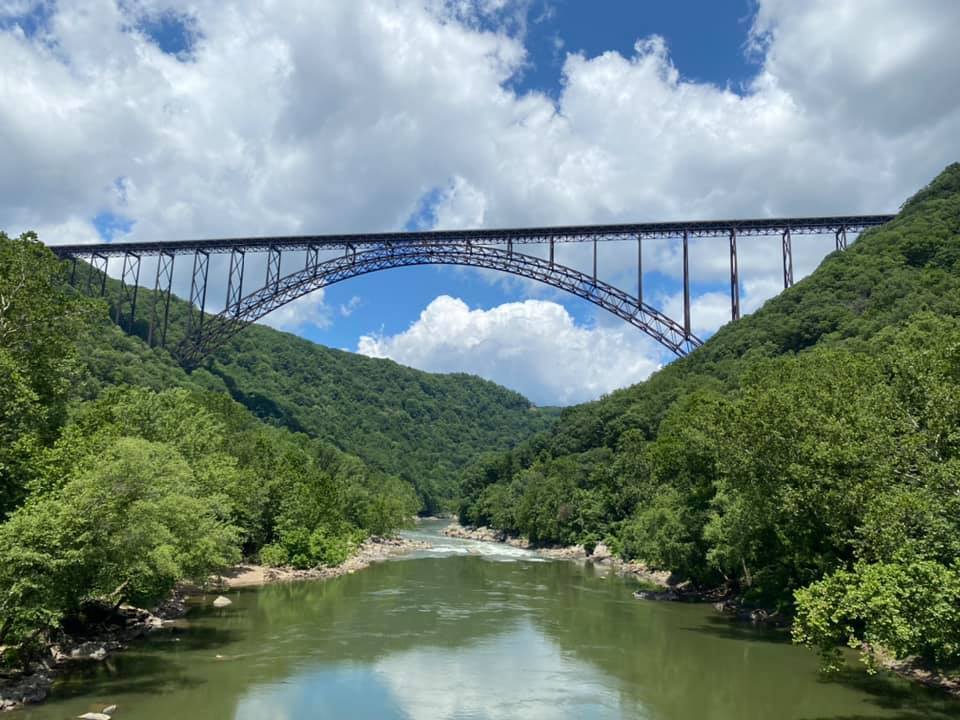
The New River Gorge is America's newest National Park. Officially the New River Gorge National Park and Preserve, it encompasses more than 70,000 acres along the New River which is one of the oldest rivers in the continent. The listed coordinates will bring you to the pedestrian pathway on the Fayette Station Bridge. A waypoint for parking has been provided and nearby you will find several interpretive signs that are part of the Fayette Station Road Tour (if interested, you can pick up a copy at the visitor center). Here you will have a great view of the New River Gorge Bridge, the longest steel arch bridge in the country! The bridge is 876 feet above the river and once it opened in 1977, it reduced the drive across the river from 45 minutes to under 45 seconds.
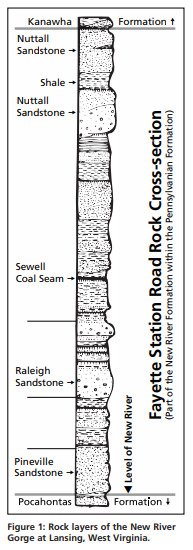
This spot offers good views of the New River, where we can observe several geologic process taking place. The rocks in this part of the gorge are mostly shale and sandstone (with some layers of coal as well). Siltstone and sandstone are both sedimentary rocks. Siltstone is mostly composed of silt and has a gray/red/brown color. Sandstone is composed of sand particles and can also be found in variety of colors including tan, brown, yellow, red, gray and white. Sandstone layers are highly resistant to weathering and erosion because of it has a high quartz content. Here we can view two important geologic processes taking place. Weathering causes the rocks to break down. Then erosion transports the sediments away from where they originated. There are two two types of weathering processes, physical or chemical. Physical weathering breaks rocks apart without changing their chemical composition. For example fast moving water can cause rocks to collide with each other, breaking off small pieces. Another example is frost action. When water freezes it expands. When a small amount of water gets into cracks within the rock and then freezes, it gradually keeps expanding the crack within the rock wider and wider until it breaks off. Lastly there are plant roots. When plants grow in cracks within rocks, their roots can cause the crack to become larger and eventually break apart the rock. Chemical weathering in contrast breaks apart the rock by chemical reaction. Examples include oxidation, hydrolysis, or carbonation. Oxidation is kind of like rust, it can give a rock a bright red color, which we mostly see out west. Hydrolysis breaks down rocks by acid rain resulting in clay and soluble salts. Carbonation occurs when water is mixed with carbon dioxide to form carbonic acid, which can dissolve rocks such as limestone and form caves.
Logging Requirements:
- Looking downstream, you should notice a huge boulder in the river slightly to the right. Where do you think it originated from and what process do you think is primarily responsible for breaking it off the canyon wall? What process is responsible for transporting it into the river?
- Describe the surface/texture of the boulder. Do you see any evidence of weathering? Of the two main forms of weathering, which do you think is most dominant?
- Of the different weathering process described, which do you think is the main one at work here?
- Upload a photo with either yourself or a personal object, taken at the listed coordinates showing the view of the river and bridge.