This is an Earthcache – as such, there is no physical cache. Instead, after examining the marble shaft at the posted coordinates, you will answer 4 questions, and message me the answers. This memorial is located in Long Wharf Municipal Park and placed with Permission. Please be respectful of the memorial and visit during daylight hours.
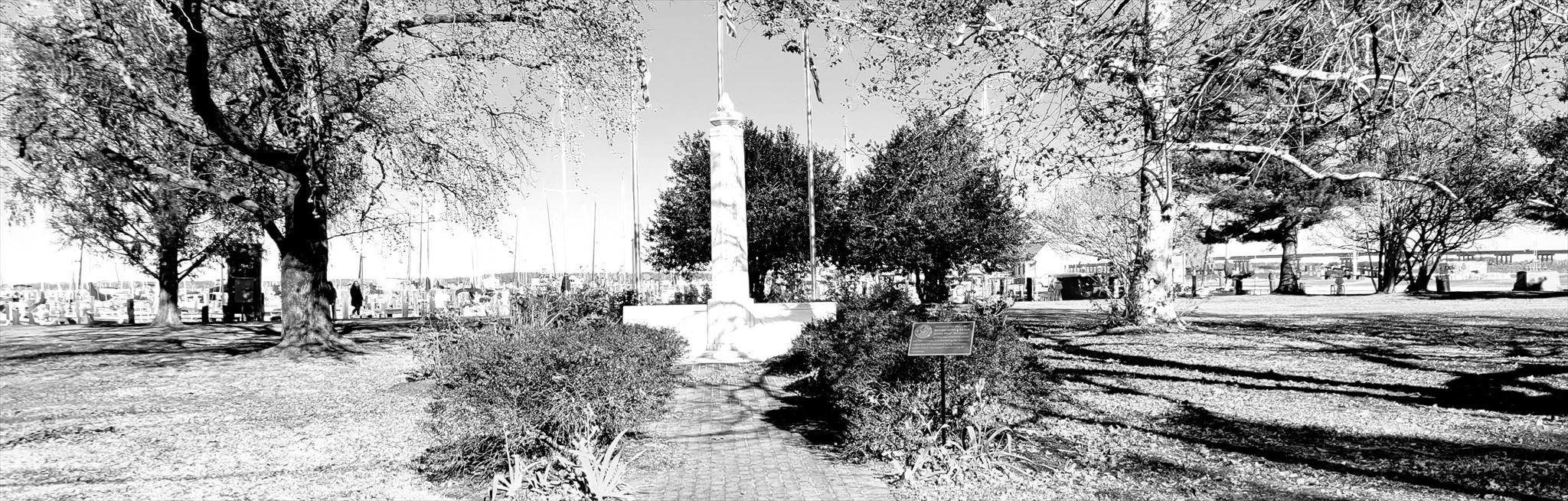
The Eternal Flame Monument here at Long Wharf Municipal Park stands as a tribute to the memory of the fallen heroes of World War II. Names of Cambridge's native sons are inscribed along with the words "Peace to the Mighty Dead." This marble monument was dedicated on November 11, 1947, and it was erected by the Army Mothers Club of Dorchester County.
Marble is an extremely hard, metamorphic stone composed of calcite (CaCO3). It is formed from the recrystallization of limestone under intense geologic processes of heat and pressure. Due to its structure, marble can take a very high polish and is a very popular decorative stone for sculptural and architectural uses.
Marble has many structural and decorative uses. It is used for outdoor sculpture as well as for sculpture bases; in architecture it is used in exterior walls, flooring, decorative features, stairways, and walkways.
It is said that “Only age and weathering can make a stone memorial fit gracefully into the landscape.” Because... once rain and snow have descended upon it, cold winds have stung it, and the blazing summer sun scorches it, the stones exterior will eventually become "more distinguished" over time. The most common symptoms of weathering are a loss of the highly polished surface of the memorial, and a loss of crisp edges and decorative details that where carved in the stone.

One of the most important things to keep in mind about marble is that it is absorbent. Like a sponge, stone too is porous, and liquid will find ways to seep into the stone and cause discolorations or dullness.
Rainwater, especially in combination with atmospheric gases, can result in dissolution of the marble.

Over the course of time the surface of marble exposed to carbonic acid will be corroded. This will be one means of decay. Water will get into the interstices formed by the openings created by the action of the carbonic acid. In the winter this water will solidify, expand, and then crack the marble. Once the surface was broken the rest will be comparably faster. What happens to a small section of the stone will eventually happen to the whole.

Erosion on the surface of stone can work to create a very granulated or “sugary” surface appearance, which can be indicative of a certain brittleness or tendency of the stone to break up or dissolve. Carbonate stones, especially fine-grained marbles, are particularly susceptible to this form of deterioration. The surface takes on a rough granular, crystalline or sometimes powdery appearance.
LOGGING REQUIREMENTS:
To log this Earthcache: Read the geology lesson above. Answer all four questions posted below. Answers for 1-4 can be sent via e-mail or messenger contacts on my Geocaching profile. Group answers are fine, just make sure to note who is in your group.
QUESTION 1. Rainwater. combined with what can result in the sugaring or dissolution of the marble?
A) CaCO3
B) De-Icing Salt
C) Atmospheric gases
QUESTION 2. Does the flowery carving above the words "PEACE" look sharp and clean?
QUESTION 3. Run your hand across a flat section of stone. Does it feel smooth or grainy?
QUESTION 4. Did you observe any other forms of weathering such as cracking, chips, or staining?
OPTIONAL PHOTO: Posting a photo that readily indicates that you (and anyone else logging the find) are at the location.

 Awesnap has earned GSA's highest level:

REFERENCES:
1. Dorchester Dedicates War Memorial Shaft, The Daily Times, Tuesday November 11, 1947, Page 1, newspapers.com
2. All Marble is Not Free of Deterioration, Cumberland Sunday Times, April 11, 1948, Page 26, newspapers.com
3. The Slow Carbon Cycle, Jun 16, 2011, earthobservatory.nasa.gov
4. Baltimor in A.D. 2007; Will it be like Athens?, The Baltimore Sun, February 17, 1907, Page 14 newspapers.com