
Benvenuti sulla spiaggia di Tropea !
Tropea è un comune italiano della regione Calabria nella provincia di Vibo Valentia.
Qui sulla spiaggia c'è questa bellissima grotta nell'arenaria.
Si può raggiungere la grotta dal lato terra, ma anche dal lato mare.
Questo mi ha dato l'idea di creare una CE qui.
Quindi spero di potervi offrire una CE educativa che vi piacerà.
Ma ecco alcune informazioni generali su questo villaggio costiero e sulla grotta.
Questa grotta è nata naturalmente, ma è stata sviluppata e utilizzata anche da persone per un beneficio mercantile. Oggi serve solo come vista locale e meta di escursioni.
La città è situata su una roccia alta una quarantina di metri sul Mar Tirreno. Dalla città vecchia si ha una buona vista sulla spiaggia di sabbia fine, in parte intervallata da rocce, e sul mare. In una giornata limpida, la vista arriva fino all'isola vulcanica di Stromboli e alle altre isole Lipari. Non lontano dal centro si trova il santuario di Santa Maria dell'Isola, arroccato su una roccia.
A sud di Tropea si trova il famoso belvedere di Capo Vaticano.
( Fonte Wikipedia )
PIETRA ARENARIA:
L'arenaria è una roccia sedimentaria clastica contenente almeno il 50% di grani di sabbia, cioè grani di dimensioni comprese tra 0,063 e 2 mm secondo la definizione generale di granulometria della sabbia. I grani di sabbia sono costituiti da vari minerali, ma soprattutto da quarzo.
L'arenaria la cui frazione sabbiosa consiste di almeno il 90% di quarzo è chiamata arenaria quarzifera o arenaria in senso stretto. Una proporzione di feldspati del 25% o più è chiamata arkose, e un'alta proporzione di matrice argillosa e una proporzione di meno del 75% di quarzo nella frazione di sabbia è chiamata greywacke.
L'arenaria è formata dalla cementazione di sabbia sciolta e da miscele di particelle sedimentarie più grosse o più fini (argilla, limo, ciottoli). In contrasto con le rocce chimiche e biogeniche (composte principalmente da resti di organismi viventi), come il calcare o il carbone, è di origine clastica (detritica), cioè consiste in minuscoli detriti di rocce erose dagli agenti atmosferici. Il quarzo si trova principalmente in molte rocce magmatiche. Poiché il quarzo è anche relativamente resistente agli agenti atmosferici chimici, le particelle di quarzo delle dimensioni dei grani di sabbia possono accumularsi fortemente nel ciclo della roccia (ciclo esogeno), mentre altri minerali potenzialmente in grado di formare grani di sabbia si decadono chimicamente in modo relativamente rapido. Questo è il motivo per cui la maggior parte delle arenarie sono costituite prevalentemente da quarzo.
Le zone di formazione più importanti per le arenarie sono i mari poco profondi vicino alla costa, le piattaforme. Tuttavia, la sabbia di solito proviene dalla terraferma e viene trasportata dai fiumi e dalle correnti oceaniche al suo luogo finale di deposizione. Nelle regioni marine profonde lontane dalla costa, invece, si depositano principalmente fanghi a grana fine, dai quali non si può formare alcuna arenaria. Fanno eccezione le arenarie dei depositi turbiditici. Queste provengono da materiale sabbioso dal bordo della piattaforma che scivola lungo la scarpata continentale. Tuttavia, ci sono anche numerosi depositi di arenaria che si sono formati sulla terraferma. Le arenarie fluviali, cioè quelle depositate dai fiumi, predominano chiaramente sulle arenarie eoliche, cioè quelle depositate dal vento.
L'ambiente deposizionale di un'arenaria può essere determinato, tra le altre cose, dalle strutture sedimentarie che contiene. Questi includono forme caratteristiche di stratificazione obliqua o certe tracce di fossili. I corpi fossili sono anche importanti indicatori dell'ambiente di deposizione. La granulometria e soprattutto l'ordinamento dei grani (maturità testuale) sono importanti per distinguere le arenarie fluviali da quelle eoliane: le arenarie eoliane sono sempre relativamente omogenee a grana fine. Anche la composizione minerale e l'arrotondamento dei grani danno indizi sulla formazione. Un contenuto di quarzo relativamente basso (bassa maturità compositiva) e bassi gradi di arrotondamento dei grani sono tipici delle arenarie che sono state depositate nelle profondità dell'avampaese montano o nei bacini dell'avampaese come parte delle serie flysch o molasse, greywackes o arkoses, rispettivamente.
Arenaria con scolithos (tane di vermi) del Cambriano.
A causa della pressione di carico dei depositi più giovani, sovrastanti, nonché della precipitazione di minerali disciolti nel mare o nelle acque sotterranee, e spesso anche a causa dei minerali contenuti nell'arenaria stessa, la sabbia si solidifica (diagenesi). Questo processo si svolge a ritmi diversi e dura da qualche decennio a diversi milioni di anni.
Avviso importante:
Per favore, fate attenzione alla vostra sicurezza quando entrate nella grotta e non correte rischi.
Né Groundspeak né io accettiamo alcuna responsabilità.
IL TUO COMPITO PER LA CACHE:
1.) A quale tipo di roccia appartiene l'arenaria?
2.) Guarda da vicino le pareti della grotta, a che livello stimi il contenuto di quarzo?
3.) La grotta aveva uno scopo speciale in passato. Chi pensa che l'abbia usato per cosa?
4.) Quanto è alta la grotta nel punto più alto, quanti metri pensi che siano?
5.) Qui c'è anche una lunga scala nell'acqua, quanti gradini ha?
6.) Scatta una foto di te stesso dall'interno della grotta per il diario di bordo!
Divertiti con questa CE e divertiti in questo posto fantastico.
Mandami le tue cinque risposte tramite il Centro messaggi e includi la foto del registro.
Poi si può registrare immediatamente, se le risposte non sono corrette vi contatterò.
Se non ricevo nessuna risposta o se la foto del log manca, dovrò purtroppo cancellare i vostri log.
.........................

Willkommen am Strand von Tropea !
Tropea ist eine italienische Gemeinde in der Region Kalabrien in der Provinz Vibo Valentia.
Hier am Strand befindet sich diese wirklich schöne Höhle im Sandstein.
Man kann die Höhle von der Landseite erreichen, aber auch von der Meerseite.
Das hat mich zu der Idee gebracht hier einen EC auszulegen.
So hoffe ich hier einen lehrreichen EC anzubieten zu können der Euch Spaß macht.
Hier aber nun einige allgemeine Informationen zu diesem Küstenort & der Höhle.
Diese Höhle ist natürlich entstanden, aber wurde von Menschen für einen kaufmannischen Nutzen ausgebaut und auch verwendet. Heute dient sie nur noch als lokale Sehenswürdigkeit und Ausflugsziel.
Der Ort liegt auf einem ungefähr vierzig Meter hohen Felsen am tyrrhenischen Meer. Von der Altstadt aus hat man einen guten Blick auf den feinsandigen, teilweise mit Felsen durchzogenen Strand und das Meer. Bei klarem Wetter reicht die Sicht bis zur Vulkaninsel Stromboli und den anderen liparischen Inseln. Unweit des Zentrums befindet sich die auf einem Felsen gelegene Wallfahrtskirche Santa Maria dell’Isola.
Südlich von Tropea befindet sich der berühmte Aussichtspunkt Capo Vaticano.
( Quelle Wikipedia )
SANDSTEIN:
Sandstein ist ein klastisches Sedimentgestein mit einem Anteil von mindestens 50 % Sandkörnern, d. h. von Körnern, die nach der allgemeinen Definition der Korngröße Sand zwischen 0,063 und 2 mm groß sind. Die Sandkörner bestehen aus verschiedenen Mineralen, meistens jedoch aus Quarz.
Bei einem Sandstein, dessen Sandfraktion zu mindestens 90 % aus Quarz besteht, spricht man von einem Quarzsandstein oder auch Sandstein im engeren Sinne. Ab einem Anteil von 25 % Feldspäten spricht man von Arkose, bei einem hohen Anteil an toniger Matrix und einem Anteil von weniger als 75 % Quarz in der Sandfraktion von Grauwacke.
Sandstein entsteht durch die Verkittung (Zementation) von lockerem Sand und Beimengungen groberer oder feinerer Sedimentpartikel (Ton, Silt, Gerölle). Er ist, im Gegensatz zu chemischen und biogenen (überwiegend aus Resten von Lebewesen zusammengesetzten) Gesteinen, wie Kalkstein oder Kohle, klastischen (detritischen) Ursprungs, besteht also aus Kleinsttrümmern verwitterter und abgetragener Gesteine. Quarz kommt in sehr vielen magmatischen Gesteinen primär vor. Da Quarz zudem relativ resistent gegen chemische Verwitterung ist, können sich sandkorngroße Quarzpartikel im Gesteinskreislauf (exogener Zyklus) stark anreichern, während andere potenziell sandkornbildende Minerale relativ schnell chemisch zerfallen. Deshalb bestehen die meisten Sandsteine überwiegend aus Quarz.
Die wichtigsten Entstehungsräume für Sandsteine sind die küstennahen Flachmeere, die Schelfe. Der Sand stammt aber meist vom Festland und wird durch Flüsse und Meeresströmungen an seinen endgültigen Ablagerungsort transportiert. In tiefen, küstenfernen Meeresregionen lagern sich hingegen vorwiegend feinkörnige Schlämme ab, aus denen kein Sandstein entstehen kann. Ausnahmen sind die Sandsteine turbiditischer Ablagerungen. Diese gehen aus sandigem Material der Schelfkante hervor, das den Kontinentalhang hinabrutscht. Es gibt aber auch zahlreiche Sandsteinvorkommen, die auf dem Festland entstanden sind. Dabei überwiegen die fluvialen, d. h. die von Flüssen abgelagerten, Sandsteine deutlich über die äolischen, also vom Wind abgelagerten.
Das Ablagerungsmilieu eines Sandsteins lässt sich u. a. anhand der enthaltenen Sedimentstrukturen bestimmen. Dazu gehören jeweils charakteristische Formen der Schrägschichtung oder aber bestimmte Spurenfossilien. Auch Körperfossilien sind wichtige Indikatoren für den Ablagerungsraum. Für die Unterscheidung fluvialer von äolischen Sandsteinen ist die Korngröße und vor allem die Kornsortierung (texturelle Reife) von Bedeutung: äolische Sandsteine sind immer relativ homogen-feinkörnig. Auch die mineralische Zusammensetzung und die Kornrundung geben Hinweise auf die Entstehung. Ein relativ geringer Quarzanteil (geringe kompositionelle Reife) und geringe Kornrundungsgrade sind typisch für Sandsteine, die in Gebirgsvortiefen oder Vorlandbecken als Teil von Flysch- bzw. Molasseserien abgelagert wurden, Grauwacken bzw. Arkosen.
Sandstein mit Skolithos (Grabgängen von Würmern) aus dem Kambrium
Durch den Auflastdruck der jüngeren, überlagernden Ablagerungen sowie durch Ausfällung von Mineralen, die im Meer- oder Grundwasser gelöst sind, oft auch durch die im Sandstein selbst enthaltenen Minerale kommt es zur Verfestigung (Diagenese) des Sandes. Dieser Prozess läuft unterschiedlich schnell ab und dauert zwischen wenigen Jahrzehnten und mehreren Millionen Jahren.
Wichtiger Hinweis:
Bitte achtet beim betreten der Höhle auf Eure Sicherheit und geht kein Risiko ein.
Sowie Groundspeak als auch ich übernehmen keinerlei Haftung.
EURE AUFGABE ZUM CACHE:
1.) Zu welcher Gesteinsart gehört Sandstein?
2.) Schau Dir die Wände der Höhle genau an, wie hoch schätzt Du ist der Quarz Anteil?
3.) Die Höhle hatte früher einen besonderen Zweck. Was glaubst wer hat es für was genutzt?
4.) Wie hoch ist die Höhle an der höchsten Stelle, wieviele Meter meinst du?
5.) Es gibt hier auch eine lange Treppe ins Wasser, wieviele Stufen hat sie?
6.) Erstelle für den Log ein Logfoto mit Dir aus dem inneren der Höhle !
Ich wünsche euch viel Spaß bei diesem EC und einen schöne Zeit an diesem tollen Ort.
Schickt mir Eure fünf Antworten über das Nachrichtencenter und stellt beim loggen das Logfoto mit ein.
Dann dürft ihr sofort loggen, sollten die Antworten nicht stimmen werde ich mich bei Euch melden.
Sollte ich keine Antworten erhalten oder das Logfoto fehlt, werde ich leider Eure logs löschen müssen.
.........................

Welcome to Tropea beach !
Tropea is an Italian municipality in the region of Calabria in the province of Vibo Valentia.
Here on the beach is this really beautiful cave.
You can reach the cave from the land side, but also from the sea side.
This has brought me to the idea to lay out an EC here.
So I hope to be able to offer here an instructive EC which makes you fun.
But here is some general information about this coastal village and the cave.
This cave was created naturally, but was developed and also used by people for a mercantile benefit. Today it serves only as a local landmark and excursion destination.
The town is situated on a rock about forty meters high on the Tyrrhenian Sea. From the old town you have a good view of the fine sandy beach, partly interspersed with rocks, and the sea. In clear weather, the view extends to the volcanic island of Stromboli and the other Lipari islands. Not far from the center is the sanctuary of Santa Maria dell'Isola, perched on a rock.
South of Tropea is the famous viewpoint Capo Vaticano.
( Source Wikipedia )
SANDSTONE:
Sandstone is a clastic sedimentary rock containing at least 50% sand grains, i.e., grains that are between 0.063 and 2 mm in size according to the general definition of sand grain size. The sand grains consist of various minerals, but mostly quartz.
Sandstone whose sand fraction consists of at least 90% quartz is referred to as quartz sandstone or sandstone in the narrower sense. A proportion of feldspars of 25% or more is called arkose, and a high proportion of clayey matrix and a proportion of less than 75% quartz in the sand fraction is called graywacke.
Sandstone is formed by the cementation of loose sand and admixtures of coarser or finer sediment particles (clay, silt, pebbles). In contrast to chemical and biogenic rocks (mainly composed of remains of living organisms), such as limestone or coal, it is of clastic (detrital) origin, i.e. it consists of minute debris of weathered and eroded rocks. Quartz occurs primarily in very many igneous rocks. Moreover, because quartz is relatively resistant to chemical weathering, quartz particles the size of sand grains can accumulate strongly in the rock cycle (exogenous cycle), while other potentially sand grain-forming minerals decay chemically relatively quickly. Therefore, most sandstones are composed predominantly of quartz.
The most important formation areas for sandstones are the shallow seas near the coast, the shelves. However, the sand usually originates from the mainland and is transported by rivers and ocean currents to its final depositional site. In deep marine regions far from the coast, on the other hand, mainly fine-grained muds are deposited, from which no sandstone can form. Exceptions are the sandstones of turbiditic deposits. These originate from sandy material from the shelf edge that slides down the continental slope. However, there are also numerous sandstone deposits that were formed on the mainland. Fluvial, i.e. river-deposited, sandstones clearly predominate over aeolian, i.e. wind-deposited, sandstones.
The depositional environment of a sandstone can be determined, among other things, by the sedimentary structures it contains. This includes characteristic forms of oblique stratification or certain trace fossils. Body fossils are also important indicators of the depositional environment. For the distinction of fluvial from eolian sandstones the grain size and especially the grain sorting (textural maturity) is important: eolian sandstones are always relatively homogeneous-fine grained. The mineral composition and grain rounding also provide clues to the formation. A relatively low quartz content (low compositional maturity) and low degrees of grain rounding are typical of sandstones deposited in mountain foreland depths or foreland basins as part of flysch or molasse series, graywackes and arkoses, respectively.
Sandstone with scolithos (burrows of worms) from the Cambrian.
Due to the loading pressure of the younger, overlying deposits as well as precipitation of minerals dissolved in sea or ground water, often also due to the minerals contained in the sandstone itself, the sand solidifies (diagenesis). This process takes place at different rates and lasts between a few decades and several million years.
Important Notice:
Please take care of your safety when entering the cave and do not take any risk.
Groundspeak, and also I, assume no liability.
YOUR TASK FOR THE CACHE:
1.) To which type of rock does sandstone belong ?
2.) Look at the walls of the cave, how high do you estimate the quartz content ?
3.) The cave used to have a special purpose. Who do you think used it for what ?
4.) How high is the cave at the highest point, how many meters do you think ?
5.) There is also a long staircase into the water here, how many steps does it have ?
6.) Make a log photo of yourself from inside the cave for the log !
I wish you a lot of fun with this EC and a nice time at this great location.
Send me your five answers via the message center and include the log photo.
Then you may log immediately, if the answers are not correct I will contact you.
If I do not receive any answers or the log photo is missing, I will have to delete your logs.
Se vuoi, puoi aggiungere il banner al tuo profilo.
Wer möchte kann das Banner in sein Profil einbauen.
Whoever wants to can add the banners to their own profile.
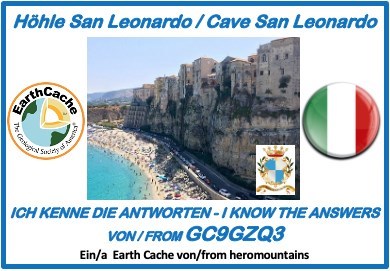
Aggiungi semplicemente il seguente codice al tuo profilo:
Füge dazu einfach folgenden Code in Dein Profil ein:
Just add the following code to your profile:
<a href="http://coord.info/GC9GZQ3" target="_blank"><img src="https://s3.amazonaws.com/gs-geo-images/ce03ac75-bddd-4328-b90c-e69ea0007cd8_l.jpg?rnd=0.7346961" border="0" /></a>
Per i primi tre trovatori c'è una piccola lista di vincitori !
Für die ersten drei Finder gibt es eine kleine Tabelle!
For the first three finders there is a small table!
1.) Saemse
2.) Kröti13 / crazyhabanero
3.) daxy1
