Most caboose hides require finding a cache hidden either on or inside the caboose. This challenge requires reading the biography of a railroader below who worked inside a caboose. Definitions may also be found by checking the sources listed below and signs located near the caboose or stenciled onto the outside of the caboose.
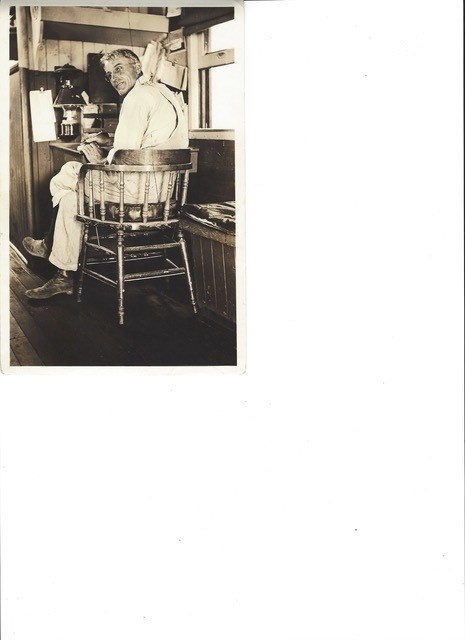
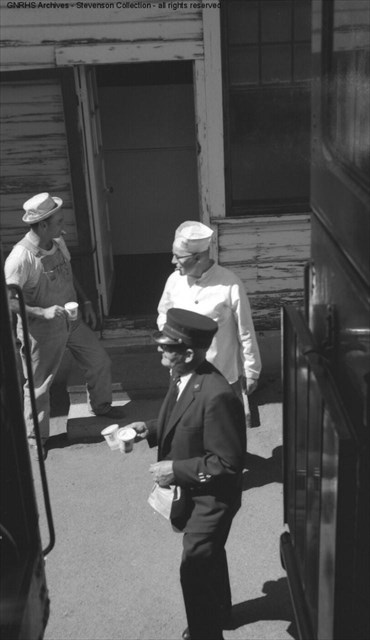
George Richert (my step grandfather) was one such employee who has worked inside a caboose. He started his career in Starbuck, WA working as a call boy. He then entered train service as a brakeman and then later, was promoted to conductor. He liked to relate what happened when he sat for the conductor's exam. After studying the rule books extremely hard for the conductor's exam, he would laugh and state that he was only asked one question. "What is a train?" He was based in Walla Walla and then moved to Spokane. He was in passenger train service when he retired from the railroad in March 1962 after over 50 years of service at age 70. The pictures below show him as a freight train conductor in a caboose and then as a passenger train conductor.
Excerpt from the Union Pacific Heritage Website.
The caboose served several functions, one of which was as an office for the conductor. A printed "waybill" followed every freight car from its origin to destination, and the conductor kept the paperwork in the caboose.
The caboose also carried a brakeman and a flagman. In the days before automatic air brakes, the engineer signaled the caboose with his whistle when he wanted to slow down or stop. The brakeman then would climb out and make his way forward, twisting the brakewheels atop the cars with a stout club. Another brakeman riding the engine would work his way toward the rear. Once the train was stopped, the flagman would descend from the caboose and walk back to a safe distance with lanterns, flags and other warning devices to stop any approaching trains.
Once under way, the trainmen would sit up in the cupola and watch for smoke or other signs of trouble from overheated wheel journals (called hotboxes)
The Cupola
The addition of the cupola – the lookout post atop the car – is attributed to a conductor who discovered in 1863 that he could see his train much better if he sat atop boxes and peered through the hole in the roof of his boxcar
Home Away From Home
It was common for railroads to assign a caboose to a conductor for his exclusive use. Conductors took great pride in their cars, despite the caboose's many derogatory nicknames, including crummy, doghouse, bone-breaker, snake wagon and hearse.
The men decorated their car interiors with many homey touches, including curtains and family photos. Some of the most important additions were ingredients for cooking meals that became a part of American folklore. Augmented with such comforting features, the caboose served as a home away from the trainmen's home terminals.
https://www.up.com/heritage/history/caboose/early_uses/index.htm
https://en.wikipedia.org/wiki/Conductor_(rail)
To solve the challenge, you need to fill in the missing coordinates of the final location N46 18.ABC / W117 58.XYZ
A) What is a call boy?
7) an employee responsible for ensuring that members of a train crew are on hand for their regular runs and for notifying them of an extra run.
9) an employee on passenger trains selling newspapers and food items to passengers
B) Who is in charge of the train?
3) the brakeman 5) the engineer 8) the conductor
C) What is a train (1948 rule book)? -Answer: An engine or more than one engine coupled, with or without cars, displaying markers.
2) True 4) False
---------------------------------------------------------------------------------------------------------------------
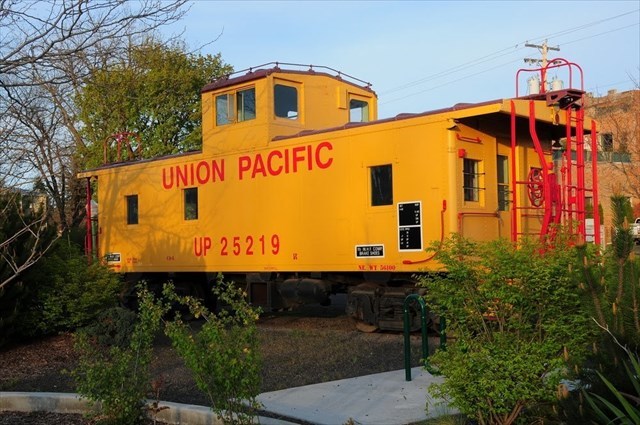
UP Caboose 25219
X) Year built - Drop the hyphen, add the three digits together and then subtract 5
Y) Year donated 19Y2
Z) Add the digits of the caboose net weight together then subtract 12