This is an Earthcache – as such, there is no physical cache. Instead after examining the extrusive basalt block at the posted coordinates you will answer 4 questions and message me the answers. This marker is located at The Poe Museum in the Shockoe Bottom neighborhood of Richmond. Please visit during daytime hours and be respectful of the property. This Earthcache was placed with permission of The Poe Museum.

THE MYSTERY OF THE EDGAR ALLAN POE STONE
No, this isn’t Edgar Allan Poe’s grave. Poe is buried in Baltimore. So why is there a heavy basalt stone marker just sitting here?
According to a 1970’s newspaper clipping, this mysterious “Poe Stone” was found by two boys who were playing in the East End Landfill near Church Hill. Curious about it, the then curator of collections at the Valentine Museum, James Gergat, investigated. He theorized that it was probably a discarded original base for the Poe statue in that now resides in Capitol Square.

You see, Edgar Allan Poe spent more of his life in Richmond than in any other city. That is why Dr. George E. Barksdale of Philadelphia believed that Poe should be honored in the state he called home. In 1956, he offered to build a statue of Poe, as long as the State supplied the base for the statue.
That statue, which sits on a pink granite base, found a home in nearby Capitol Square in 1959. So, is this stone a rejected base for that statue? That has become the accepted explanation. But then, why was it dumped in a landfill? Poe would probably appreciate this mystery. What is known is that sometime after it was discovered in the dump, this half ton stone was moved here to this location at the Poe Museum.
HOW DO EXTRUSIVE IGNEOUS ROCKS FORM?
Unlike intrusive igneous rocks like granite that form from MAGMA deep below the Earth’s surface, extrusive igneous rocks like basalt form fast above the Earth’s surface from LAVA. Sure, magma and lava may have the same chemical structure, but the rock that is formed when they cool has very different properties.

The length of time it takes for lava to cool above the surface is relatively short compared to Magma deep underground. Imagine a Volcano erupting. Lava spews onto the surface and is immediately cooled by air, water, snow, or any other elements that are present. Basically, lava can solidify into solid rock in minutes, while slow cooling rock that stays insulated by the earth can take centuries to solidify. Slower cooler magma has time for the distinct minerals in the to consolidate into large crystals. Rocks formed from lava are finer grained because it cools quickly, and contains only very small crystals.
BASALT BASICS
Basalt ("ba-SALT") is an Extrusive Igneous rock that makes up 90% of the Earth’s Volcanic Rock. Most of it erupts quietly deep below the ocean along tectonic plate ridges. Lesser amounts of it erupt on volcanic ocean islands, or in occasional large outbursts elsewhere on the planet.
Basalt is darker, denser and finer grained when compared to the intrusive granites of the world. It's dark and dense because it's richer in the dark, heavy minerals bearing magnesium and iron and poorer in silicon- and aluminum-bearing minerals.
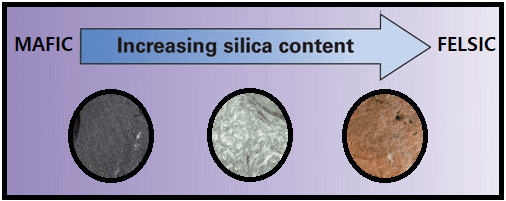
Mafic lava forms the oceanic crust and is very dark colored, while felsic lava forms the continental crust and is light colored. Mafic is rich in heavy minerals like iron, magnesium, or ferric. Felsic rocks are rich in aluminum and silica. Felsic rocks are also rich in low-density minerals like oxygen, sodium, and potassium which gives them a low density, unlike mafic rocks that have high density and are heavy.
Compared to other rocks found on Earth's surface, basalts weather relatively fast. It is a porous rock, and typically iron-rich minerals oxidize rapidly in water and air, staining the rock a brown to red rust color due to iron oxide. Basalt is largely composed of minerals with little resistance to weathering. Hence, basalt as a whole also tends to disintegrate faster than granite and other felsic rock types.
LOGGING REQUIREMENTS:
To log this Earthcache: Read the geology lesson above. Answer all three questions posted below. Answers for 1-4 can be sent via e-mail or messenger contacts on my Geocaching profile.
QUESTION 1. Was this stone formed from MAGMA or LAVA?
QUESTION 2. Is this rock Mafic or Felsic?
QUESTION 3. Can you see any individual minerals in the large "chipped" area on the front top of the stone?
QUESTION 4. Do you think the top looks unfinished on purpose, or was this bumpiness caused by weathering?
OPTIONAL PHOTO: Posting a photo that readily indicates that you (and anyone else logging the find) are at the location.

 Awesnap has earned GSA's highest level:

REFERENCES:
1. Why Richmond, Why?!? How Poe Stone Found a Home, Phil Riggan, Nov 18, 2013, website, richmond.com
2. Curator's Crypt - Episode 39: Who's Buried at the Poe Museum?, Poe Museum, Oct 1, 2021, YOUTUBE, website, youtube.com
3. Ever wonder where that big stone with EdgarAllanPoe's name on it outside the PoeMuseum front door came from?, Chris Semtner, @ChrisatthePoe, July 13, 2018, ThoughtCo, Website, twitter.com
4. About Basalt, Andrew Alden, February 3, 2019, ThoughtCo, Website, thoughtco.com