Dont miss out on the Klipgat Caves (S34° 32.760 E19° 22.593) Just follow the trail - Unfortunately, I was not able to place a cache inside the cave seeing it was too close to another cache.
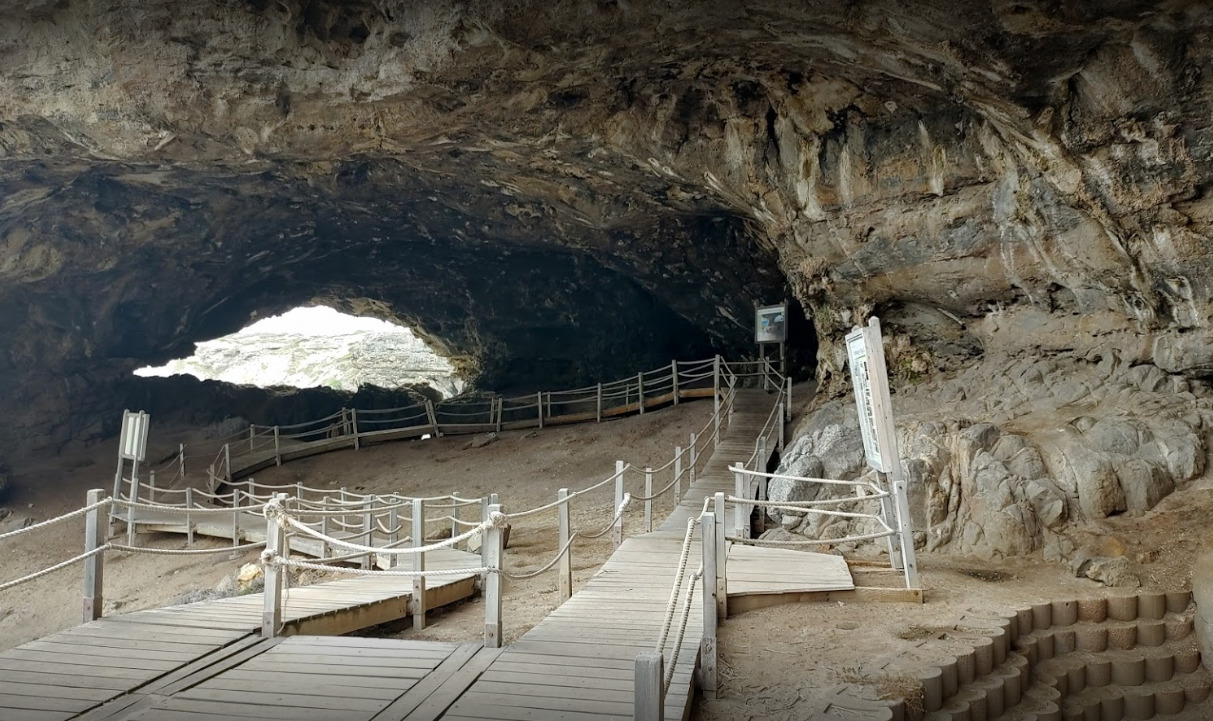
The Gansbaai suburb of De Kelders, which is Dutch for The Cellars, derives its name from the presence of numerous expansive caverns formed in its porous limestone foundation.
These caverns were formed millions of years ago through the erosive action of underwater aquifers. They were then opened up along the coastal cliffs by rising sea levels and pounding waves, forming huge caves that would later become the home of Middle Stone Age people and eventually Late Stone Age people known as the Khoikhoi. The most famous of these caves is Klipgat Cave (stone hole), named after a remarkable window-like opening that yields spectacular views over the bay.
Stones and Bones - The Stories They Tell
Three factors made the Klipgat Cave ideal for early human habitation: the abundant shelter that the cave provided, the presence of a freshwater spring, and the proximity of a constant food source - the ocean. This was a hunter-gatherer paradise.
Excavations in 1969 revealed 2000-year-old pottery, stone and bone artifacts, and the remains of shellfish, fish, and other animals that the Khoikhoi bushman had discarded. The Khoikhoi (‘people people’ or ‘real people’) are a historical division of the Khoisan ethnic group, the native people of Southwestern Africa.
Sheep bones were also found indicating that they were already herding sheep at this early stage and possibly even kept dogs and cattle. The Khoikhoi people of the area, more accurately referred to as the Quena people, thrived up until the 18th century when the first white settlers arrived. Around 1713, a devastating smallpox epidemic nearly wiped out the entire local population. Colonial expansion and land seizure further eroded their social structure and traditional way of life. Many became workers on farms while others were incorporated into existing clan and family groups of the Xhosa people. Their ancient fish traps known as viswywers (walls of rock packed to create tidal pools) can be seen at several sites along the coast, some of which are still in use today.