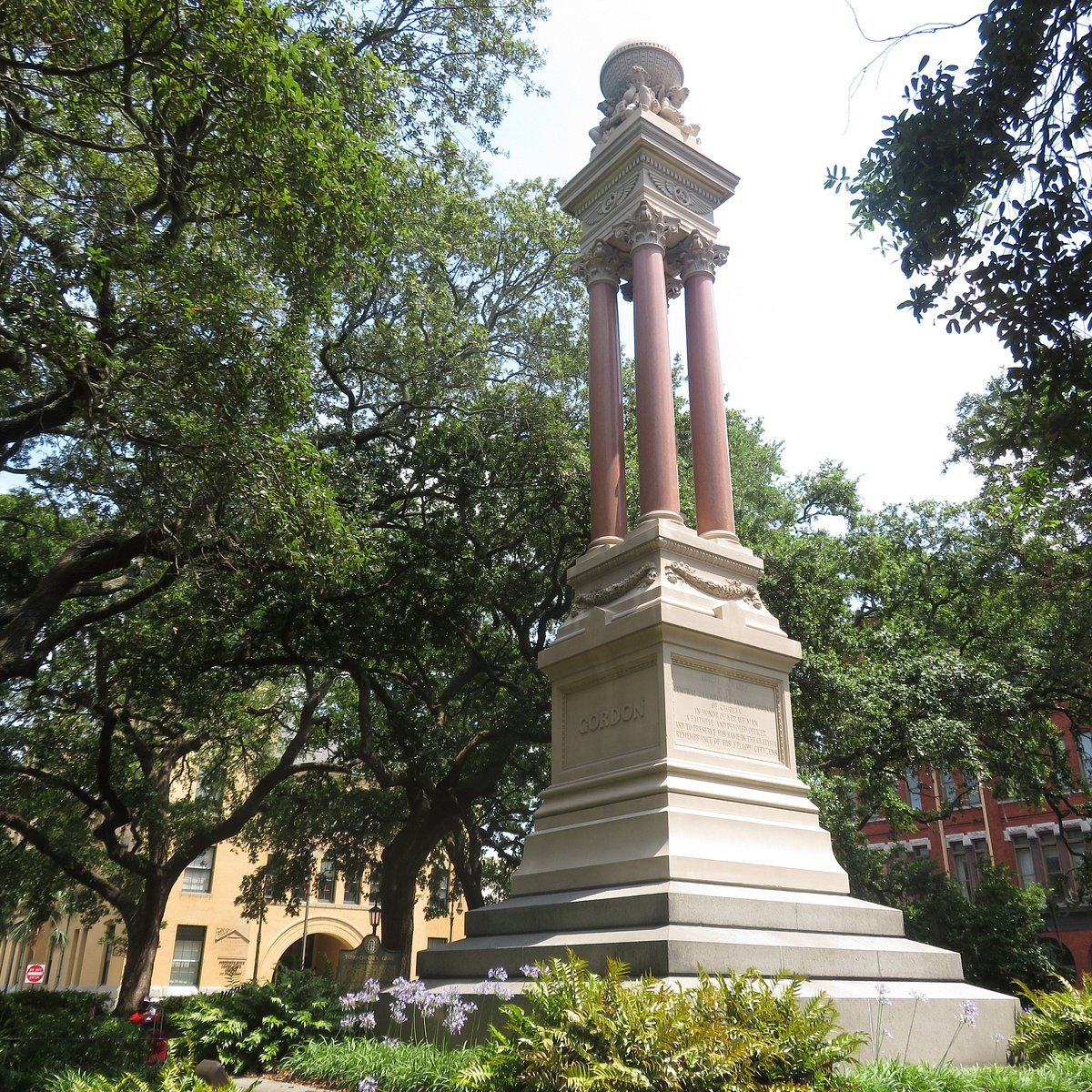
The Gordon Monument was completed in 1883 and honors William Washington Gordon, a railroad baron from the 1800's who founded the Central Georgia Railroad. It was designed by Henry Van Brunt and Frank M Howe. The monument consists of a granite pedestal and four marble columns.
Marble is a metamorphic rock, typically formed from the metamorphism of limestone or dolomite. The marble you see here is unique and is called Etowah marble (you may also hear it referred to as Georgia Pink Marble). It has a pink, salmon, rose color and is found in Pickens County in northern Georgia. Marble is formed through the process of metamorphism, which is when the composition/structure of a rock is altered by heat and pressure. The minerals within the parent rock recrystallize when exposed to these conditions and the result is a more dense, and harder rock. There are different minerals that can give rocks different colors. Iron oxide can result in a yellow/brown deposits. Iron and feldspar will form pink and red colors. Serpentine will give rock green hues. Then there is also porphyry (an igneous rock) that can result in a violet color. It is important to note though that the exact source of the pink color in Georgia pink marble is not known. There are many other minerals, though less common that will result in other colors.
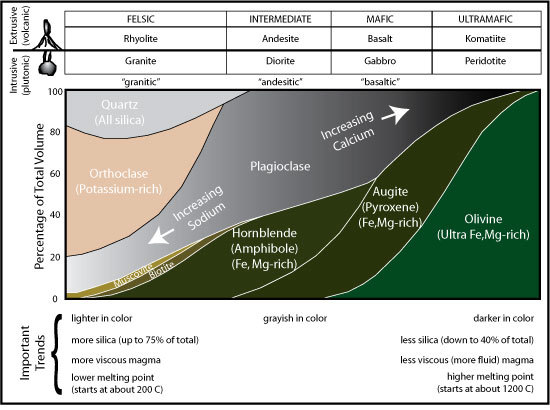
In contrast, granite is a igneous rock that has been a popular building material for centuries. The colors may vary slightly but in general, potassium feldspars commonly have pink to reddish hues, while the plagioclase feldspars tend to be white or gray. In the chart below, granite is located on the far left side. The composition may vary, but what distinguishes it from diorite is that it contains mostly feldspar and quartz. It is an intrusive, which means that it cooled slowly beneath the earths surface. The slower it cooled, the larger the crystals, and vice-versa. In contrast, extrusive rocks tend to be volcanic, and form on the earth's surface. Granite may contain mica (muscovite and siotite)which are the small shiny flakes that you sometimes can see in rocks. Lastly, there is hornblende, which are dark minerals.
![]()
Weathering is the process by which rocks, soil, and minerals are broken down through contact with Earth's atmosphere, water, and biologic resources. There are three types of weathering, physical, chemical, and biological. For this earthcache, we will focus on chemical weathering. Chemical weathering is caused by rain water (which is often slightly acidic) reacting with the minerals in the rocks to form new minerals and soluble salts. There are three forms of chemical weathering: oxidation, hydrolysis, and solution. Oxidation is the breakdown of rock by oxygen and water. It is the same process that results in rust, and like with iron, it can also give rocks a rust-colored surface. Hydrolysis is the breakdown of rocks by acidic water to produce clay and soluble salts. An example is feldspar (mineral composed of silicone, and can be pink, white, gray, or brown)in granite changing to clay. Lastly, there is solution which is removal of rocks by acidic rainwater (which contains carbon dioxide). This is how caves are formed, when acidic rainwater dissolves limestone bedrock.
Logging Requirements:
- Does the pedestal contain potassium feldspar, or plagioclase feldspar?
- Describe the color and any physical characteristics of the marble. Based on the cache description, what mineral do you think is responsible for giving the marble its unique color? Why do you think so?
- From a distance, what appears to be more weathered? What do you think is the primary cause of weathering? What are you able to thus conclude from this?
- Upload a photo with the Monument. You do not need to be in the photo, though it is strongly recommended.