Roque Cinchado
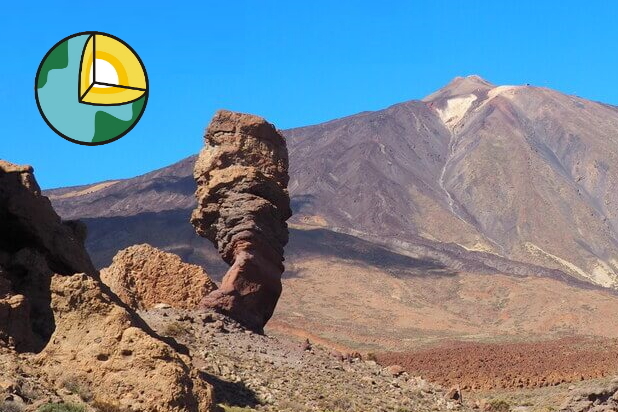
El Roque Cinchado es una de las formaciones rocosas de origen volcánico más singulares y emblemáticas de la isla de Tenerife. Se encuentra dentro del Parque Nacional del Teide (Patrimonio de la Humanidad).
El nombre de Roque Cinchado viene de la palabra "cincha", posiblemente porque parece que le hubieran puesto un cinturón. Tambíén se la conoce como Dedo de Dios o Árbol de Piedra por su forma.
Pertenece a una alineación de grandes formaciones rocosas conocidas como Roques de García que junto al pico del Teide, constituyen la imagen más conocida y popular del Parque Nacional del Teide.
Los roques dividen en dos la gran Caldera de Las Cañadas. Realmente son los restos de un antiguo edificio volcánico anterior a la formación de la Caldera, por lo tanto, más antiguos que el Teide.
Entre estos roques destacan La Catedral y el Roque Cinchado por su peculiar apariencia de permanente inestabilidad.
Estas formaciones rocosas son el resultado de un complejo proceso geológico el cual ha quedado materializado en retorcidos pináculos de lava, como es el caso del famoso Roque Cinchado.
Estas formaciones rocosas que solidificaron bajo una gran presión son los conductos por los que ascendía el magma para alimentar las erupciones, los llamados diques. Se encontraban a gran profundidad y dieron lugar a unas estructuras más duras y de materiales más resistentes que el entorno. Al producirse el deslizamiento que originó la Caldera de Las Cañadas quedaron al descubierto y expuestos a la erosión. Desde entonces la erosión los ha ido desgastando y esculpiendo de forma irregular y caprichosa debido a la diferente dureza de los materiales que las componen.
Formación de un dique
Los diques son conductos por los que ascendía el magma para alimentar las erupciones.
Reconocibles por su agrietamiento geométrico, suelen ser muy resistentes a la erosión y resaltan a menudo en el terreno.
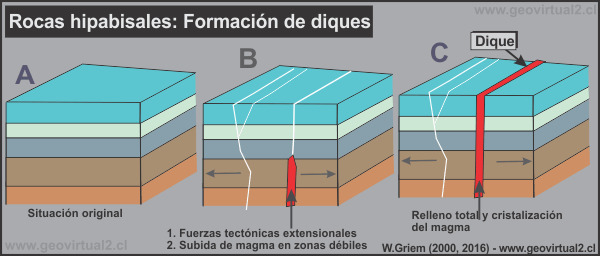 Formación de un dique
Billete 1.000 pesetas
Las sorprendentes formas del Roque Cinchado y la silueta del Teide, máxima altitud de España, se ganaron el honor de figurar en los billetes de 1.000 pesetas. Con la llegada del euro desapareció la peseta y con ella el famoso billete.
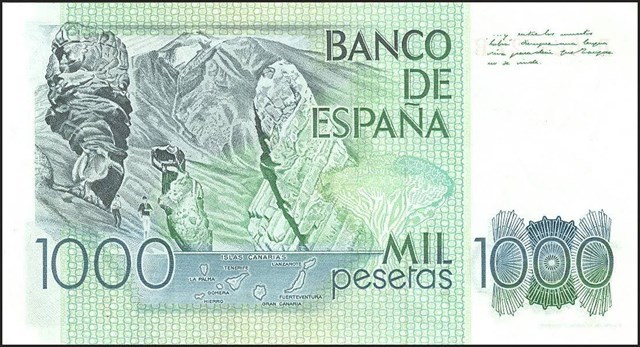 Billete de 1.000 pesetas
Leyendo el listing, visitando el lugar y leyendo el panel informativo, podréis responder a las preguntas de este earth. Recordad haceros la foto obligatoria.
PREGUNTAS
Para poder registrar como encontrado este earth, nos tenéis que mandar un correo (podéis hacerlo desde nuestro perfil de usuario) con las respuestas a las siguientes preguntas. Podéis loguear el earthcache sin haber recibido nuestra respuesta. Si no recibimos el correo con las respuestas correctas, el log podrá ser borrado sin previo aviso.
1.- Cuál de las siguientes afirmaciones sobre los diques es correcta:
A) Los diques son conductos por los que fluye el agua de la lluvia
B) Los diques son conductos por los que descendía el magma para alimentar las erupciones
C) Los diques son conductos por los que ascendía el magma para alimentar las erupciones
D) Los diques son unos títulos nobiliarios europeos
2.- Explica con tus palabras como se formó y quedó al descubierto el Roque Cinchado.
3. ¿Crees que llegará el día en qué el Roque Cinchado desaparezca? Razona tu respuesta.
4.- FOTO. Hazte una fotografía con el Roque Cinchado simulando la imagen del billete de 1.000 pesetas sin salir del camino. Si no quieres salir, un papel con tu nick o tu GPS será válido. Recuerda que esta fotografía es OBLIGATORIA para demostrar que has visitado este earthcache.
Si no recibimos las respuestas, el log será borrado sin previo aviso.
También podrán ser borrados todos los logs que no incluyan la fotografía obligatoria de la pregunta 4 (desde la actualización de las guidelines de junio de 2019, la fotografía puede ser obligatoria para demostrar que se ha visitado el sitio).
No olvides que estás dentro de un entorno natural, hay que respetarlo y cuidarlo.
Gracias por vuestra comprensión y esperemos que disfrutéis del lugar.

ENGLISH VERSION
Roque Cinchado (ENG)
Roque Cinchado is one of the most unique and emblematic rock formations of volcanic origin on the island of Tenerife. It is located within the Teide National Park (World Heritage).
The name of Roque Cinchado comes from the word "cinch", possibly because it seems that they have put a belt on it. It is also known as Dedo de Dios (God's Finger) or Árbol de Piedra (Stone Tree) because of its shape.
It belongs to an alignment of large rock formations known as Roques de García which, together with the Teide peak, constitute the best-known and most popular image of the Teide National Park.
The rocks divide the great Caldera de Las Cañadas in two. They really are the remains of an old volcanic building from before the formation of the Caldera, therefore older than Teide.
Among these rocks, La Catedral and Roque Cinchado stand out for their peculiar appearance of permanent instability.
These rock formations are the result of a complex geological process which has materialized in twisted pinnacles of lava, as is the case of the famous Roque Cinchado.
These rock formations that solidified under great pressure are the conduits through which the magma rose to feed the eruptions, the so-called dikes. They were found at a great depth and gave rise to harder structures and more resistant materials than the environment. When the landslide that caused the Caldera de Las Cañadas occurred, they were exposed and exposed to erosion. Since then, erosion has been wearing them down and sculpting them in an irregular and capricious way due to the different hardness of the materials that compose them.
Formation of a dike
The dikes are conduits through which the magma ascended to feed the eruptions.
Recognizable by their geometric cracking, they are usually very resistant to erosion and often stand out on the ground.
Formation of a dike
1.000 pesetas bill
The surprising shapes of
Roque Cinchado and the silhouette of Mount Teide, the highest altitude in Spain, earned the honor of appearing on the 1,000 pesetas bills. With the arrival of the euro, the peseta disappeared and with it the famous bill.
1.000 pesetas bill
By reading the listing, visiting the place and reading the information panel, you will be able to answer the questions of this earth. Remember to take the obligatory photo.
QUESTIONS
In order to register as a found this earth, you have to send us an email (you can do it from our user profile) with the answers to the following questions. You can log the earthcache without having received our response. If we do not receive the email with the correct answers, the log may be deleted without prior notice.
1.- Which of the following statements about dikes is correct:
A) Dikes are conduits through which rainwater flows
B) Dikes are conduits through which the magma descended to feed the eruptions
C) Dikes are conduits through which the magma ascended to feed the eruptions
D) Dikes are European titles of nobility
2.- Explain in your own words how Roque Cinchado was formed and became visible.
3.- Do you think the day will come when Roque Cinchado disappears? Reason your answer.
4.- PHOTO. Take a picture of yourself with the Roque Cinchado simulating the image of the 1.000 pesetas bill without leaving the path. If you don't want to appear, a piece of paper with your nickname or your GPS will be ok. Remember this photograph is REQUIRED to prove that you have visited this earthcache.
If we don't receive the answers, the log will be deleted without prior notice.
All logs that do not include the required photograph in question 4 may also be deleted (since update of the guidelines in June 2019, the photograph may be required to prove that the place has been visited).
Don't forget you are in a natural environment, you have to respect it and take care of it.
Thank you for your understanding and we hope you enjoy the place.