|
FINISTERRE KM. 0
English version below
El Camino de Finisterre o de Fisterra es más antiguo incluso que la Cristiandad, existen pruebas de que los paganos hacían el camino hasta Finisterre, en la Costa da Morte, dónde creían que el sol moría y los mundos de la luz y las tinieblas se juntaban a la vez. En ese momento preciso en el que el sol moría los paganos rezaban y realizaban ofrendas de agradecimiento a los Dioses. Emprender la peregrinación a Fisterra desde Santiago (86 km), supone emprender la experiencia de caminar “hasta el fin del mundo”, en un sentido figurado. Dicen, que peregrinar hasta Fisterra es el último acto de fe y purificación de los peregrinos. Una especie de ritual de renacimiento en el que te liberas. Si alargáis el camino hasta aquí podréis recoger la acreditación llamada La Fisterrana.
Los que haciendo el Camino de Santiago llegan hasta aquí deberían realizar el siguiente ritual:
1) Una vez llegado a Fisterra deberás bañarte.
2) Deberás desprenderte de las cosas materiales que lleves contigo, como la ropa, quemándolas (actualmente esto se realiza de forma simbólica ya que hubo que prohibir la quema de cosas por el riesgo de incendios).
3) Asistir a una misa.
4) Para terminar el proceso de purificación deberás contemplar el atardecer desde el “fin de la tierra”. El proceso de desaparición del sol en el horizonte atlántico significa liberarte por completo, es un proceso de resurrección místico en el que renaces purificado.
Una vez estemos en Finisterre, podemos continuar la ruta hasta el Santuario de la Virgen de la Barca en Muxía ya que es otro punto tradicional de peregrinaje en una impresionante localización, bordeados por el Océano Atlántico. Se calcula que entre el 10 y el 15% de los peregrinos que llegan a Compostela siguen su periplo hasta Fisterra, y muchos de ellos aprovechan también para acercarse a Muxía (la etapa de enlace está señalizada en ambos sentidos, Fisterra-Muxía o Muxía-Fisterra, mediante mojones y flechas dobles). Incluso hay quien, tras visitar ambos destinos finales de la ruta jacobea, continúa caminando de vuelta hacia Santiago realizando un recorrido casi circular.
Un faro ubicado en el fin del mundo
Si bien su ubicación privilegiada es una de sus características más llamativas, sus 17 metros de alto es otro de sus rasgos que más sorprende a los turistas. Si contamos desde su punto más alto, este está situado a 143 metros del nivel del mar, logrando con su potente luz llegar a las 23 millas náuticas. En el año 1888 se le añadió una sirena actualmente conocida como la “vaca de Fisterra” debido al gran naufragio que allí tuvo lugar en 1870 y que desgraciadamente se llevó la vida de 482 personas.
VALIDACIÓN DEL VIRTUAL
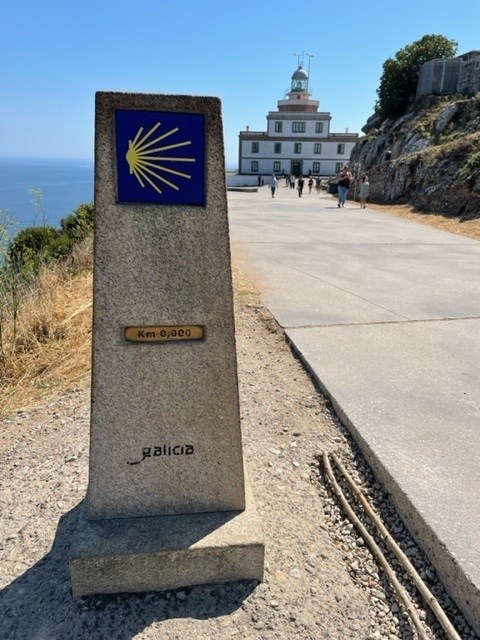
Muy cerca del faro del Cabo Fisterra, se encuentra este mágico Kilómetro Cero de la ruta donde deberéis acreditar vuestra visita aportando al registro una fotografía donde aparezcáis en la misma foto con estos dos elementos (ver la de ejemplo):
1) El mojón del Kilómetro Cero
2) El Faro de Cabo Finisterre
Preferimos las fotos en las que aparezcáis vosotros mismos, pero si sois tímidos y no queréis aparecer podréis poner en la foto un texto con vuestro Nick.
Los registros que no cumplan los requisitos podrán ser eliminados sin previo aviso.
Virtual Rewards 3.0 - 2022-2023 Este caché virtual es parte de un lanzamiento limitado de virtuales creado entre el 1 de marzo de 2022 y el 1 de marzo de 2023. Solo 4000 propietarios de cachés tuvieron la oportunidad de ocultar un caché virtual. Obtenga más información sobre Virtual Rewards 3.0 en el Blog de Geocaching.
English version
Camino de Finisterre or de Fisterra is even older than Christianity, there is evidence that the pagans made the way to Fisterre, on the Costa da Morte, where they believed that the sun died and the worlds of light and darkness came together the time At that precise moment when the sun died, the pagans prayed and made gratefulness offerings to the Gods. Begining the pilgrimage to Fisterra from Santiago (86 km), means undertaking the experience of walking "to the end of the world", in a figurative sense. They say that pilgrimage to Fisterra is the last act of faith and purification of the pilgrims. A kind of rebirth ritual that sets you free. If you lengthen the path to here, you can collect the accreditation called La Fisterrana. Those who doing Camino de Santiago arrive here should perform the following ritual:
1) Once you arrive to Fisterra you must take a bath.
2) You must get rid of the material things that you carry with you, such as clothes, by burning them (currently this is done in a symbolic way since the burning of things had to be prohibited due to the risk of fires).
3) Attend a mass
4) To finish the purification process you must contemplate the sunset from the "end of the earth". The process of the disappearance of the sun on the Atlantic horizon means to free yourself completely, it is a mystical resurrection process in which you are reborn purified.
Once we are in Finisterre, we can continue the route to the Sanctuary of the Virgen de la Barca in Muxía, as it is another traditional point of pilgrimage in an impressive location, bordered by the Atlantic Ocean. It is estimated that between 10 and 15% of the pilgrims who arrive in Compostela continue their journey to Fisterra, and many of them also take the opportunity to approach Muxía (the link stage is signposted in both directions, Fisterra-Muxía or Muxía- Fisterra, by means of milestones and double arrows). There are even those who, after visiting both final destinations of the Jacobean route, continue walking back to Santiago making a circular route.
A lighthouse located at the end of the world
Although its privileged location is one of its most striking features, its 17 meters high is another of its features that most surprises tourists. If we count from its highest point, it is located 143 meters above sea level, reaching 23 nautical miles with its powerful light. In 1888 a hooter was added, currently known as "Fisterra cow", due to the great shipwreck that took place there in 1870 and which unfortunately took the lives of 482 people.
VIRTUAL VALIDATION
Very close to Cabo Fisterra lighthouse, you will find this magical Kilometer Zero of this route where you must include to your log a photo by where you appear with these two elements (see the example):
1) Kilometer Zero milestone
2) Cape Finisterre Lighthouse
We prefer photos in which you appear yourself, but if you are shy and do not want to appear, you can put a text with your Nick in the photo.
Logs that don't meet the requirements may be deleted without previous notice.
THANKS FOR THE VISIT AND WE HOPE YOU HAVE ENJOYED THE “END OF THE EARTH”!!!
Virtual Rewards 3.0 - 2022-2023 This Virtual Cache is part of a limited release of Virtuals created between March 1, 2022 and March 1, 2023. Only 4,000 cache owners were given the opportunity to hide a Virtual Cache. Learn more about Virtual Rewards 3.0 on the Geocaching Blog

|