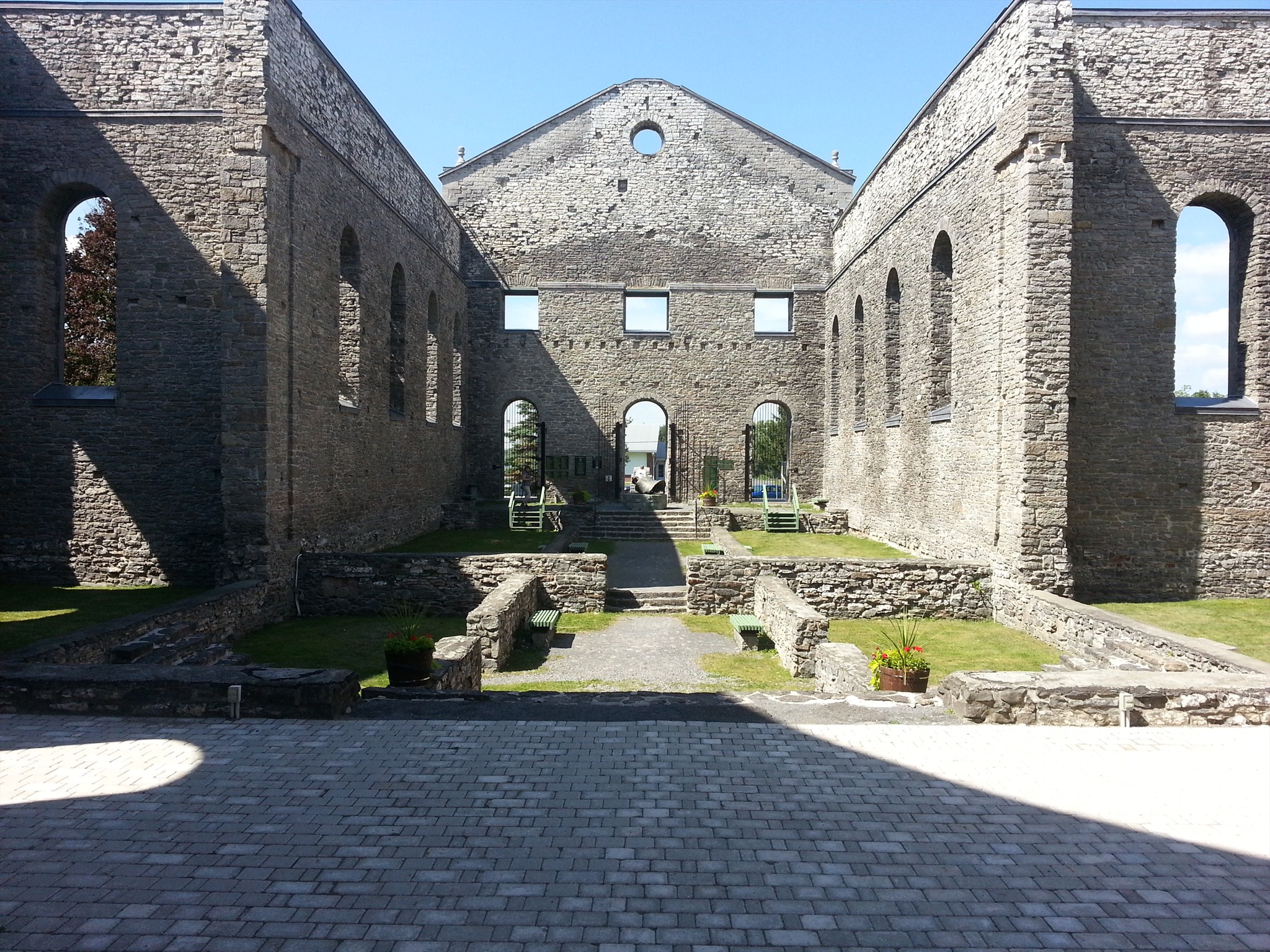
St. Raphael’s Catholic Church was a large, beautiful church in Eastern Ontario, serving early Canadians for over 150 years before burning down in 1970. My aunt and uncle were scheduled to be married here when a couple weeks before their wedding the church burned down! The wedding was moved to St. Andrew’s, and that became the family church. Some historical information from saintraphaelsruins.com follows.
St Raphael’s is situated in the former Charlottenburgh Township, now South Glengarry on the seventh concession back from the St Lawrence River. Commenced by Alexander Macdonell, vicar general and future Roman Catholic Bishop of Upper Canada, this large stone church served a congregation of Gaelic-speaking Catholic Highlanders who had settled in the easternmost county of Upper Canada in 1786. For a time St Raphael’s function as the administrative centre of the Roman Catholic Church in Upper Canada and today is recognized as the founding church for the Anglophone Catholics of the province.
The church was constructed during a period when the province was still under the jurisdiction of the Bishop of Quebec, a state of affairs which continued until 1826, when the dioceses was divided and Macdonell became the first Bishop of Kingston (Upper Canada). Evidence of this transitional period in Church history is preserved by Macdonell’s plan for St Raphael’s, which resembles the cruciform design developed by Abbe Pierre Conefroy and popular in Lower Canada from 1812 to 1830.
Throughout the early 19th century, St Raphael’s constituted the largest parish of Roman Catholics in the colony. Its significance was reflected not only in the size of the church but also in the educational buildings that were associated with it. These included a large stone presbytery which Macdonell built for his own use in 1808 and which served from 1817 as a boys’ school; a single story building which once housed the former College of Iona, a seminary established by Macdonell to train young men for the priesthood; and a school building for girls of the parish (since demolished). These were among the first Roman Catholic educational institutions in the province. Macdonell’s account book indicates that payment for the first load of cut stone was made through the building contractor and master mason, Archibald Fraser, in the spring of 1816.
In 1970 a fire destroyed St Raphael’s roof, its 1830’s tower and all of its interior decorations. Fortunately the outer walls were spared and thus its plan, its impressive scale and its fine masonry work – three physical characteristics of Macdonell’s church – remain. The parishioners of St Raphael’s decided to preserve the ruin and build an unobtrusive modern church against its southwest corner. The original structure was designated as Heritage property 1974 under the Ontario Heritage Act and an Ontario Heritage Foundation Grant supported the work of consolidation. Despite the church’s loss of original purpose, its stark silhouette against the rural landscape of Glengarry County powerfully engages the minds of all who see it, evoking those early days in the history of the Church and preserving the memory of those intrepid settlers.
TO LOG THIS GEOCACHE:
Upload TWO unique photos per "Found it" log:
1. Include a photo of you with the church bell with your log in order to validate your find. Your face doesn't need to be visible.
2. Take an artistic photo of the ruins: something that captures its character or an interesting/uncommon angle.
NOTE: It is normal for the interior of the ruins to be locked during the snowy season, and over the years the ruins may not always be accessible due to maintenance, private bookings, pandemics, etc. Please do your best to accomplish the tasks, but please obey signage and be respectful of the site.
Virtual Rewards 3.0 - 2022-2023
This Virtual Cache is part of a limited release of Virtuals created between March 1, 2022 and March 1, 2023. Only 4,000 cache owners were given the opportunity to hide a Virtual Cache. Learn more about Virtual Rewards 3.0 on the Geocaching Blog.