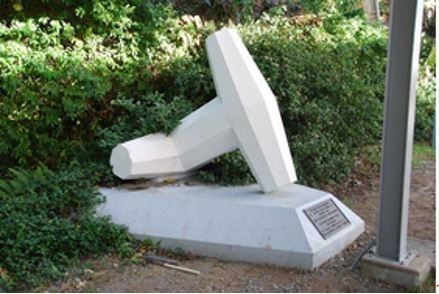
THE DOLOS BREAKWATER BLOCK WAS DESIGNED IN EAST LONDON IN 1963
BY MR. E. M. MERRIFIELD HARBOUR ENGINEER.
There is a perfect specimen of a Dolos at the entrance to the East London harbour as can be seen in the picture above. It is inside the harbour and needs special permission to enter the premises from security which is difficult to obtain and this is the reason for not placing the virtual at the memorial.
A dolos is a concrete block in a complex geometric shape weighing up to 80 tons, used in great numbers to protect harbour walls from the erosive force of ocean waves. It is also used as a form of coastal management to build revetments for protection against the erosive force of waves from a body of water. They were developed in East London in 1963 by EM MERRIELD and was first deployed in 1964 on the breakwater of East London, a South African port city. Today there are millions used around the world.
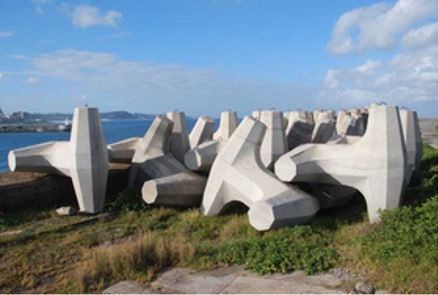
Dolosse are normally made from un-reinforced concrete, poured into a steel mould. The concrete will sometimes be mixed with small steel fibers to strengthen it in the absence of reinforcing.
They work by dissipating, rather than blocking, the energy of waves. Their design deflects most wave action energy to the side, making them more difficult to dislodge than objects of a similar weight presenting a flat surface. Though they are placed into position on top of each other by cranes, over time they tend to get further entangled as the waves shift them. Their design ensures that they form an interlocking but porous and slightly flexible wall.
The individual units are often numbered so that their movements can be tracked. This helps engineers gauge whether they need to add more dolosse to the pile.
The design of the dolos is usually credited to the South African Eric Mowbray Merrifield, one-time East London Harbour Engineer (from 1961–1976). In the late 1990s the claim of Aubrey Kruger gained more prominence. Kruger's claim is that he and Merrifield had considered the shape of concrete blocks to be used to protect East London's extensive breakwaters for the City's non-natural harbour, following a major storm in 1963. Merrifield wished to design a block that did not break up or shift when struck by the sea; that was cheap; and that did not require precise placement. He said in later years that he wanted a block designed in such a way that it could be "sprinkled like children's jacks". Kruger stated that he went home for lunch, cut three sections from a broomstick, and fastened them with nails into an H-shape with one leg turned through 90 degrees to create the distinctive dolos shape. Merrifield was intrigued by the object and had Kruger draw a plan. Kruger never formally received credit for the invention. Merrifield won the Shell Design Award and the Associated Science and Technology Societies of South Africa’s Gold Medal.
The design of the dolos is not protected by any form of patent. Merrifield did not take the necessary steps to protect the concept. The reason for this is uncertain. Two reasons for this have been put forward: one by Merrifield; the other by Kruger. Merrifield stated that he did not protect them as he wished them to benefit humanity. Kruger alleges that Merrifield received incorrect legal advice: to wit, that as the blocks had been designed during office hours while employed by the State (South African Railways and Harbours Administration), he was unable by law to protect their design.
The listed coordinates will take you to the entrance of the Orient Beach / Eastern Breakwall if you wish to visit the area or get closer. However, there is an entrance fee, but it is not necessary to enter in order to claim this Virtual Cache. You may take your picture from anywhere on the beachfront provided the breakwater is visible.
In order to log this cache you need to do the following:
Upload a picture with your find log;
OF yourself holding your GPS (face optional) with the breakwater/wall visible
OR your geocaching name and date written on something with the breakwater/wall visible
PLEASE COMPLY WITH THE OPTIONS OTHERWISE YOUR LOG WILL BE DELETED
If you are caching in a group every team in the group has to have their own picture. No group or duplicate photos will be allowed.
Virtual Rewards 3.0 - 2022-2023
This Virtual Cache is part of a limited release of Virtuals created between March 1, 2022 and March 1, 2023. Only 4,000 cache owners were given the opportunity to hide a Virtual Cache. Learn more about Virtual Rewards 3.0 on the Geocaching Blog.