This EarthCache is intended to explore a process of fossilisation. To be in the correct position to attend this EarthCache, find the inscribed stone, which starts 'Gosodwyd', then look directly above. Here you will see a fossil ammonite.
Ammonites
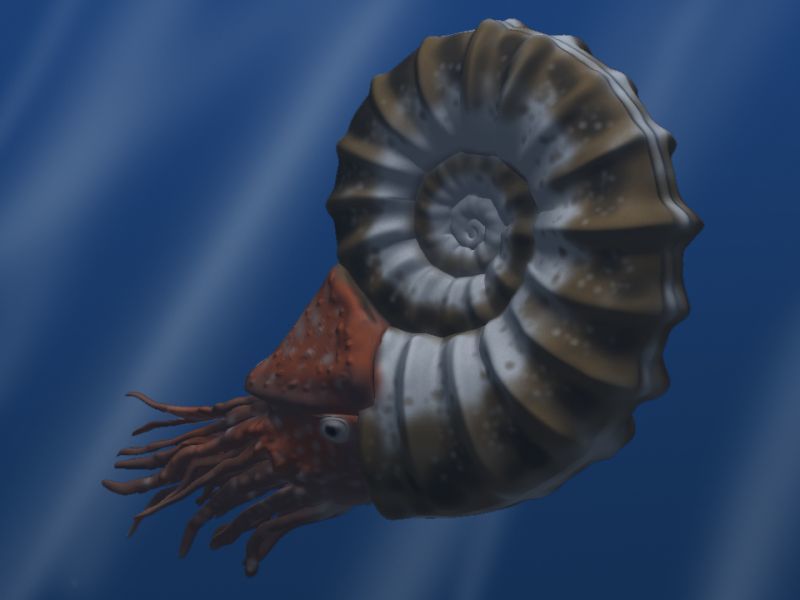
Ammonites are a group of extinct marine animals, that are related to modern day squid, cuttlefish and octupus. The living animal lived in a body chamber in a circular shell which had different chambers known as phragmocone. The circular shell consisted of a progressively larger chambers, known as camerae, with each camerae seperated from another, by thin wall called septa. Only the last and the largest of the chambers was occupied by the living animal. A thin tube passed through all the chambers, which allowed the animal to empty / fill each chamber with water, thus creating buoyancy, and allowing the ammonite to rise up and down in the water. The coiled appearance of an ammonite shell is known as planispiral.
The type of rock that forms this building is known as Jura Limestone. Limestone is a sedimentary rock.
Sedimentary rocks are types of rock that are formed by the deposition and subsequent cementation of that material at the earth's surface and within bodies of water. Sedimentation is the collective name for processes that cause mineral and/or organic particles to settle in place. The particles that form a sedimentary rock by accumulating are called sediment. Before being deposited, the sediment was formed by weathering and erosion from the source area, and then transported to the place of deposition by water, wind, ice, mass movement or glaciers. Sedimentation may also occur as minerals precipitate from water solution or shells of aquatic creatures settle out of suspension.
Limestone is a sedimentary rock composed largely of the minerals calcite and aragonite, which are different crystal forms of calcium carbonate. Many,but not all limestones are composed of skeletal fragments of marine organisms such as coral, crinoids and molluscs.
This type of limestone is known as Jura Limestone, and it comes from Bavaria in Germany. This type of limestone was formed during the Jurrasic period, which is also known as the age of reptiles, during this time, a shallow tropical sea covered the area now known as Bavaria.
As previously stated we are here to look at a specific process of fossilisation, we are here to look at perimineralisation.
Perimineralisation.
When a fossil is being formed from once what was a living being, the fossil absorbs mineral rich fluid. This mineral rich fluid eventually replaces organic matter with minerals, and eventually turns to stone.
There are three subgroups of permineralisations: silicification, pyritisation, and carbonate mineralisations.
(1) Silification. This is where the silica rich fluid fills the structures of the fossil, and as a result very detailed fossils can occur. Quartz crystals form from this silica rich fluid.
(2) Pyritisation. This is where the mineral suflur is predominent in the fluid, and pyrite crystals can form in the structures of the fossil.
(3) Carbonate. This is where the minerals calcium, magnesium and occasionally iron saturate the fossil, commonly these can form a round structure around the fossil.
This being an EarthCache, in order to log it, I ask that you answer the above questions. Please send them to me, and do not include them in your log. You can send them to me by using the message facility or email, both of which can be found by looking at my profile.
1. Looking at the ammonite fossil, please tell me what evidence there is of perimineralisation occuring?
2. Using the information gained from answering question 1, please tell me what type of perimineralisation has occured here.
3. How many chambers in the ammonite fossil have been affected by perimineralisation?
Please feel free to take a photograph at the location, but please do the show the specific fossil.