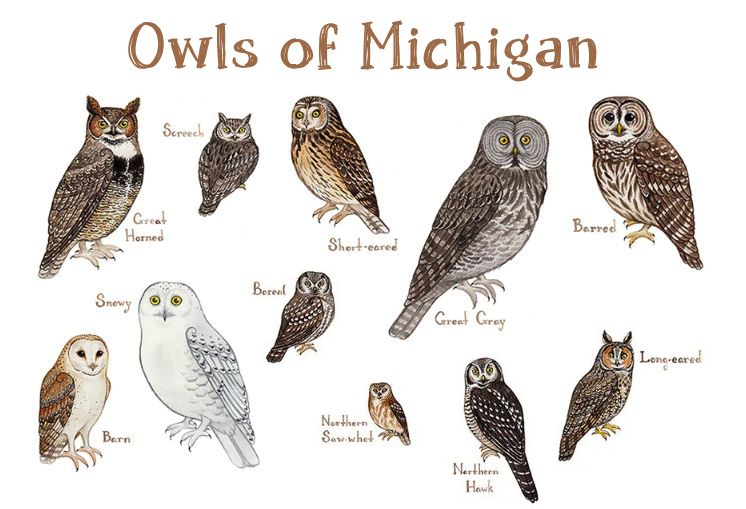
Owls of Michigan
Michigan, with more than half of the state forested, is home to eleven species of owls. Spotting owls can be tricky since most species are inactive during the day. And owls, by nature, are shy and elusive creatures.
Here are some tips for successful owling:
- Learn – Find out about the species of owls in the area you are looking for.
- Listen – Familiarize yourself with the calls of different owls you can come across and listen actively. You are more likely to hear them before seeing them.
- Look carefully – Owls have excellent camouflage, and their plumages are adapted to blend into the night.
- Signs – Also look out for their pellets which are oblong or spherical and brown or grey in color. A large number of pellets indicates a nearby nesting or roosting owl.
- Be respectful – Be still and silent, and refrain from using bright lights, so as not to disturb or frighten them away.
This cache is one of twelve that were published for the 2022 Autumn in Oakwoods event. Each cache will focus on one of the owls that you will find in the state, many of which can be found right here in Oakwoods. A link to all 12 of the caches may be found HERE.
Barn Owl
- Scientific name – Tyto alba
- Lifespan – 2 – 4 years (wild); 25 years (captivity: maximum recorded)
- Size – 13 -15 in
- Weight – 8 – 25 oz
- Wingspan – 31 – 37 in
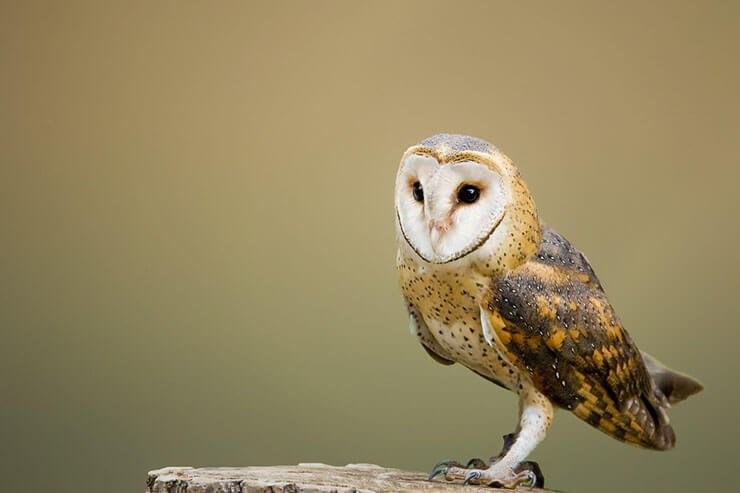
The barn owl is one of the most widespread birds in the world. Owing to their peculiar appearance and eerie call, the barn owl is sometimes called the demon owl, the ghost owl, and even the death owl. Yet barn owls are incredibly useful animals that help keep rodents at bay.The barn owl is an unusual beauty. It is a medium-sized owl with a heart-shaped face and characteristic pale, speckled plumage. The upperparts are rusty-brown with dark patches. The face and underparts range from cream to white. It has slender, feathered legs and long, broad wings that enable sharp, agile movements.
Barn owls occur in the open countryside at lower altitudes. They inhabit grasslands, farmlands, open woodlands, and woodland edges. They often nest in barns and old buildings – behavior for which they are named. They also nest in tree holes or in cavities and crevices along cliffs or ridges. They sometimes use the nests of other birds and readily take to nest boxes. The female shreds up dried, regurgitated pellets as nesting material for the chicks.
You are likelier to catch sight of a barn owl in the south of the state. It is an unmissable bird. Look out for a flash of white in the open country at night. Barn owls have an undulating flight pattern. They hunt by gliding low above the ground, scanning for prey. They may also be spotted taking off from a perch or flying to and from the nest. They are sometimes seen during the day flying between roosting sites. Barn owls don’t hoot. The call is a piercing, shrill screech.
Barn owls are strictly nocturnal. In North America, they consume a large number of voles. They also eat other rodents, insects, lizards, amphibians, bats, and birds. Although they are widespread birds, many localized populations are declining due to habitat loss, collisions with vehicles, and indirect poisoning from pesticides. Source: https://avibirds.com/owls-of-michigan/
The Cache: The cache is a medium-sized lock & lock hidden along the Iron Belle hike/bike trail.
| This cache is located within Oakwoods Metropark, a part of the Huron-Clinton Metropolitan Authority park system. A Metropark Vehicle Entry Permit is required: Annual Permit $40. Senior(62+) Permit $29. Daily Permit $10.
For general information please call 810-227-2752 or 800-47-PARKS. Or visit our website at www.metroparks.com.
All park rules and regulations apply. Park in parking lots only. Check the Metroparks website for park hours.
|
The permit for this cache has been submitted and approved by the Southern District Interpretive Services Supervisor of the Huron-Clinton Metroparks