This is an Earthcache – as such, there is no physical cache. Instead you will partake in a geology lesson by making observations and answering 4 questions about the Rock Maze at the posted coordinates.
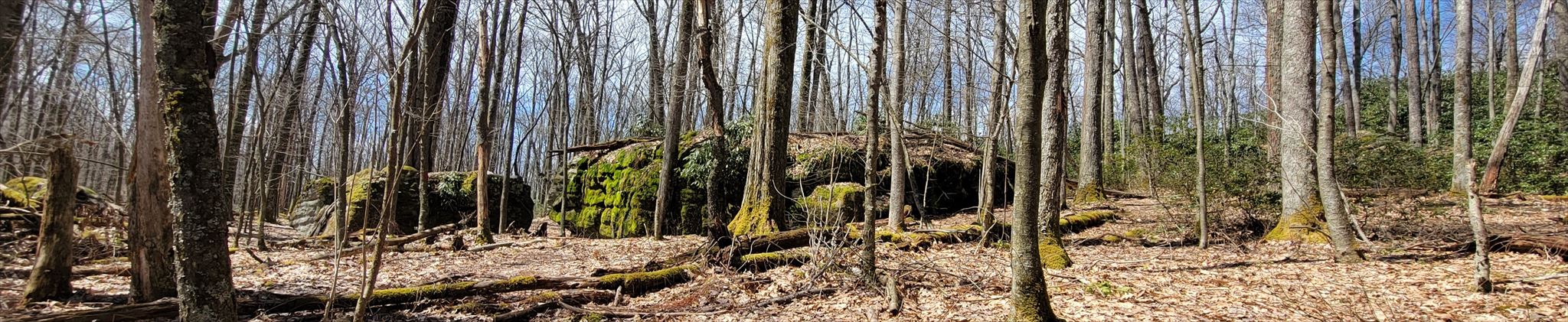
This ½ acre boulder maze is made up from massive blocks of conglomeratic sandstones from the Homewood Formation. At one point, 400 million years ago these boulders were a sandstone cap rock upon the Pennsylvanian Pottsville Formation.
Sedimentary rocks are formed by the consolidation of sediment particles. These particles are eroded from other rock types from higher elevations that gradually migrated towards the ocean over time. This stone was formed by the compaction of individual grains of sand that experienced immense pressure that hardened it to a solid stone. Sandstone is usually comprised of particles of quartz or feldspar, clay, or calcite.

Different types of sandstone can vary in hardness, but these rocks tend to be softer than other rock types such as granite. Homewood Sandstone in particular is a well cemented, medium- to coarse-grained sedimentary stone with little primary porosity or permeability. As strong these boulders are, they are still exposed to the elements and open to weathering and erosion.
Physical Weathering occurs when physical forces repeatedly act on the rock. For example, a rock tumbles over, hits another rock, and they both break apart. Another example is that plants causing physical weathering as their roots grow. A seed starts to grow in a crack, it’s roots put pressure on the crack, making it wider, and eventually splitting the rock.

Geologists believe that the major change that originally separated this boulder outcropping occurred during the last ice age. Here permafrost and ice wedging led to freezing and expanding. This happened repeatedly over hundreds of years until the joints were eventually shattered. The result being is these boulders have been wedged apart along vertical joint planes to form a maze of meter wide pathways.

Cross-beds are the groups of inclined layers, and the sloping layers are known as cross strata.

Cross bedding forms on a sloping surface such as ripple marks and dunes. This allows us to interpret if the depositional environment was water or wind. Examples of cross-bedding are ripples, sand waves, hummocks, dunes, bars, and deltas. Cross-bedding is widespread in three common sedimentary environments: rivers, tide-dominated coastal and marine settings.
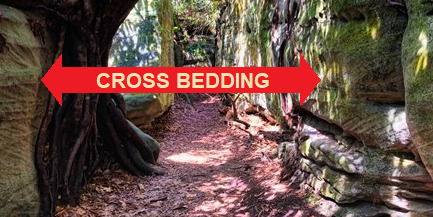
The distinct layers of tabular cross-bedding that appear at the rock maze can be correlated across pathways, which indicates that lateral displacement was dominant. Frost wedging during a previous cold climate was the most likely agent for this movement, as root wedging would displace only single blocks, and gravity-driven movement such as solifluction would cause tilting of the boulders (also unlikely on this gentle slope).
LOGGING REQUIREMENTS:
To log this Earthcache: Read the geology lesson above. Answer all four questions posted below and send them via e-mail or messenger contacts on my Geocaching profile.
QUESTION 1. How many years ago these boulders were a sandstone cap rock upon the Pennsylvanian Pottsville Formation?
QUESTION 2. How are tree roots and moss effecting the boulders?
QUESTION 3. Besides the Physical Weathering from Ice Expansion and tree roots, what other Physical Weathering did you see present here?
QUESTION 4. Locate a section of crossbedding in the maze that is parrellel to another wall of crossbedding. Do the crossbedding marks appear to line up?
OPTIONAL PHOTO: Posting a photo that readily indicates that you (and anyone else logging the find) are at the location.

 Awesnap has earned GSA's highest level:

REFERENCES:
1. Snaggy Mountain Rock Maze, R.Admas, M.Swift. S.Kite, D.Brezinski, Forts, Floods, and Periglacial Features: Exploring the Pittsburgh Low Plateau and Upper Youghiogheny Basin, Geological Society of America, January 01, 2017, GeoScienceWorld.org
2. Crossbedding - Reading the Rock, Keweenaw Geoheritage, website, geo.mtu.edu