
"This earth cache is located on public land and it is open to every one free of charge."
If you have small children please keep them under supervision.
And don’t forget to find the near by great traditional Glorious Gorge
Introduction
For millions of years Undara was an active shield volcano.
Then only about 190,000 years ago, in the Cainozoic Era, there was a massive eruption and lava flowed more than 90km to the north and over 160km to the northwest. An estimated 23.3km3 of lava flowed from the volcano at a rate of about 1000m3 every second. It is thought that the lava flowed at a temperature of around 1200°C.
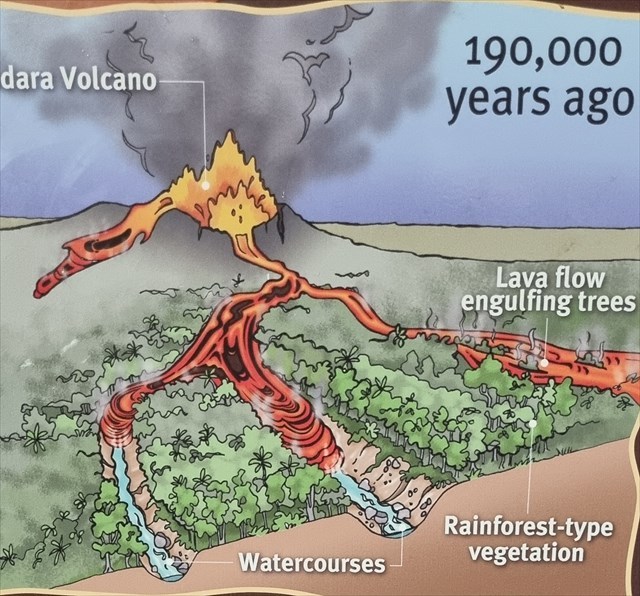
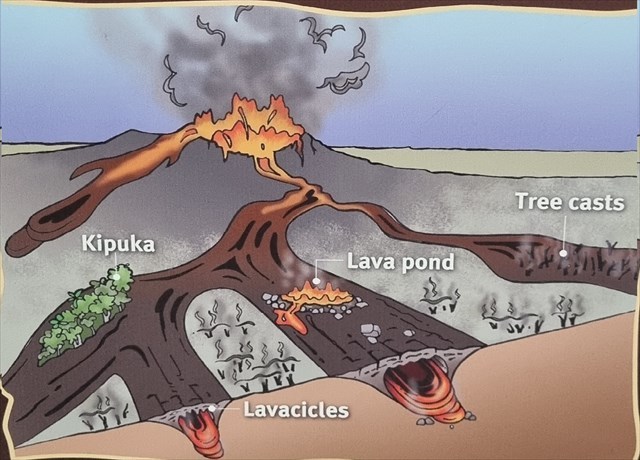
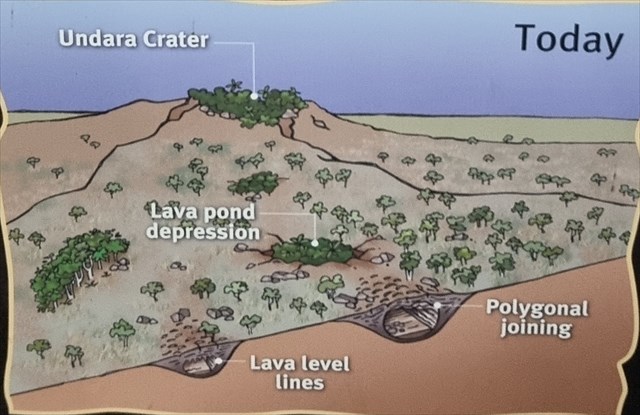
These lava tubes and caves were formed when rivers of lava confined to a valley crusted over, and the insulated lava flow carried on for tens of kilometres before draining out, leaving an empty tube of lava. What we call lave tubes.
A lava tube is a type of lava cave formed when a low- viscosity lava flow develops a continuous and hard crust, which thickens and forms a roof above the still-flowing lava stream.
Lava usually leaves the point of eruption in channels.
These channels tend to stay very hot as their surroundings cool. This means they slowly develop walls around them as the surrounding lava cools and/or as the channel melts its way deeper. These channels can get deep enough to crust over, forming an insulating tube that keeps the lava molten and serves as a conduit for the flowing lava.

View inside a Lava Cave
This fantastic area you are looking at is one of the Undara lave tubes at the south west end of the flow.
This gorge was formed when the Copperfield River eroded through a fault in the Basalt of the lava cave roof and eventually it collapsed and exposed what you can see today.
Geology Lesson
Basalts are common igneous extrusive rocks, they makes up about 90% of all the lava rock on Earth and are composed of minute grains of Plagioclase feldspar, Pyroxene, Olivine, Biotite, Hornblende, and less than 20% Quartz and rarely Biotite.
Basalts are usually dark grey to black colour.
Basalts are formed by rapid cooling of basaltic lava, from the interior of the crust and exposed at or very close to the surface. These basalt flows are thick and extensive in which gas cavities are nearly absent.
In the case of thin and irregular lava flows, gas cavities are formed at the rock surface (“vesicular”).
Basalt can also form Columns as it cools. They usually begin to shape from the top down into the middle or even bottom of the lava flow. This is how really tall colomns can form. They might not all be hexagons… instead of 6, they might have 5 or 7 sides, or a more irregular shape.
When they form long, straight columns, these are called colonnade.
When they have more irregular shapes that look like they’ve been pushed or morphed, it’s called entablature.
Now the logging tasks, don’t worry they are not that hard and not far apart.
Please send your answers through the message centre on Geocaching.com.
At WP1 you will be standing on a darker coloured rock than the surrounding old river bed.
Q1/ What sort of rock do you think it is? Do you think it cooled fast or slow, (give a simple reason for your answer.)
WP2 Here you will see some nicely patterned rock.
Q2/ How do you think these patterns were formed?
Take a picture of one of these patterned rocks and send with your answers.
WP3 Here you will be looking down at a very large rock jutting out of the river bed, the largest rock.
Q3/ Do you think this rock was formed where it is?
Q4/ If you look at this rock you can see some columns, would you call them colonnade or entablature?
We understand teams like to log in order so feel free to log your find after sending the answers to us.
If the answers are not received in a timely manner your log will be deleted.
references Parks Queensland website
Local advice from Undara tour guide.
Google.