Pipitea Station opened in 1874 as the Wellington terminus of the Hutt Valley Line on Pipitea Point, a small bit of earthquake lifted land about 600m north of here. At that time there was not much land available between the commercial space and the sea and Railways soon realised that it was going to need more space than was available, especially when they start building their own engines and rolling stock, rather than buying them complete from England. But space wasn't the only problem. Soon people were complaining about how far away the station was from town (people often wanted the station in the middle of town - see Manawatu Rail: Foxton for why this is a bad idea). The space problem was solved with acquiring more land at Petone Station and moving the workshops there. A fire in 1878 destroyed Pipitea Station and the remaining workshop buildings and although Pipitea Station building was replaced, the loss prompted a rethink of the location.
Wellington had very little flat land, and from 1850 to about 1890 there was considerable and constant reclamation of the harbour. Nearly all of Wellington's central city flat area was once sea. (See the earthcache Wellington Waterfront for a good description of this. For a tour of the shoreline try Wellington’s Old Shoreline Trail multi-cache.) The reclaimed area solved some of the problems and in 1880, 2 years after the Pipitea fire, Wellington Station was built to be the new terminus of the Hutt Valley Line. It was located on Featherston Street where the Rydges Hotel stands today, 100m south of the current Wellington Station. It was built of kauri and totora despite a Government approved council by-law requiring that all buildings in the area to be built of non-combustible materials such as brick or stone - and despite the fire at Pipitea, which started at a hotel across the road. Besides being closer to town, another reason to build there was proximity to the new Railway Wharf (now Waterloo Wharf). However the greater than expected traffic at Wellington Station restricted access to the wharf, so in 1885 the station building was jacked onto railway bogies and moved to a new home, much to the delight of the crowds that formed daily to watch the progress. The new site is just under 100m from this cache, on the other side of the railway yard from here - see the attached waypoints.
In 1908 the Government bought the Wellington and Manawatu Railway, and Wellington Station was renamed to Lambton. In the meantime Thorndon Station, the southern terminus of the Manawatu line, was still located near the old Pipitea site and public pressure was forming to have a single station servicing both lines. Lambton station building was now 28 years old and considered by reporters of the day to be no longer suitable however it was kept until the current Wellington Station building was opened.
Wellington's current railway station was first proposed in 1907 and designed in 1929, but steel shortages from the war delayed the start of construction till December 1934. Building took 3 years. At the time it was the largest building in New Zealand. It held a creche on the top floor, and a dining room and newsagents on the ground floor where the ticket booths are today. It had public bathrooms with baths and showers. A few days after it was opened Thorndon and Pipitea station buildings and platforms were removed, as they choked the outgoing rail lines. The removal of Lambton Station was less urgent - it stood until 1938, and part of its platform is can still be seen under the covered walkway of the building beside platform 1.
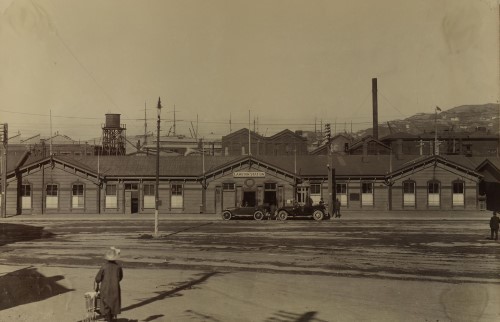
Lambton Station, about 1916
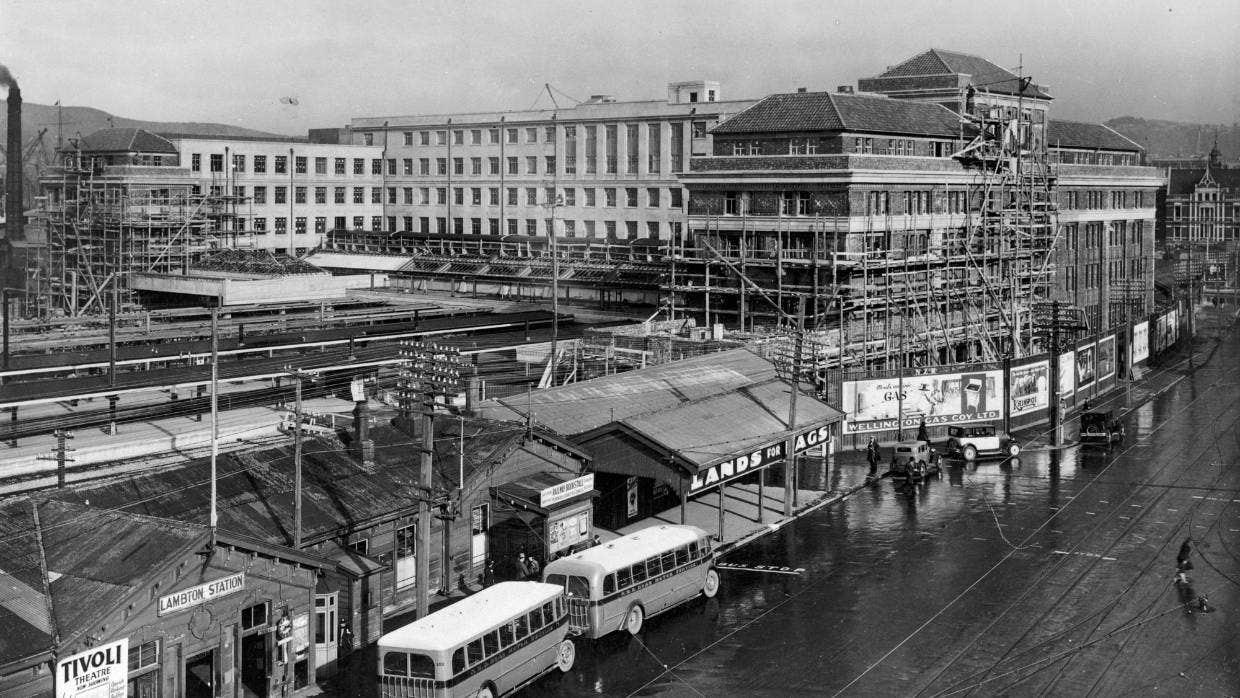
Wellington Station, nearly complete, 1936. Lambton Station in the foreground.
References:
Welllington.govt.nz, "History of Welllington Waterfront"
Scoble, J: "Names and Opening and Closing Dates of Railway Stations", published by the Rail Heritage Trust of New Zealand, 2010.
Parsons, D: "Wellington's Railways Colonial Steam to Matangi", published by the Rail Heritage Trust of New Zealand, 2010.
Stuff.co.nz, "Wellington train station a paramount of style and comfort - 150 years of news", 14 July 2005