| Note: there may be water near GZ - gumboots could be useful. |
Kaiwarra Station was opened 14 April 1874. In 1879 a station building was installed, which was upgraded in 1911 when the lines were double-tracked. In the 1930s the new line to Tawa (and the removal of the Johnsonville to Tawa section) resulted in a realignment of the line here. The station building was removed and the platforms remade into the two narrow islands you can still see here, with just a simple shelter on each - there being no room for anything more. These were removed in the 1990s over safety concerns - the narrow islands are just too narrow to allow sufficient room to walk past the shelters. It wasn't till 1951 that the station name was at last corrected to Kaiwharawhara. I must admit the name Kaiwarra was a real surprise to me - NZR were usually quite careful to get Māori names correct.
The platforms were accessed via a pedestrian overbridge from the published coordinates, but in 2013 when the bridge was surveyed it was found to have excessive corrosion. Railways decided that the low numbers of passengers using the station did not warrant the replacement of the bridge, and so the station was closed on 21 November of that year.
Before the closure this was a regular stop on the Hutt Valley and Melling lines, but only a request stop on the Kapiti line, thus my inculsion here with the Hutt Rail series.
Building the Line
A rail line to the Wairarapa was first mooted in 1853 and a proposal in various forms was re-raised every few years, but it was the 1855 earthquake that lifted the land between Ngauranga and Petone to provide a stable, dry and wide shelf suitable for a road, and the 1870 £10M loan from England to provide the funds for public works, that allowed the project to commence. The Wellington to Wairarapa line was one of the first authorised under the 1870 Public Works Act and the 1871 Railways Act. Surveying to Lower Hutt was conducted and construction started in 1872. Although it was not declared a public holiday, the 20th of August might well have been, as everyone celebrated the turning of the first sod. The first year saw only the Pipitea (the terminus) to Kaiwarra completed, and by April 1874 the line was opened for traffic from Pipitea to Lower Hutt.
It is interesting to note that within the first year of operation after connection to Upper Hutt, £1002 revenue was collected from passengers, and only £61 from freight. Kaiwharra / Kaiwharawhara station is also unique in being the only non-terminus commuter station in New Zealand to have 4 lines.
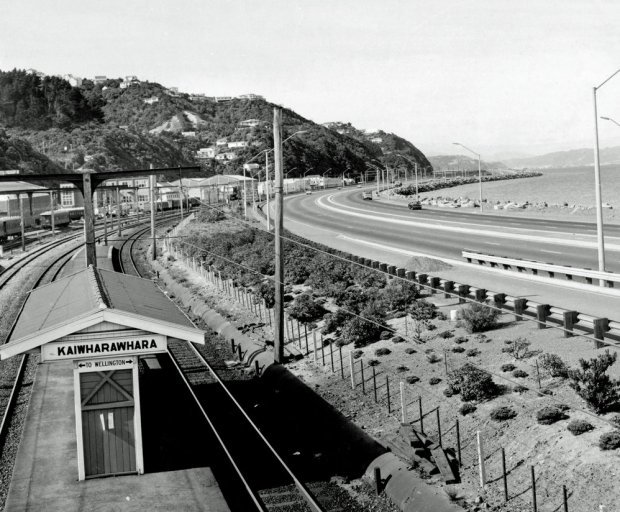
Kaiwharawhara station, looking north from the pedestrian overbridge, 1957
Alas there is no room to place a good cache at the station. Instead, find a sign. There are lots to choose from.
You need to go to:
S 41° 1a.bcd E 174° 4e.fgh, where
a = Last of the smallest digits
b = Sum of the large digits, plus one.
c = Number of light squares in the logo
d = Number of dark squares in the logo
e = Digit after the last zero
f = Number of big spots
g = First of the smallest digits
h = Number of words in the title
Σ(a-h) = 40
This will take you to a place as uniquely Kaiwharrian as their skinny platforms. Once there, there is another 30m walk to the cache. Note that there may be a couple of centimetres of water near GZ - gumboots might be a good idea.
Kaiwharawhara is named for the nearby Kaiwharawhara Stream, which in turn refers to the grass-like Astelia Banksii (wharawhara), the berries of which were used as food (kai).
References:
"Kaiwharawhara Railway Station", Wikipedia.org
Scoble, J: "Names and Opening and Closing Dates of Railway Stations", published by the Rail Heritage Trust of New Zealand, 2010.
Parsons, D: "Wellington's Railways Colonial Steam to Matangi", published by the Rail Heritage Trust of New Zealand, 2010.