This is an Earthcache – as such, there is no physical cache. Instead after examining the red granite memorial at the posted coordinates, you will answer 4 questions and message me the answers. Metered street parking is available nearby.
WORLD WAR II AND KOREAN WAR MEMORIAL
On January 13, 1962, Memphis was presented with a new fountain memorial dedicated to its Veterans. Placed here in front of the Main Post Office, the “controversial structure” was made of aluminum and granite. The two hundred attendees of the reveal were told to “see in this memorial what you want to see.”

The architects who designed it said that its abstract design was to “make people look at it and say ‘What is it?’” What most saw was a gleaming rectangular dish gurgling water into a granite pool. It’s designers wanted people to look upon this modern art piece and be “reminded of the destruction of war, and the warm security of peace.”

Often referred to as a “bathtub” or a “gravy boat,” this memorial was not what the people wanted. It came with plenty of pesky problems. Wind would blow water on pedestrians, the basin overflowed, the glare off the fountain disrupted drivers, and in the winter the surrounding sidewalk would be covered with slippery ice. Pranksters would throw everything in it from soap, to dye, to fish. Due to its location on the sidewalk at the intersection of Front and Madison people would fall in, and the granite base was often hit by cars. The fountain was troublesome to maintain, it clogged easily, and it eventually became inoperable. By 1970 it was decided to put it in “permanent drydock.” The “shiny bathtub” was placed in storage, and the granite pool was transformed into the planter you see before you.

Over the years the Post Office turned into the U &M Law School, a new War Memorial Plaza was built in Overton Park, and the aluminum “gravy boat” was lost to time after being put in storage. Yet, this Minnesota Granite remained.
ST. CLOUD RED GRANITE
The red granite at the posted coordinates was quarried by Cold Spring Granite Company in St. Cloud. Located in Central Minnesota, St. Cloud resides on the bank of the Mississippi River just like Memphis. Central Minnesota landscape is full of glacial deposits which are a source of aggregate, and underneath the glacial till are these high-quality Archean granites which are quarried for buildings and monuments. The outcrops near St. Cloud are about 1.7 billion years old.
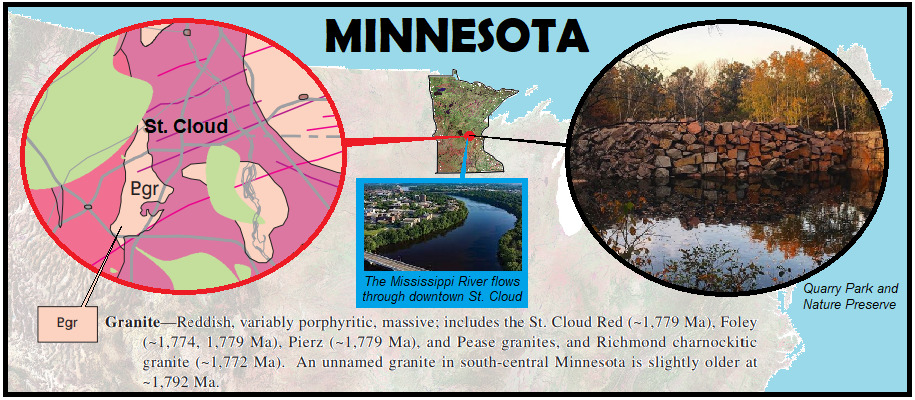
This city was once a hotbed of mining activity with 20 quarries, but operations there ceased in the 1950’s. The land has since been repurposed as a 684 acre park and nature preserve. The slabs that make up this memorial had to be replaced once, and again in 2011 the quarry was briefly opened again as a section of the red stone was needed to make repairs on a fountain in Iowa.
Like most all granites, St. Cloud Red Granite is an intrusive igneous rock that started out in a molten liquid state, then solidified as it cooled. The texture was determined by the rate in which it cooled.

The large crystals that you see in some granites are evidence that it cooled slowly from molten rock. That slow cooling occurred beneath the earth's surface and required a long period of time. Granite which cools closer to the earth's surface as when it is exposed to air or water, cools more rapidly and the result is a granite with crystals that are smaller. Texture of a rock refers to the details of its visible character, including the size and quality and interrelations of its grains and the fabric they form. Three common types of textures of granite are:
 * Pegmatitic - A pegmatitic texture is one in which the rocks crystals are about 1” long to larger.
* Phaneritic -A rock with phaneritic texture has crystal grains large enough to be distinguished with the eye.
* Aphanitic -Aphanitic texture consists of extremely small crystals.
Granites are rocks composed predominantly of the minerals feldspar, quartz, and biotite. Minerals are composed of one or more elements. St. Cloud Red Granite is a medium-grained hornblende-biotite granite, consisting of pink feldspar with a small admixture of pale-green feldspar, black hornblende, and subordinate biotite, together with both clear and smoky quartz. The chief feldspar is microcline. In places grains of hornblende and quartz form inclusions in the larger feldspar crystals.
 ELEMENTS: Elements are atoms, the smallest piece that we can split matter into. Different elements have different properties.
MINERALS: Elements often are stacked together with other elements to form minerals. Minerals are simply a collection of one or more elements that are stacked neatly together in a form called a crystal structure.
ROCKS: Rocks are a composed of one or more minerals. A rock can be made up of only one mineral or, as shown in the figure, a rock can be made up of a number of different minerals.
Granite comes in a wide variety of colors--greens, blues, reds, browns, yellows, black, white, gray, and more. The pink color of this is from the orthoclase in the stone. Orthoclase is a feldspar mineral and it is most widely known as the pink feldspar found in many granites. It is one of the most abundant rock-forming minerals of the continental crust.
LOGGING REQUIREMENTS:
To log this Earthcache: Read the geology lesson above. Answer all four questions posted below. Answers can be sent via e-mail or messenger contacts on my Geocaching profile within a reasonable time. Group answers are fine, but please include the members of the group you are with.
QUESTION 1. What kind of stone is granite? (CHOOSE ONE)
A) Sedimentary
B) Igneous
C) Metamorphic
QUESTION 2. INTRUSIVE rocks are formed from cooling ______.
A) Magma
B) Lava
QUESTION 3. What is the texture of the red granite wall?
A) Pegmatitic
B) Phaneritic
C) Aphanitic
QUESTION 4. Now look closely at the crystals that make up this St.Cloud Red Granite. Would you say the range of Orthoclase Feldspar in this stone is:
A) 75% to 100% Mostly pinkish Orthoclase Feldspar with barely any minerals showing.
B) 50% to 75% A more even "salt & pepper" mixture of Orthoclase Feldspar and Quartz.
C) 0% to 50% Rock is a majority of other darker Minerals and with less amounts of Orthoclase Feldspar and Quartz.
OPTIONAL PHOTO: Posting a photo that readily indicates that you (and anyone else logging the find) are at the location.
 Awesnap has earned GSA's highest level:

REFERENCES:
1. Structural and Ornamental Stones of Minnesota, O.Boweles, United States Geological Survey, Department of the Interior, Bulletin 663, pg 101- 102, 1918, pubs.usgs.gov
2. Granite Delay War Memorial Repairs, W.Risher, The Commercial Appeal, December 21, 1989, Section N, Pg 1, newspaper, newspapers.com
3. Architect Tell Purpose Behind Design of New War Memorial, P.Vanderwoodn, The Memphis Press-Scimitar, January 16, 1962, Pg 1, newspaper, newspapers.com
4. City Presents New Memorial to its Veterans, The Commercial Appeal, January 14, 1962, Pg 1, newspaper, newspapers.com
5. War Memorial to Become a Planter, The Commercial Appeal, January 22, 1970, Section C, Pg 1, newspaper, newspapers.com
6. Quarry Park's red granite used for fountain in Des Moines, K.Morohn, St. Cloud Times, July 30, 2011, Pg 1, newspaper, newspapers.com