This is an Earthcache – as such, there is no physical cache. Instead after examining the “Mediation Rock” sedimentary outcrop at the posted coordinates you will answer 8 questions and message me the answers you can log the find. This earthcache is located in Memorial Recreation Park with permission from Fredericksburg Park and Recreation. The park is open from 6am - 10pm daily. Street parking can be found on Washington Avenue and Kenmore Avenue.
 “Meditation Rock” was a favorite spot of Mary Washington’s where she would go to read her Bible and pray for the safety of her son George Washington during the Revolutionary war. She loved the spot here at the Kenmore Estate so much she chose a location nearby for her grave. In 1894 a 40 foot shaft of Vermont Granite from Barre was erected near her burial spot.
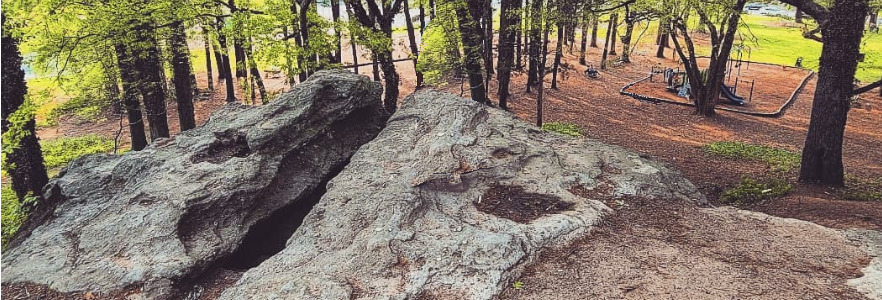
Although Fredericksburg is very close to the fall line, this park lies within the Piedmont Province. This is a geological province that is situated between the coastal plains to the east and the mountains to the west. It is mostly made up Metamorphic and Igneous rocks, with some Sedimentary rocks that were formed in Triassic Basins. These basins formed when the supercontinent Pangea split up around 250 million years ago.
DETRITAL SEDIMENTARY ROCKS
Detrital sedimentary rocks are those for which the material has been transported as solid particles. These particles themselves derived from either the physical weathering or chemical weathering of other rocks. After weathering processes break down other rocks into finer material, these particles are often transported and deposited as sediment. Over time, as more particles pile up, they go through processes of compaction and cementation that turn them into solid rock.

The texture of sedimentary rocks is described as "clastic." This means that they are composed of discrete particles that are compacted and cemented together. The composition of a clastic sedimentary rock refers to the uniformity in the composition of the rock's grains.
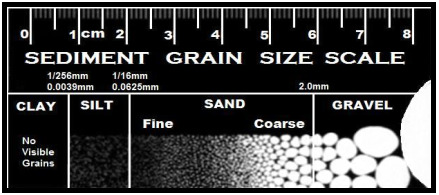
Sedimentary rocks are grouped according to grain size and what they are made of. Solid rock fragments in sediment are defined by the class size of the fragments (largest to smallest): BOULDERS, COBBLES, PEBBLES, SAND, SILT, and CLAY.
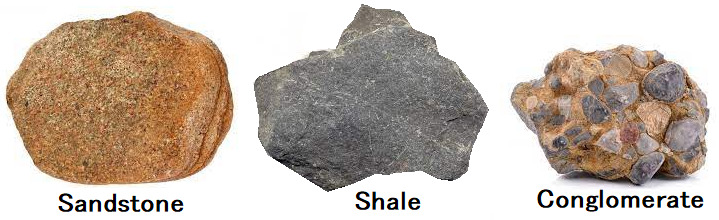
About 95% of all sedimentary rocks consists of sandstones, mudrocks, and carbonate rocks. Of these, mudrocks are most the most abundant sedimentary rock making up about 65% of them.
Mineral grains like quartz are more resistant to erosion than other minerals and make up many of the larger gravels in detrital sedimentary rocks. Most sediment that has been transported a long distance and undergone a lot of erosion will be mostly made of quartz, because other minerals such as feldspar will have broken down earlier in the journey.

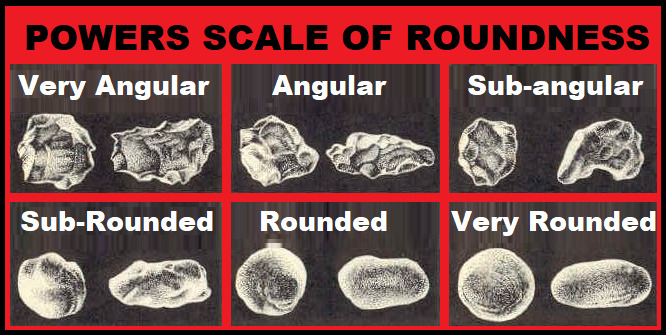
The shape of the particle takes place in the transportation process. Grains that travel get reduced in size due to abrasion. This results in the eventual rounding off of sharp corners and edges. The rounder the grain or rock, the longer it was in the transportation cycle. Geologist use scales like the one below to classify rock shapes.
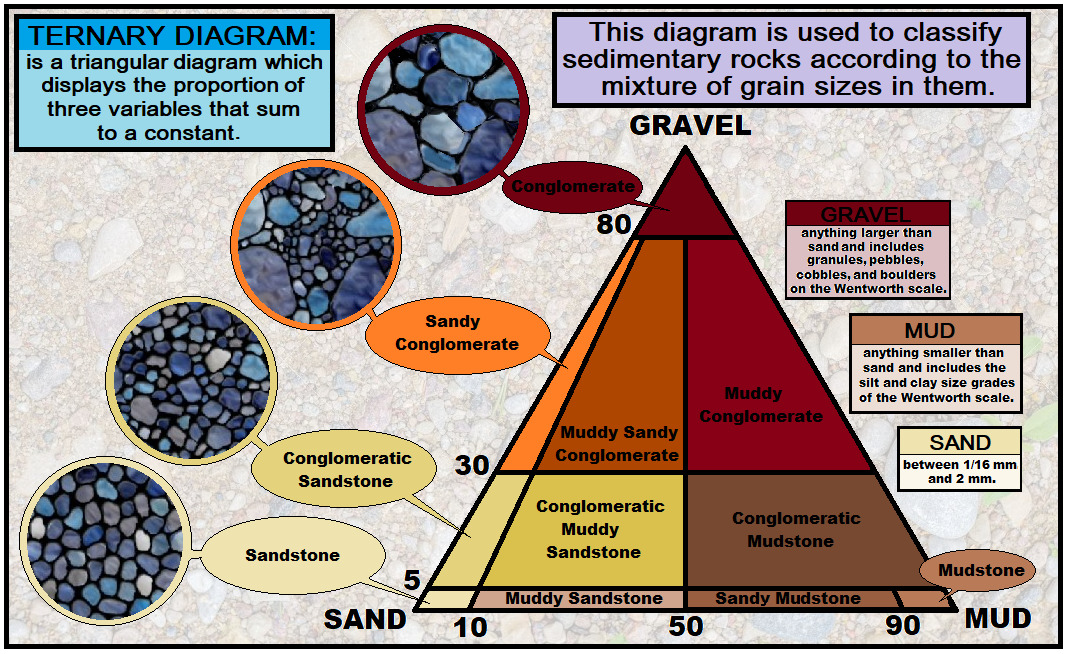
Sedimentary rocks that are made up of grains smaller than 2mm and above .0625 mm are known as sandstones. If the grains are smaller than .0625 mm it is considered a mudstone. Clastic sedimentary rocks in which a significant proportion of the clasts are larger than 2 mm are known as conglomerates. The difference in the composition between a sandstone and a conglomerate is that sandstone is composed of uniformed fine sand grains, while a conglomerate is mostly composed of large pebbles.
If a rock has gravel sized particles then one can use a ternary diagram to identify it's composition. Depending on the different amounts of gravel, sand, and silt the rocks condition changes. See graph below:
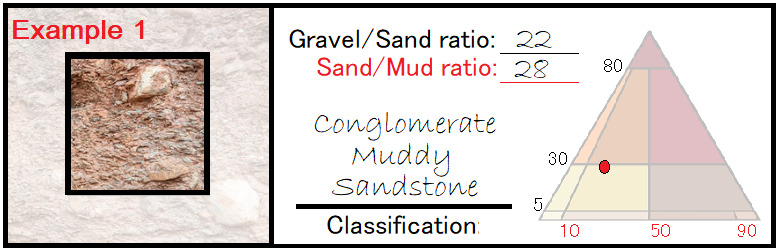
For example 1 below if you observe the particles in a 1” ft X 1” ft square it appears that the larger gravel grains take up about 22% of the area. From this sample only 28% of the small particles could not be identified as sand. If you plot those points on the above Ternary Diagram you can deduce that this is a Conglomerate Muddy Sandstone.
For example 2 below it appears that at least 81% of it is covered by gravel, and that you couldn't identify 5% as sand. After you plot this data on the Ternary Diagram you will find that this stone is classified as an Conglomerate.
 LOGGING REQUIREMENTS:
To log this Earthcache: Read the geology lesson above. Answer all eight questions posted below. Answers can be sent via e-mail or messenger contacts on my Geocaching profile within a reasonable time. Group answers are fine, but please include the names of the members of your group you are with in your message.
QUESTION 1. Even though Fredericksburg is very close to the fall line, what geological province is Memorial Recreation Park in? (from the reading)
Select a location on the rock where you can imagine about a 1” ft X 1” ft square. Observe the particles in your “square." For this exercise precise measurements are not required. If you don't have a ruler here are some things you can use to help determine the size:
A US 5 cent coin (a nickel) is 21.21 mm wide and 1,95 mm thick, the thickness of the average house key is about 2mm, and a US drivers license is usually 85.6 mm x 54 mm.
A grain of sand can be seen without the use of magnification, and anything smaller that you can't make out with your eye will be considered "mud." Also for this exercise you do not have to count every particle, just take an average.

QUESTION 2. For the smaller particles what is the MUD to SAND ratio of your square?
QUESTION 3. For the larger particles what is the GRAVEL to SAND ratio of your square?
QUESTION 4. If you were to plot your data into the ternary diagram from the reading, what classification would you give Meditation Rock?
Now pick one of the larger pebble/gravel sediments that you can find on the Meditation Rock.

QUESTION 5. What size is it? (CHOOSE ONE)
A) PEBBLE 4–64 mm (.15 inches to 2.5 inches)
B) COBBLE 64–256 mm (2.5 inches to 10 inches)
C) BOULDER >256 mm (10 inches or more)
QUESTION 6. Quartz in the Piedmont is normally milky white to gray. Do you think that the large particle you measured is quartz?
QUESTION 7. Using the Powers Scale of Roundness identify the shape of the gravel sediment you measured?
QUESTION 8. Does it's shape indicate that the gravel particle you measured was transported far and for a long period of time, or was it transported only a short distance?
OPTIONAL PHOTO Posting a photo that readily indicates that you (and anyone else logging the find) are at the location.

 Awesnap has earned GSA's highest level:

REFERENCES:
1. Geology of Fredericksburg,Virginia, J.Campbell, Field Methods 240, website, coursehero.com
2. 5 Sedimentary Rock Diagrams, A.Alden, May 21, 2019, website, thoughtco.com
3. Megascopic Study of Common Sedimentary Rocks, Experiment 7, website, egyankosh.ac.in
4. Introduction to QFL, A.Sutter, Sedimentology, Depositional Environments and Sequence Stratigraphy, Feb 2008, website, seddepseq.co.uk
5. All About Sediment Grain Size, A.Alden, June 20, 2019, website, thoughtco.com
6. Sedimentary Rocks, Radford University, 2014, website, sites.radford.edu