”Hoist the flag!”
A flag is a piece of fabric (most often rectangular or quadrilateral) with a distinctive design and colours. It is used as a symbol, a signalling device, or for decoration. The term “flag” is also used to refer to the graphic design employed, and flags have evolved into a general tool for rudimentary signalling and identification, especially in environments where communication is challenging (such as the maritime environment, where semaphore is used). The study of flags is known as "vexillology" from the Latin “vexillum”, meaning "flag" or "banner".
National flags are patriotic symbols with widely varied interpretations that often include strong military associations because of their original and ongoing use for that purpose. Flags are also used in messaging, advertising, or for decorative purposes.
Some military units are called "flags" after their use of flags. A flag (Arabic: لواء) is equivalent to a brigade in Arab countries. In Spain, a flag (Spanish: bandera) is a battalion-equivalent in the Spanish Legion.
History
The origin of the flag is unknown. In antiquity, field signs or standards were used in warfare that can be categorised as vexilloid or 'flag-like'. This originated in ancient Egypt or Assyria. Examples include the Sassanid battle standard Derafsh Kaviani, and the standards of the Roman legions such as the eagle of Augustus Caesar's Xth legion, or the dragon standard of the Sarmatians; the latter was let fly freely in the wind, carried by a horseman, but judging from depictions it was more similar to an elongated dragon kite than to a simple flag.
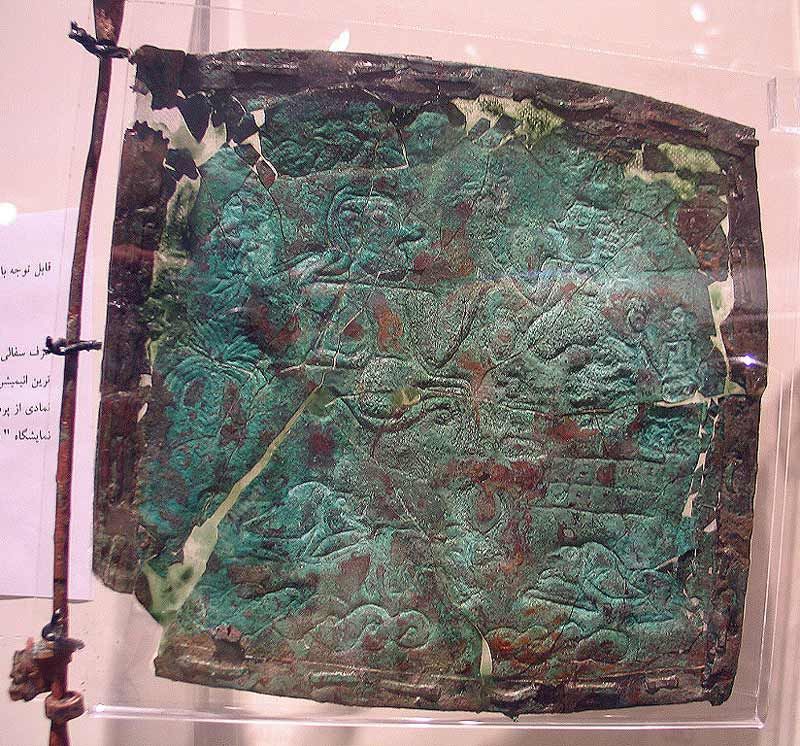
Bronze flag found in Shahdad, Iran, 3rd millennium BC
Flags as recognized today, made of a piece of cloth representing a particular entity, were invented in the Indian subcontinent or Chinese Zhou dynasty (1046-256 BCE). Chinese flags depicted colourful animals and royal flags were to be treated with a similar level of respect attributed to the ruler. Indian flags were often triangular and decorated with attachments such as yak's tail and the state umbrella. These usages spread to Southeast Asia as well, and were transmitted to Europe through the Muslim world where plainly coloured flags were being used due to Islamic proscriptions.
In Europe, during the High Middle Ages, flags came to be used primarily as a heraldic device in battle, allowing more easily to identify a knight than only from the heraldic device painted on the shield. Already during the high medieval period, and increasingly during the Late Middle Ages, city states and communes such as those of the Old Swiss Confederacy also began to use flags as field signs. Regimental flags for individual units became commonplace during the Early Modern period.
During the peak of the age of sail, beginning in the early 17th century, it was customary (and later a legal requirement) for ships to fly flags designating their nationality; these flags eventually evolved into the national flags and maritime flags of today. Flags also became the preferred means of communications at sea, resulting in various systems of flag signals.
Use of flags outside of military or naval context begins only with the rise of nationalist sentiment by the end of the 18th century, although some flags date back earlier. The flags of countries such as Austria, Denmark or Turkey emerged from the midst of legend while many others, including those of Poland and Switzerland, grew out of the heraldic emblems of the Middle Ages. The 17th century saw the birth of several national flags through revolutionary struggle. One of these was the flag of the Netherlands, which appeared during the 80-year Dutch rebellion which began in 1568 against Spanish domination.
Political change and social reform, allied to a growing sense of nationhood among ordinary people, led to the birth of new nations and flags all over the world in the 19th and 20th centuries.
National flags
One of the most popular uses of a flag is to symbolise a nation or country. Some national flags have been particularly inspirational to other nations, countries, or subnational entities in the design of their own flags.
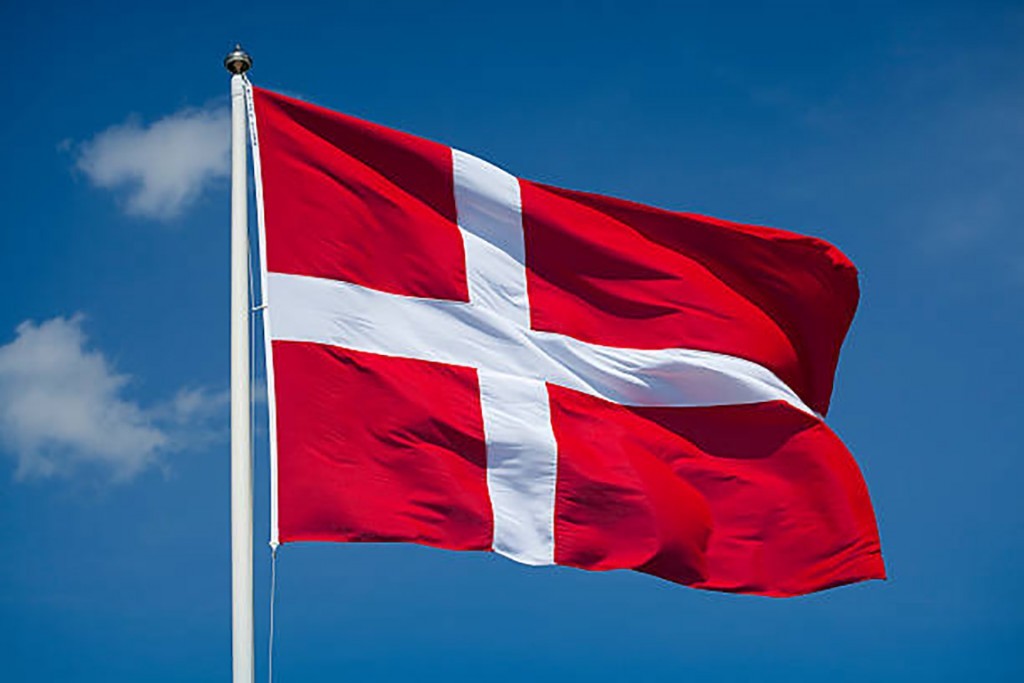
The Danish national flag (Dannebrog)
The flag of Denmark, the “Dannebrog,” is attested in 1478, and is the oldest national flag still in use. It inspired the cross design of the other Nordic countries: Norway, Sweden, Finland, Iceland, and regional Scandinavian flags for the Faroe Islands, Åland, Scania and Bornholm, as well as flags for the non-Scandinavian Shetland and Orkney.
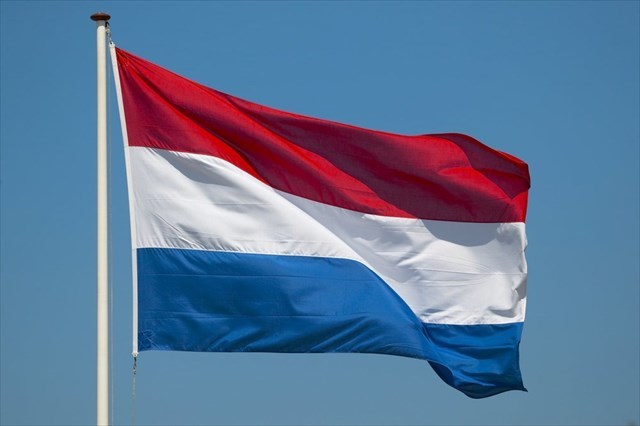
The Dutch national flag
The flag of the Netherlands is the oldest tricolour. Its three colours of red, white and blue go back to Charlemagne's time, the 9th century. The coastal region of what today is the Netherlands was then known for its cloth in these colours. Maps from the early 16th century already put flags in these colours next to this region, like Texeira's map of 1520. A century before that, during the 15th century, the three colours were mentioned as the coastal signals for this area, with the three bands straight or diagonal, single or doubled. As state flag it first appeared around 1572 as the Prince's Flag in orange–white–blue. Soon the more famous red–white–blue began appearing, becoming the prevalent version from around 1630. Orange made a comeback during the civil war of the late 18th century, signifying the orangist or pro-stadtholder party. During World War II the pro-Nazi NSB used it. Any symbolism has been added later to the three colours, although the orange comes from the House of Orange-Nassau.
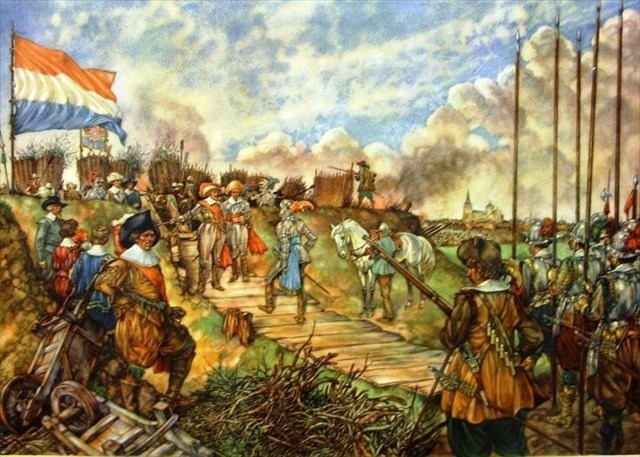
Prince's flag 1628
This use of orange comes from Nassau, which today uses orange-blue, not from Orange, which today uses red-blue. However, the usual way to show the link with the House of Orange-Nassau is the orange pennant above the red-white-blue. It is said that the Dutch Tricolour has inspired many flags but most notably those of Russia, New York City, and South Africa (the 1928–94 flag as well the current flag). As the probable inspiration for the Russian flag, it is the source too for the Pan-Slavic colours red, white and blue, adopted by many Slavic states and peoples as their symbols; examples are Slovakia, Serbia, and Slovenia.
The cache
The cache is placed at a logical place 😊. You can’t miss it. You are looking for a glass pot with a plastic lid. Inside you will find a logsheet and a pencil (take care of the pot – it’s made of glass). Put the cache back the way you found it (or better if it was not put the right way).
Though it can be really quiet here, there are also moments there are muggles around. So use stealth when needed…
Happy caching!
Marrakesj