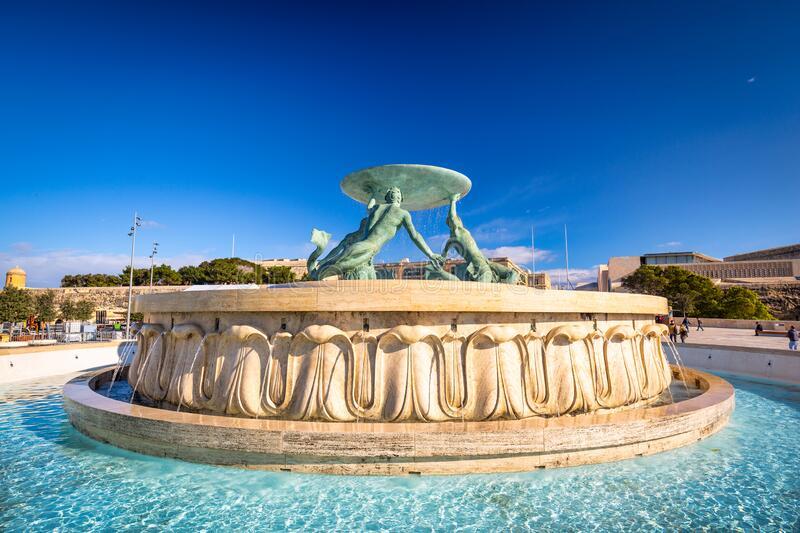
The Tritons’ Fountain is a fountain located just outside the City Gate of Valletta, Malta. It consists of three bronze Tritons holding up a large basin, balanced on a concentric base built out of concrete and clad in travertine slabs. The fountain is one of Malta's most important Modernist landmarks.
The base of the fountain was originally designed with a quadripartite plan inspired by Rome's Fontana delle Naiadi, but this was later changed to a tripartite concentric plan. The base is constructed out of reinforced concrete, and it consists of four concentric water basins. The exterior is clad with a total of 730 tons of travertine slabs from Tivoli. The outer slabs of the vasca intermedia are decorated with a relief representing foliage.
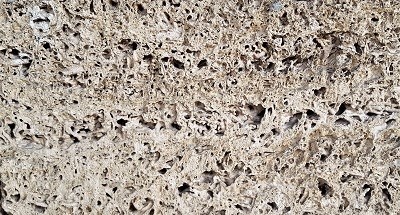
Travertine is a form of limestone deposited by mineral springs, especially hot springs. Travertine often has a fibrous or concentric appearance and exists in white, tan, cream-colored, and even rusty varieties. It is formed by a process of rapid precipitation of calcium carbonate, often at the mouth of a hot spring or in a limestone cave. In the latter, it can form stalactites, stalagmites, and other speleothems. It is frequently used in Italy and elsewhere as a building material. Travertine is a terrestrial sedimentary rock, formed by the precipitation of carbonate minerals from solution in ground and surface waters, and geothermally heated hot springs. Similar (but softer and extremely porous) deposits formed from ambient-temperature water are known as tufa.
Modern travertine is formed from geothermally heated supersaturated alkaline waters, with raised pCO2. On emergence, waters degas CO2 due to the lower atmospheric pCO2, resulting in an increase in pH. Since carbonate solubility decreases with increased pH, precipitation is induced. Precipitation may be enhanced by factors leading to a reduction in pCO2, for example increased air-water interactions at waterfalls may be important as may photosynthesis.
Both calcite and aragonite are found in hot spring travertines; aragonite is preferentially precipitated when temperatures are hot, while calcite dominates when temperatures are cooler. When pure and fine, travertine is white, but often it is brown to yellow due to impurities.
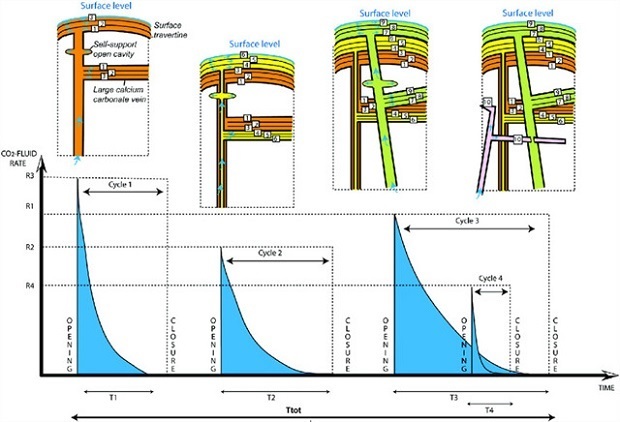
Conceptual model of travertine development in relation to fault opening/sealing episodic cycles. The travertine mound development is function of the rate and duration of the leaky fluid flow coming from the fault. Here four cycles are shown with associated mineralization (orange in cycle 1, yellow in cycle 2, green in cycle 3 and pink in cycle 4). Each leakage cycle gives rise to three ways of mineralization: (1) vertical to sub-horizontal veins that occur in self-supporting open cavities at depth and are sealed with centripetal growth deposition. (2) Surface travertine with stratigraphic order deposition if the fluid pressure and the amount of fluid flow are sufficient for the fluid to escape up to the surface, (3) Large horizontal compact veins with top-to-the-bottom growth driven by crystallization force at depth up to 10-20 m depth in travertine or sandstone.
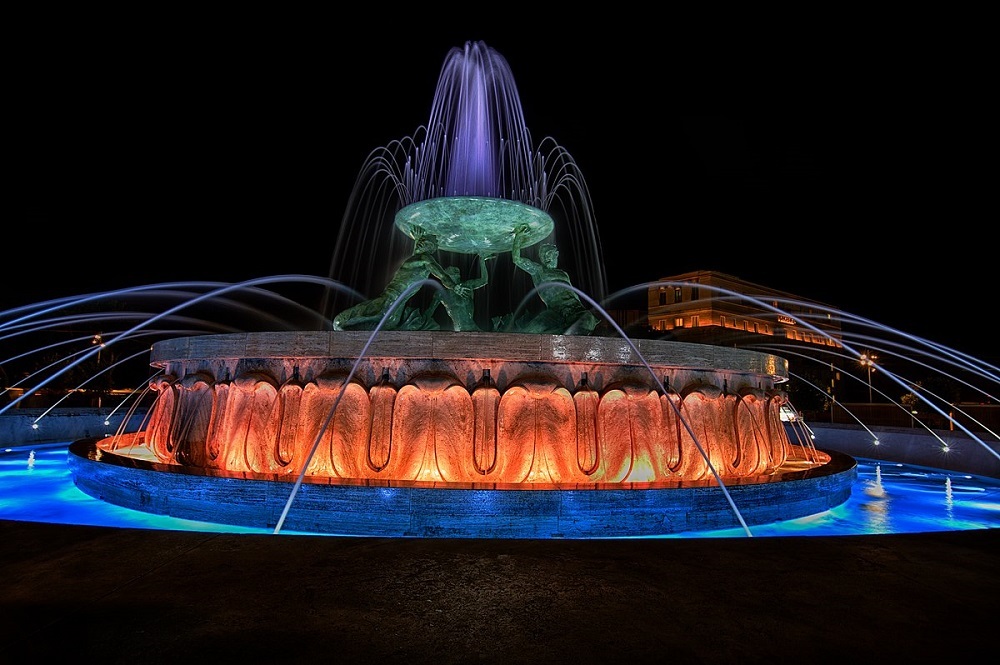
Travertine from the Fountain is from Italy, well-known travertine quarrie in Tivoli and, where is the most important quarries since Ancient Roman times. The Guidonia quarry has major historic value, as it was one of the quarries where Gian Lorenzo Bernini selected material from which to build the famous Colonnade of St. Peter's Square in Rome (colonnato di Piazza S. Pietro) in 1656-1667. Michaelangelo also chose travertine as the material for the external ribs of the dome of St Peter's Basilica.Travertine derives its name from the former town, known as Tibur in ancient Roman times. The ancient name for the stone was lapis tiburtinus, meaning tibur stone, which was gradually corrupted to travertine.

How to log this cache:
To log this cache, take a picture of travertine from the Triton Fountain at the coordinates. You also need to answer the following questions and answers send me to email in the profile:
- From which country was imported the Travertine used in the fountain?
- What is main colour of Travertine rock used on fountain?
- What is structure of Travertine rock used on fountain?
- Measure and tell me the size of the smallest and largest pores on the fountain?
- Can you see fossils on Travertine used in fountain? What is their shape?
- Please post a photo of yourself, or GPS with the Travertine rock from fountain.
Feel free to log this cache. You do not need to wait for permission to log. If your answers are not correct, incomplete, I will contact you by e-mail. But if your e-mail is not coming to me within 3 days from your log, I will delete your log without notice.

Kif tilloggja din il-cache:
Biex tilloggja din il-cache, ħu stampa tat-travertina mill-Funtana tat-Tritoni fil-koordinati. Trid ukoll twieġeb il-mistoqsijiet u t-tweġibiet li ġejjin ibgħatli email fil-profil:
- Minn liema pajjiż ġie importat it-Travertin użat fil-funtana?
- X'inhu l-kulur prinċipali tal-blat tat-Travertin użat fuq il-funtana?
- X'inhi l-istruttura tal-blat tat-Travertina użata fuq il-funtana?
- Kejjel u għidli d-daqs tal-iżgħar u l-akbar pori fuq il-funtana?
- Tista 'tara fossili fuq Travertina użati fil-funtana? X'inhi l-forma tagħhom?
- Żid ir-ritratt tiegħek quddiem il-funtana tat-Travertina.
Ħossok liberu li tilloggja din il-cache. M'għandekx bżonn tistenna l-permess biex tilloggja. Jekk it-tweġibiet tiegħek mhumiex korretti, mhux kompluti, nikkuntattjak bl-e-mail. Imma jekk l-e-mail tiegħek ma tiġix għandi fi żmien 3 ijiem mill-log tiegħek, jiena nħassar il-log tiegħek mingħajr avviż.
