To
log this earthcache, send me an email with the answer
to the following questions:
1. What were
the main minerals of greatest interest in these
mines? What elements make up pyrite?
2. How does the pyrite appear in
this mine? By the components that accompany the
pyrite in this mine, were they formed in a high or
low temperature hydrothermal environment?
3. Locate the place indicated by
the spoiler photo, can you see traces of rust?
Looking closely at the vein, samples of pyrite can
be seen, indicate its approximate thickness
4. Add a photograph of you in the
premises, or another in which you can see an object,
or your nick on a piece of paper
If you believe you have successfully completed this
Earth Cache goals and has already sent to me all the
requirements as requested, Please, feel free to log
it as found. Later i will verify the requirements
sent and, if necessary, contact you in order to make
the necessary corrections to your log.
|
|
Location
The mine is located in the Ourensano de A Gudiña
municipality, in the small village of Barxa and next to the
Ribeira de Pentes river, here we find a fascinating place where
prisoners of the civil war and locals worked in the extraction of
tungsten and tin, minerals that the Germans paid four times the
official price, women and men of the place found in the extraction
of tungsten a way to survive in the middle of the famine due to
the post-war period, the hard work and the discovery over time
that the stones of quartz when extracting tungsten released
arsenic deteriorated the health of the miners due to their
poisoning and many of these people died in a few years.
Geomorphology
These mines were exploited from the 18th century until the
beginning of the 1960s. The quartz veins contain main metallic
minerals such as cassiterite, arsenopyrite and pyrite; and as
accessory minerals wolframite and iron hydroxides.
In the A Barxa area there was interest in the elements tin and
tungsten, which were incorporated into the metallic minerals
within the quartz veins, and associated with the location of the
granite
Pyrite
Pyrite is a mineral from the group of sulfides whose chemical
formula is FeS2. It is made up of 53.48% sulfur and 46.52% iron.
Often solid, fine granular, sometimes radiated subfibrous;
reniform, globular, stalactitic. Insoluble in water, and magnetic
by heating. Its name derives from the Greek root pyr (fire), since
when rubbed against metals it emits sparks, which intrigued the
ancient world. Also known as "fool's gold", "fool's gold" or "poor
man's gold" because of its close resemblance to gold. Pyrite is an
extremely common mineral, and fine examples exist in many
localities in everyone.
Pyrite occurs in a wide variety of geological settings, from
igneous, sedimentary, and metamorphic rocks to hydrothermal
mineral deposits, as well as in coal beds and as a replacement
mineral in fossils. Pyrite can be disseminated throughout igneous
rock or concentrated in layers, depending on the mechanism of
deposit and the environment
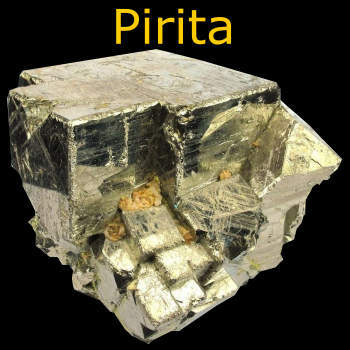
Aspect
It has a cubic shape, the faces sometimes cemented, also often in
octahedrons, pyritohedrons (twelve pentagonal faces) and rarely
icosahedrons (twenty triangular faces). Often twinned, massive,
radiated, granular, its color is brassy yellow and its luster is
metallic, hardness: it is hard 6-6.5. It does not exfoliate, and
the fractures are conchoidal (shell-shaped). Stripe color:
blackish green, diaphaneity: opaque. Pyrite melts easily, 2.5-3 on
the Kobell scale, and releases sulfur vapors, leaving pyrrhotite
as a solid residue.
Origin, formation and geological environment
Pyrite is a mineral that can occur in various geological
environments, however, the most common are sedimentary
environments associated with the decomposition of organic matter
and hydrothermal environments in a wide range of temperatures, in
addition, it can form directly from magma crystallization.
Pyrite in sedimentary environment
Conditions include sediments rich in decaying organic material,
iron supply, sulfur supply, and all in generally shallow marine
oxygen-poor conditions or environment.
Let's understand a bit, the organic decomposition in these
sediments consumes oxygen and releases sulfur that reacts with the
iron existing in the environment and forms pyrites.
For this reason it is common to find this mineral in rocks with a
high percentage of organic matter such as shales and siltstones
(black and gray shales), slates and phyllites (black and gray,
that is, graphitous) and limestones (black and gray). Furthermore,
it is thanks to this process that pyrite fossils can be found.
Hydrothermal pyrite
When pyrite has a hydrothermal origin, it does not represent a
mineral that forms at the same temperature, rather, it is a
mineral that occurs in hydrothermal environments from low to high
temperatures. Therefore, it is associated with different types of
deposits, such as high sulphidation epithermals, volcanogenic
massive sulphides (VMS), porphyry copper deposits and skarns.
To define the temperature range and the associated deposit, the
minerals that occur together must be seen.
For example, if it occurs in association with argentite, cinnabar,
and stibnite, it would be a low-temperature, shallow-depth
environment.
But if it occurs in association with cassiterite, magnetite,
chalcopyrite, wolframite, molybdenite, it would be in a deep,
high-temperature hydrothermal environment.
In addition, when the pyrites that have formed in deep conditions
are exposed to the surface, it is common for gossans or iron cover
to form, which is nothing more than the oxidation of pyrites. This
oxidation produces a high content of ferrihydrite or limonite.
In calcite and quartz veins, pyrite oxidizes to iron oxides or
hydroxides such as limonite, an indicator that pyrite is present
in the underlying rock. These oxidized areas are called "gossan",
which appear as oxidized areas on the surface. Gossans can be a
good drill target for gold and other precious or base metals
|