
Welcome to Joaquin Miller Park! The park is dedicated to the life and legacy of poet Cincinnatus Heine Miller (pen name Joaquin Miller), nicknamed the “Poet of the Sierras.”
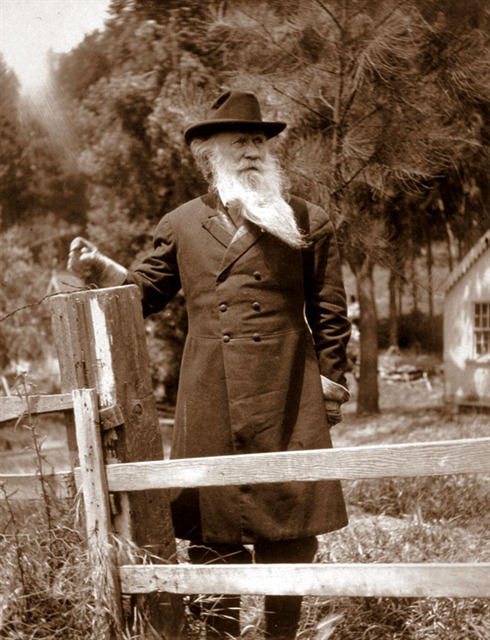
The park not only showcases a statue of Miller and monuments and an abbey Miller built himself, but also boasts an impressive range of rock specimens!
Today we will be touring the park, looking for some different examples of the geology that underlies this park. A lot of these rock types come from being pushed up by millions of earthquakes (which is a simple way to explain in part California’s complex geologic history!). Each type of rock we’ll see today plays a special role in the soil, affecting mineral concentrations which have implications for certain plants and animals. Watch the ground as you hike around the park, even when in-between stages of this earthcache! There is a lot to see in locations that are not specifically highlighted here. REMINDER: collecting or breaking rocks in the park is not permitted.
STAGE 01: Listed Coordinates
The cache is listed at a good starting point for this earthcache. Here you will find a nice informational sign about the rock types and locations we will be visiting today. This information has been worked into this cache, so it is not imperative that you visit this location. I know the park has multiple parking lots that are not super close to this point, so you do not have to visit this waypoint if it is too far of a walk. Additional note: you do not have to visit the following waypoints in any specific order, but STAGES 02-05 are mandatory for this cache. STAGE 01 (listed coordinates) is the only waypoint that does not have to be visited. Therefore, there are no logging requirements for STAGE 01.
STAGE 02: Serpentine
Serpentine is a blue-green metamorphic rock that is formed from hydration, or the addition of water to magnesium silicates. This happens at convergent plate boundaries where an oceanic plate is forced down into the mantle. Nice examples of serpentine can be found on the slopes around the Pyramid to Moses. It is the rock shards that are poking out through the grass/dirt on the sloped terrain around the pyramid. This should be easy to spot. Touch the rocks. Are the rocks smooth or rough to the touch?
STAGE 03: Blueschist
Blueschist is a metamorphic rock formed at high-pressure, low-temperature conditions. Blueschist get its colors from minerals called glaucophane and garnet. Large boulders of blueschist can be found around the entrance to the Lookout Point. See if you can identify any garnet in the specimen. What color is it? Hint: visiting the signboard at STAGE 01 will offer a clue. If you can not identify any garnet, report the dominant color of the rock specimen you look at.
STAGE 04: Basalt
Basalt is an igneous rock rich in magnesium and iron. It is formed by the rapid cooling of low-viscosity lava. Basalt actually underlies more amount of Earth than any other rock. However, most of the basalt bedrock is in oceanic basins; it is actually much less common up on the continents themselves. Basalt can be located here in the roadcut near the Browning Monument. Take a close look at the basalt. Dried lava is usually black/gray. Is that the case here? What would contribute to other colors you may see in the rock here?
STAGE 05: Joaquin Miller Formation
The Joaquin Miller Formation is a relatively young formation of bedrock, created around 70 to 95 million years ago. It is a formation of sedimentary rock belonging to the more expansive Great Valley Complex. It is comprised of fined-grained shale, made up of what was once sand and clay. It weathers very easily. The edge of the formation stretches into the park in this location north of Palo Seco Creek, yet it is harder to find than the other waypoints. Do your best to locate a sample near the creek(s). It will appear as a crumbly, ligh-to-dark brown, layered exposure of rock. If located, run your hand along it gently (without any force). What is the consistency of the rock?
This concludes our tour of geology at Joaquin Miller Park. Send me a message with the name of this cache and the answers to the questions posed at each waypoint. Post all the pictures you want! Thanks for visiting!
Sources:
-Informational signs placed in Joaquin Miller Park by Vice Mayor Jean Quan
-Andrew Alden, the man behind oaklandgeology.com, Geocaching user oaklandgeology
-Karen Paulsell, Friends of Sausai Creek, map
-Rachel Blau, panel design
-Friends of Joaquin Miller Park
-oaklandnet.com/joaquinmillerpark
-https://en.wikipedia.org/wiki/Joaquin_Miller
-https://oaklandgeology.com/2010/09/13/basalt-at-joaquin-miller-park/
-https://oaklandgeology.com/2010/05/06/serpentinite-of-visionary-ridge-joaquin-miller-park/
-https://en.wikipedia.org/wiki/Serpentine_subgroup
-https://www.britannica.com/science/serpentine-mineral
-https://geology.com/minerals/serpentine.shtml
-https://www.alexstrekeisen.it/english/meta/blueschist.php
-https://en.wikipedia.org/wiki/Basalt
-https://geology.com/rocks/basalt.shtml
-https://oaklandgeology.com/2010/03/18/joaquin-miller-formation/
-https://pubs.usgs.gov/of/1990/0226/report.pdf