Skip to content

Surgencia artesiana y kárstica de Cella EarthCache

Hidden : 2/5/2023
Difficulty:
2.5 out of 5
Terrain:
1.5 out of 5

Size: Size:   other (other)

Join now to view geocache location details. It's free!

Watch

How Geocaching Works

Please note Use of geocaching.com services is subject to the terms and conditions in our disclaimer.

Geocache Description:


Surgencia artesiana y kárstica de Cella


Español


Para registrar este earthcache, enviame um correo eletrónico com la respuesta a las seguintes preguntas:

  1. Explica muy brevemente que es necesario para que pueda existir un aquifero desde el punto de vista geologico. ¿Que dos tipos de rocas forman la unidad gelogica que forma este acuífero
  2. Clasifica este acuífero según las 4 caracteristicas indicadas en el listing
  3. ¿Cuantas salidas de agua puedes ver en la "piscina"?
  4. Añade una fotografia tuya en el local, u otra en la que se pueda ver algún objeto, o tu nick en un papel

 
-Si crees que as concluido con exito los objetivos de este Earth Cache, y me ha enviado todas las respuestas solicitadas, puede hacer el log. Luego yo comprobaré que son correctas, y si hay cualquier problema me pondre en contacto para arreglarlo.

-Logs sin respuestas enviadas previamente, seran borrados sin aviso

Localización

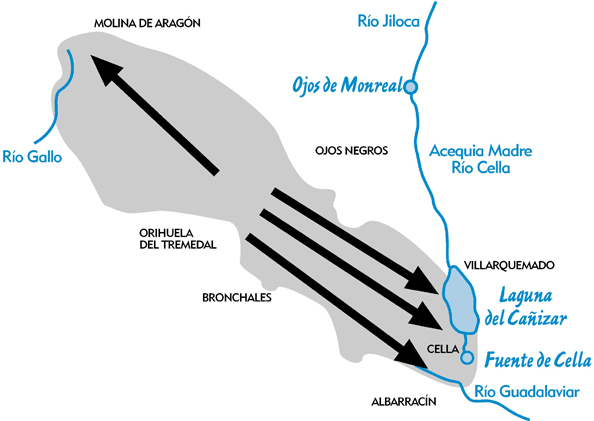
En la población de Cella, cercana a la capital turolense, podemos encontrar uno de los fenómenos hidrológicos más sorprendentes de Aragón. El agua que aflora en la fuente procede de un pozo artesiano, cuyo acuífero transporta las aguas recogidas a kilómetros de distancia. Se alimenta de las precipitaciones caídas en una superficie de 1.350 km2 entre Cella y Molina de Aragón, y entre Ojos Negros y Orihuela del Tremedal. El agua de lluvia y nieve recogida en toda esta extensión aflora en cuatro puntos: el río Gallo aguas arriba de Molina de Aragón, el río Guadalaviar aguas abajo de Albarracín, la laguna del Cañizar y la fuente de Cella. Se introduce en la tierra porosa que cubre esta zona adentrándose a varios cientos de metros de profundidad. A pesar de las precipitaciones abundantes en la superficie, los barrancos tienen poco desarrollo debido a la rápida desaparición del agua, y la vegetación de la superficie es propia de zonas más áridas. En la zona de infiltración también destacan la formación de dolinas (grandes depresiones) ya que el agua origina la disolución de las calizas, haciendo desaparecer cada año cientos de toneladas de roca disueltas por el efecto del agua

La Fuente de Cella tiene forma elíptica con un diámetro mayor de 34,83 metros y un diámetro menor de 24,84 metros. El perímetro es de 130 metros y está rodeado por un pretil de piedra de sillería, en un extremo se da salida al agua por medio de un paso cubierto por una ermita, dedicada a San Clemente. La profundidad es de 9 metros en la orilla y 11,5 metros en el centro y el caudal medio que mana este pozo es de unos 3.500 litros por segundo.

La fuente es el origen de tres acequias que riegan 7 pueblos. Las acequias son la «acequia Madre», la «acequia del Caudo» y la «acequia de la Granja». Los pueblos que aprovechan estas aguas para el regadío son Cella, Villarquemado, Santa Eulalia, Torremocha, Torrelacarcel, Alba y Villafranca. El regadío está escrupulosamente regulado por las «Reales Ordenanzas y Providencias de 1772».


Acuiferos

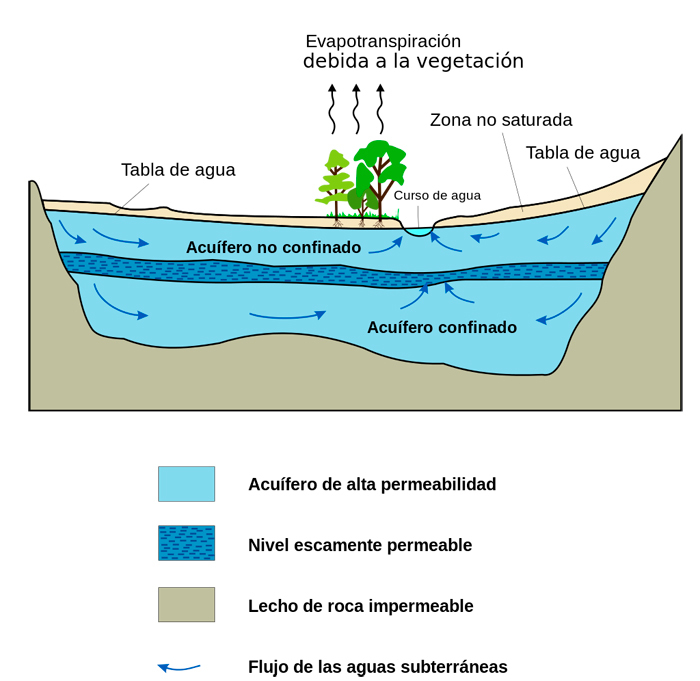
Un acuífero se define como una formación geológica que está constituida por una o más capas de rocas, capaz de almacenar y ceder el agua. Se sitúa en el suelo en la zona denominada “zona saturada”. Los acuíferos se caracterizan por poseer una permeabilidad y una porosidad determinada, los cuales son parámetros que definen las características hidráulicas del acuífero, es decir, el movimiento del agua depende del tipo de rocas del suelo.

Los acuíferos se forman gracias a las aguas pluviales que se infiltran en el suelo hasta llegar a estratos impermeables que impidan el paso del agua y se deposite entre las rocas subterráneas. Las aguas pluviales que se infiltran en el suelo permiten recargar de agua las rocas porosas de los acuíferos.

Tipos de acuíferos

Los acuíferos se pueden clasificar de varias maneras según el criterio que se utilice:

Características litológicas: detríticos y carbonatados.

Tipo de huecos: poroso, kárstico y/o fisurado.

Presión hidrostática: libres o no confinados (en contacto con el aire y separado por la zona no saturada), confinados o cautivos (sometidos a una presión superior a la atmosférica y en zona totalmente saturada) y semiconfinados (algunas capas confinadas son semipermeables).

Extensión: acuíferos locales o puntuales (pequeña extensión) y acuíferos regionales (muy extensos)

Acuifero de Cella-Molina de Aragón


El origen del agua que mana en la Fuente de Cella se enmarca dentro del contexto una gran unidad hidrogeológica denominada "Cella-Molina de Aragón". Simplificando la compleja estructura de esta gran unidad, se puede afirmar que se trata de un gran acuífero formado por las calizas jurásicas, que presentan alta permeabilidad por fisuración y karstificación. El sustrato impermeable lo constituyen las arcillas y yesos del Triásico Inferior.

Haciendo una analogía que facilite su entendimiento se puede considerar a esta unidad hidrogeológica como una gran esponja con una superficie agua de 1350 km2 que se extiende desde Cella al Sureste, hasta Molina de Aragón al Noroeste


English

To log this earthcache, send me an email with the answer to the following questions:

   
1. Explain very briefly what is necessary for an aquifer to exist from a geological point of view. What two types of rocks form the geological unit that forms this aquifer?
    2. Classify this aquifer according to the 4 characteristics indicated in the listing
    3. How many water outlets can you see in the "pool"?
    4. Add a photograph of you in the premises, or another in which you can see an object, or your nick on a piece of paper
 

If you believe you have successfully completed this Earth Cache goals and has already sent to me all the requirements as requested, Please, feel free to log it as found. Later i will verify the requirements sent and, if necessary, contact you in order to make the necessary corrections to your log.


Location


In the town of Cella, close to the Teruel capital, we can find one of the most surprising hydrological phenomena in Aragon. The water that emerges at the source comes from an artesian well, whose aquifer transports the water collected from kilometers away. It feeds on rainfall that falls on an area of ​​1,350 km2 between Cella and Molina de Aragón, and between Ojos Negros and Orihuela del Tremedal. The rainwater and snow collected in this entire area emerge at four points: the Gallo river upstream of Molina de Aragón, the Guadalaviar river downstream of Albarracín, the Cañizar lagoon and the Cella spring. It enters the porous earth that covers this area, penetrating several hundred meters deep. Despite the abundant rainfall on the surface, the ravines have little development due to the rapid disappearance of water, and the vegetation on the surface is typical of more arid areas. In the infiltration zone, the formation of sinkholes (large depressions) also stands out, since the water causes the dissolution of the limestone, making hundreds of tons of dissolved rock disappear every year due to the effect of the water.

The Cella Fountain has an elliptical shape with a greater diameter of 34.83 meters and a smaller diameter of 24.84 meters. The perimeter is 130 meters and is surrounded by a parapet of ashlar stone, at one end the water exits through a passage covered by a hermitage, dedicated to San Clemente. The depth is 9 meters on the shore and 11.5 meters in the center and the average flow from this well is about 3,500 liters per second.

The source is the origin of three ditches that irrigate 7 towns. The irrigation ditches are the “Acequia Madre”, the “Acequia del Caudo” and the “Acequia de la Granja”. The towns that take advantage of these waters for irrigation are Cella, Villarquemado, Santa Eulalia, Torremocha, Torrelacarcel, Alba and Villafranca. Irrigation is scrupulously regulated by the "Royal Ordinances and Providences of 1772".
Aquifers


An aquifer is defined as a geological formation that is made up of one or more layers of rocks, capable of storing and releasing water. It is located in the soil in the area called "saturated zone". Aquifers are characterized by having a certain permeability and porosity, which are parameters that define the hydraulic characteristics of the aquifer, that is, the movement of water depends on the type of soil rocks.
Aquifers are formed thanks to rainwater that infiltrates into the ground until it reaches impermeable strata that prevents the passage of water and deposits between the underground rocks. The rainwater that infiltrates into the ground allows the porous rocks of the aquifers to be recharged with water.

Types of aquifers

Aquifers can be classified in several ways depending on the criteria used:

Lithological characteristics: detrital and carbonate.

Type of holes: porous, karstic and/or fissured.

Hydrostatic pressure: free or unconfined (in contact with air and separated by the unsaturated zone), confined or captive (subjected to a pressure higher than atmospheric and in a fully saturated zone) and semi-confined (some confined layers are semi-permeable).

Extension: local or specific aquifers (small extension) and regional aquifers (very extensive)


Cella-Molina de Aragon aquifer


The origin of the water that flows from the Fuente de Cella is framed within the context of a large hydrogeological unit called "Cella-Molina de Aragón". Simplifying the complex structure of this great unit, it can be stated that it is a large aquifer formed by Jurassic limestone, which presents high permeability due to fissuring and karstification. The impermeable substrate is made up of clays and gypsum from the Lower Triassic.

Making an analogy that facilitates its understanding, this hydrogeological unit can be considered as a large sponge with a water surface of 1350 km2 that extends from Cella to the Southeast, to Molina de Aragón to the Northwest.


Fuentes:

El cado de Chorche
Lugar de interes Geológico
IGME: Sitemas acuiferos, Cuenca del Ebro
Iagua


Additional Hints (No hints available.)