Great Aussie Icon Hunt – A wander in Time & Space.
Round and round they go, and have done such in Australia for almost 2 centuries.
Yes I’m talking about the Windmill – an Aussie Icon seen all over Australia.
Windmill – Aussie Icon
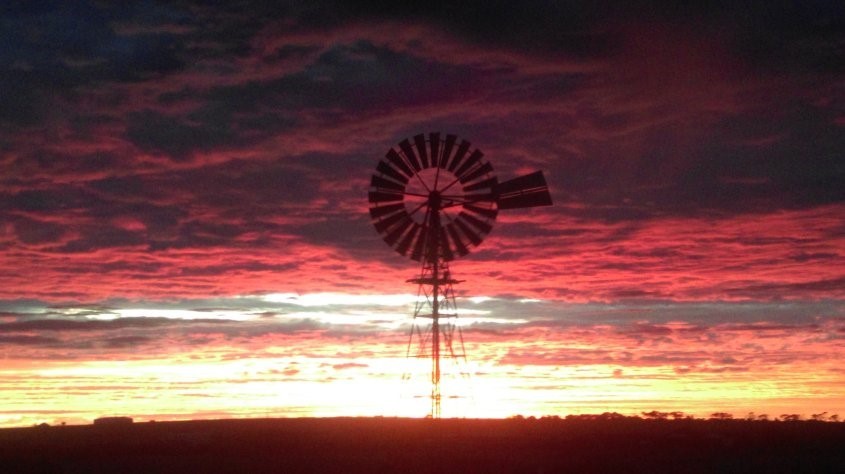
This is one of a series of great Aussie Icon hunts. Travelling around Australia you undoubtedly see windmills: Dead ones, Rusted ones, High ones, Spinning ones, Coloured ones, Huge ones, all seen along the roadside, adjacent farm houses, along river banks, in gullies, in country town parks, in museums, in fact wherever…
This series of geocaches is designed to help you when travelling around Australia, by breaking up the trip, and to discover a bit of a history lesson as you seek windmills in locations with a written history of the windmill and/or adjacent local region.
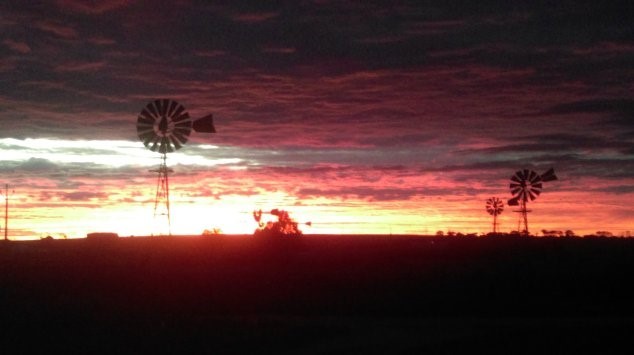
This particular Aussie Icon Hunt, A wander in Time & Space will do just that – be a wander in Time & Space.
Enjoy the trip and enjoy different parts of Australia – some parts you have probably never heard of before. You will find windmills galore: I might even let you climb one (beware of nesting magpies). You will find some weird windmills and some with an interesting past.
Have fun and enjoy the trip……. and, find some reading matter to take with you before you begin your travels.
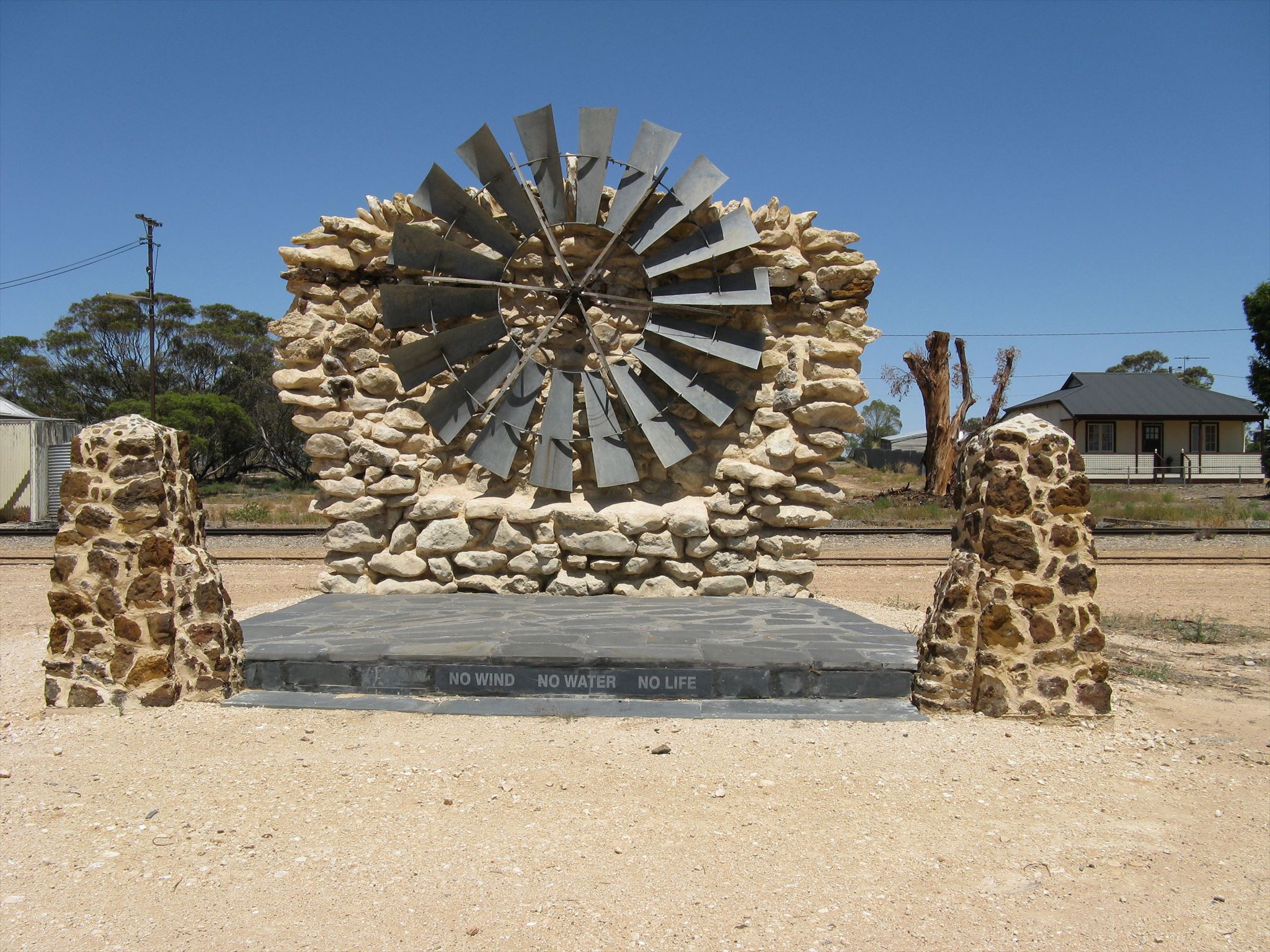
All windmills are accessible by car, bicycle or other means of wheeled transport; a floating device or wading may be required if environmental conditions dictate.
When you calculate the next windmill’s location, yes, its there! A ”Windmill” is quite varied in its shape, form, and er, ………, “appearance”…..!!
Google & Google Street & Satellite view could be useful .........
Use them (& your time machine) and all is revealed, 100%.
Counting the blades? As with all windmills, from time to time a blade may fall off and you may see the windmill before the blade/s is replaced. So, count how many blades should be there.
Yes. ALL OF THEM!
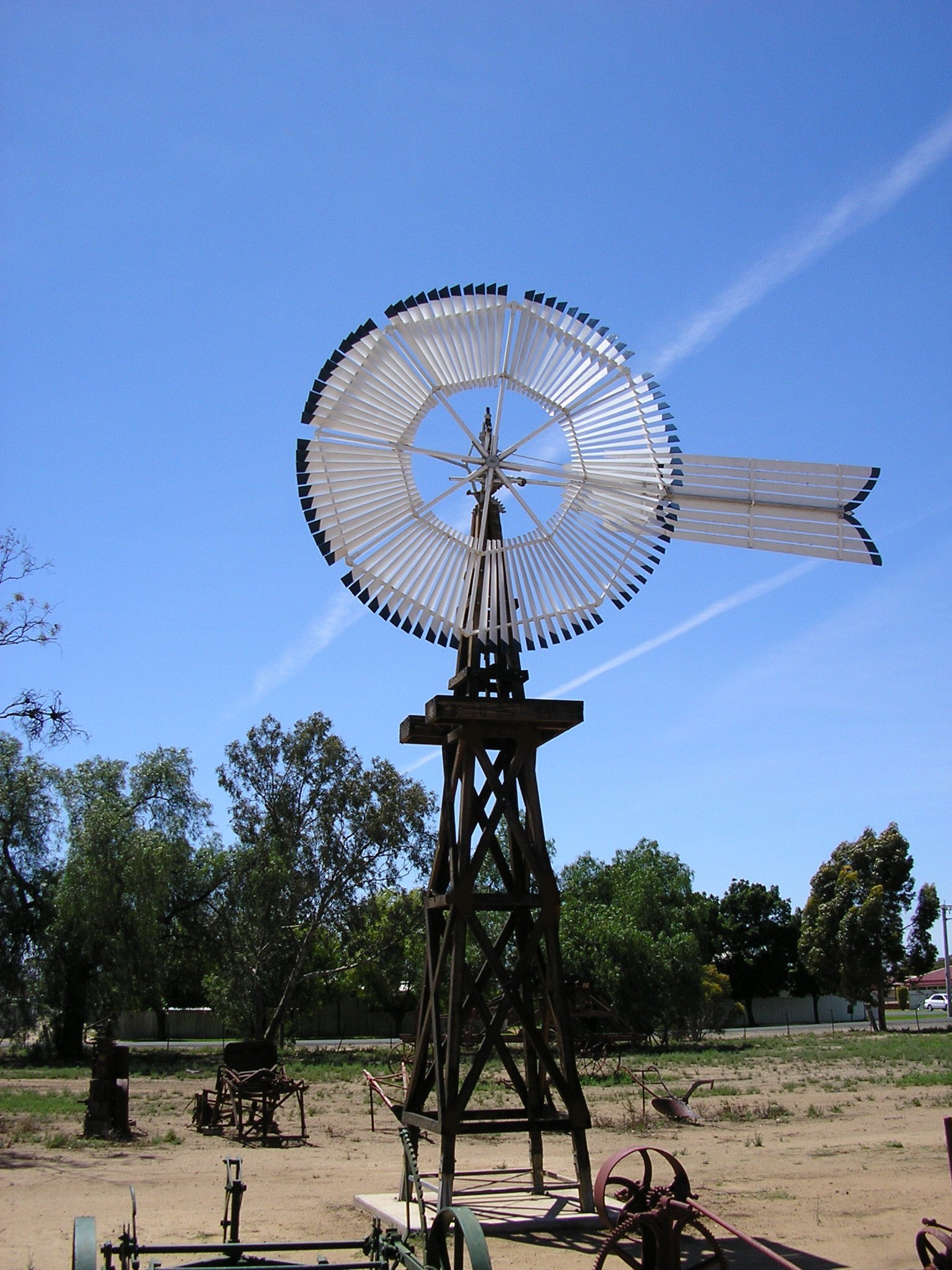
In many of the windmills, you will be required to count the number of blades on the fan. This will be difficult to impossible depending on the strength of the wind.
Therefore, a digital camera IS ESSENTIAL
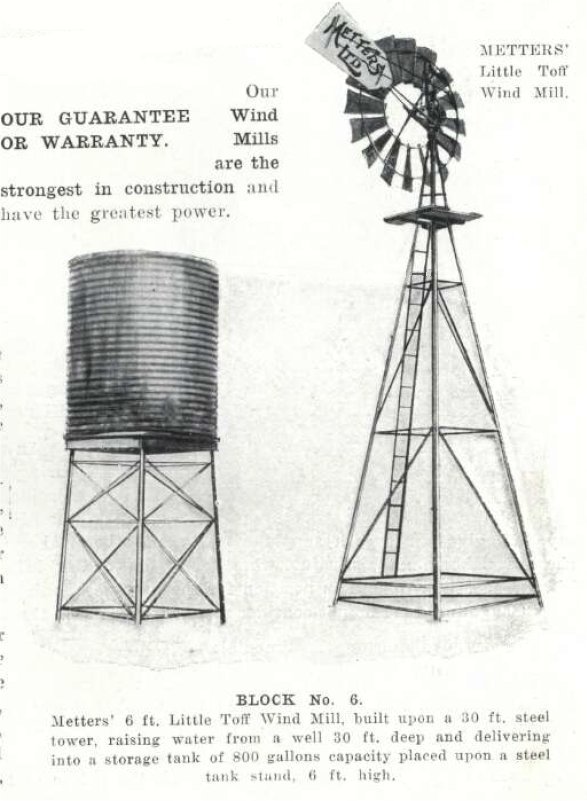
Firstly, some DEFINITIONS:
Number of steps in a ladder, as in the above Catalogue’s picture, is 16. ie, it’s the number of steps you put your foot on when ascending or descending the tower. (Count them above). If a step is temporarily missing, as with the windmill blades, count how many steps should be there.
Number of sides to a windmill’s tail, as in the above Catalogue’s picture, is 6.
Number of spokes in the windmill, as in the above Catalogue’s picture is 4. (In the above Catalogue picture, each spoke is composed of 2 members, but there are considered to be 4 spokes for the windmill. (They are “double” spokes, there are 4 of them))
Number of “X” ’s in the frame. In the above Catalogue’s picture, there are none in the windmill tower but there are 8 in the tank stand.
Number of water tanks associated with the windmill. There is one in the METTERS windmill picture above.
Not all windmills are on towers! Some are on poles, some “windmills” are hiding in plain sight, and some are in your face!!
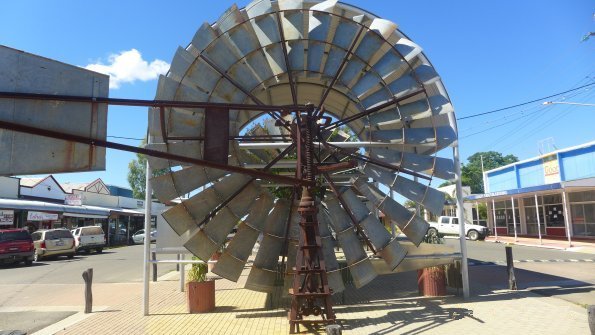
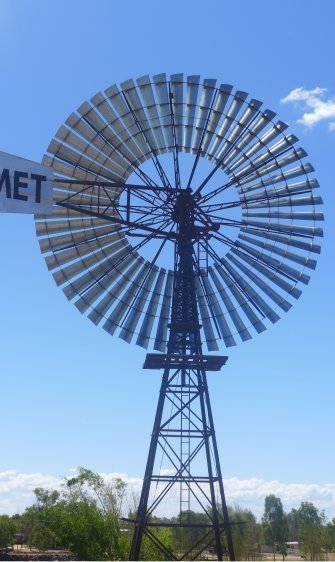
And some are monsters, and still in use today for various purposes.
Now onto this particular geocache:
CANBERRA to who knows when & where?
Enjoy the ride and don’t forget to take a pen, plenty of paper and a calculator.
Windmill A1
S 35º 17.046. E 148º 58.706
A digital camera with good zoom function will be useful. Stand GPS at S35º 17.046 E148º 58.706 and look 197m at a bearing of 260º
AA = Number of blades. AB = Number of legs for the tower. AC = Number of platforms. AD = Number of “spokes” in the fan wheel. (Each “spoke” is composed of 2 radial members, but counts as 1 (double type of) spoke).,
Windmill A2
S 35º 26.875 E 149º 03.395
A digital camera with good zoom function will be useful. Stand GPS at S35º 26.875 E149 03.395 and look 514m at a bearing of 353º.
AE = Number of blades. AF = Number of dark green water tanks situated 50m to the north-east of the windmill.
Windmill A3
S35º 17.210 E149º 04.189
A “windmill”, of sorts, was planted here.
Windmill planted here d/m/YY. AG = d. AH = m. AI = YY. A lady was here, numeric value of the first letter of her surname = AJ. There was a VIP here too, the numeric value of the first letter of his first name = AK. Technical name of this windmill has two words, number of letters in the first name = AL.
Windmill A4
S35º 17.597 E149º 07.260
A Simplex windmill from Kenya station in central Queensland (110km Nth of Longreach) was relocated here in 2011. This Simplex windmill was made by the Intercolonial Boring Company in Brisbane in the 1920s. It provided water for stock on Kenya station.
The windmill is now part of the National Museum’s National Historical Collection. It was donated by John and Pamela Seccombe and taken apart on Kenya before being moved to Canberra – from Kenya station.
The windmill formed (& still does form) part of the National Museum’s National Historical Collection. It was dismantled in the museum in late 2023 due to the space being used for a further mezzanine level of displays. However, you can locate the windmill online by appropriate searching.
AM = number of blades. AN = number of metres high. AO = 3rd digit in the number of kilometres it travelled (17?0). AP = 4th digit in the final year the windmill provided stock with water.
Locations of the B set of windmills.
Windmill B1
-(AN-AP)(AF)(AP)(AB)(AL-AG)(AC)(AN-AL)(AG)
Windmill B2
-(AK)(AP)(AK)(AA/2)(AD)(AH)(AJ+1)
Windmill B3
-(AC)(AB)(AI-AB)(AC)(AL-AB)(AH)(AB)(AP)(AF)
Windmill B4
-(AC)(AB)(AE/2)(AO-AD)(AP)(AB)(AJ-AB)(0)(AM/3)
Windmill B5
-(AF)(AH-AF)(AJ)(AP-AH)(AH-AC)(0)(AE-AA)(AI-AB)(3)
Windmill B6
-(AD)(AD)(AO)(AD)(AJ)(AM-AE-1)(AN-AL)
-----------------------------------------------------------------------------------------
B1: The Billabong Mill on 20’ tower pumping water from a bore 200’ deep. Size (in feet) of the Billabong Mill = BA. BB = Number of blades on this windmill. For the 14 ft windmill, number of strokes per minute = BC. For this same windmill, when it is pumping 195 gallons per hour, what is the inside diameter (=BD) of the pipes?
B2: The Flirting windmill. BE = Number of blades. BF = diameter of the wind wheel, in feet. BG = number of legs in the tower.
B3: BH = Number of tower legs. If the number of blades is >40, BI=7, if 31-40, BI=8, if 20-30, BI=9..
B4: BJ = Number of windmill blades (NOTE: The number is divisible by 3). BK = Number of 4 wheeled contraptions.
B5: At the Royal Show, Melbourne 16th September 1901, the tallest windmill has BL number of blades.
A Most Perfect Machine. Ceres, Carrathool, Jan 16th 1906.
James Alston, Esq.,
Dear Sir, - In reference to the windmill we purchased from you some (BM) months ago, I wish to state that the mill is giving the greatest satisfaction, and altogether is a most perfect machine for the work it is intended for. Your (BN)ft mill is a sure permanent worker. …… (BO) head of cattle & (BP) head of horses ……. There are (BQ) or (BR) more likely buyers in the vicinity for windmills, and for the benefit of purchaser and seller I will do what I can to further your interests.
We are, yours truly
KOOK BROS.
(When did you last see a letter like that to a manufacturer? !!)
B6: Now pay attention, a windmill isn’t just a rotating thingy that just sits on the ground. It needs to have good foundations and a solid anchorage to prevent the strong winds blowing it over. Right? Good! The foundation holes must be 4ft 10in deep for (BS)ft and (BT)ft towers. For a (BU)ft and 30ft towers the hole is even deeper at 6ft 6in. (That’s just taller than mtbikeroz 😊 )
Damn: The Vane Hinge Bearing for my 30ft RK windmill has seized and needs replacing. I need part “RJ (BV)” and I need ? of them. (How many of them (?) = BW)
Locations of the C set of windmills.
Windmill C1
Location: (BA-BE) (BJ-30) (BU-20) (BN-1) (BI/4) (BS-10) (BG+BM) (0) (0) (BP-9)
The Old Mill: The “windmill on the hill”.
The need for facilities for grinding wheat was first met by John Dunn who, it will be recalled, built a windmill at Hay Valley ….in 1842. In the same year, another windmill was built by F. R. Nixon “on the brow of a hill”, subsequently called “Windmill Hill”. (CA) Years later, Nixon sold his mill to Walter Patterson. Not long after, as a grand-daughter of Walter Patterson recalls, a feud took place between two similar groups of people, but geographically normally located far apart indeed.
“The scene of action was Windmill Hill, where belligerents met, and battle was set in array. Mr Patterson, being alarmed, gathered his wife and young family together and locked them in the windmill, whilst he and (CB) or (CC) other white men did their best to quell the trouble. In this way they were powerless. The fight however did not last long, as mounted troopers with drawn swords and revolvers were speedily on the scene, and suppressed the disturbance. Explanations were offered and an honourable understanding having been arrived at, the warriors dispersed, and the Encounter Bay tribe trekked back to the sea coast“
Patterson worked the windmill until 185(CD), then sold it to Mr F. W. Witter. By this time wind could not compete with steam. Milling stopped in 186(CE) and the mill lay dormant until 192(CF).
The Frame family, meanwhile, had purchased some land nearby in 184(CG). Burnbank property. John Frame had great farming success. His son, the second John Frame, continued successfully with the farm, until at age (CH), while he was driving a team on the Adelaide road near Windmill Hill, the horses bolted and he was killed.
Windmill C2
Location: (BU-BL-1) (BV-BI) (BH) (BB-BV-4) (BH) (4) (0) (BT-BV) (BM+BR) (2)
Installed in 191(CI), about fifty years after Mr Sidney Williams pioneered wind-powered pumping in Australia, a (CJ) ft Comet on “Terrick Terrick” Station, Blackall, Queensland had been in continuous service for (CK) years. Maintenance has been negligible.
Cecil P Jessop loved standing next to his windmill creations. His first “Simplex” windmill was up a 40ft tower in his yard. CL = Number of blades. CM = number of water tanks behind the windmill Cecil P Jessop is standing on.
Windmill C3
Location: (BT-BC-9) (BD) (BR+BK) (BA-BC) (BU-BB) (0) (BD) (BS-BE+3) (BL-BP-1) (BG-1)
“I’ve climbed you” he said to himself. But there was no triumph in it, only the sickening secret shame of his fear. He was afraid. Afraid to climb the windmill.
His father did not ask him to go up again. Neither did Tim volunteer. CN = number of blades on this windmill.
It was the worst night Tim had ever spent. He seemed to be climbing the windmill all night. It was (CO) hundred feet high and the steps went on forever.
It was another bad day for Tim at school. From his desk he could see a windmill in the paddock next to the school yard. Or at least the remains of a windmill. Just the tower, only a small one about (CP) feet high. All morning Tim’s eyes kept going to the tower and Mr Martin kept telling him to pay attention.
At lunchtime the boys were at a loose end and ready for mischief. Someone suggested dares. The paddock was out of bounds and so of course was the windmill. One of the boys said “I’d like to see Tim Rogers climb that windmill”
Tim looked at it for the hundredth time that day. It was such a small one, only a ?? the size of the one at home. (?? Is a fraction, CQ = the number at the base of the fraction).
He leaned his bike against the corner stanchion (of THE windmill) and looked up. …….He took a stone and aimed it at the crossbar (CR) feet up. The clang on the metal disturbed a pair of magpies which took off hastily into the air. Tim glared in angry frustration at what they left behind them – a dozen or more sticks laid across the crossbars in one corner – the beginnings of a nest.
He actually set foot on the ladder with the idea of going up and pulling down the nest. But the magpies were too quick for him. He hadn’t gone up (CS) rungs before they were circling around him, swooping in on him, screaming raucously.
…climb down. In (CT) minutes he was standing between them. Tim’s father shook his hand. Congratulations Tim. Tim took off his helmet and his mother said “So that’s where my tea cosy got to” She kissed him. “I knew you could do it” she whispered.
“Then wait until tomorrow to put it up” the painter advised. The 1st word in the name of the farm has (CU) letters. Numeric value of the 2nd letter of the first word = (CV).
Location of next windmill
S 3(CM)º (CV-CD)(CK-CH-1) . (CS-CG)(CL-CN-1)3
E 14(CU)º (CQ)(CN/2) . (CE-CB)(CO+1)6
Windmill D
Find the BIG Southern Cross windmill. It was manufactured in 19(DA) (DA is a whole 2 digit number). It is also a particular model number, last two digits of the model number = DB. The windwheel has a diameter of DC feet. It pumped water from a depth of X metres. DD = X/4. On a windmill very close to this one, are some kangaroos and emus. Number of emus = DE. (an even number).
Go for a walk, approximately 700m in a NE direction until you find another Southern Cross windmill, a 3m wheel Z pattern to be precise. Number of legs for this tower = DF. Allan lived in a place with a unique name, not a geographic name, called G….. . Numeric value of the 2nd letter of this G word = DG. Allan lived in a town, the postcode of this town is a 4 digit number. The last 2 digits of this postcode = DH. Finally, the windmill was used for: DI=5 if for domestic water, DI=7 if for irrigation, DI=9 if for farm supplies, DI=11 if for fire-fighting supplies.
Location of next windmill
S 3(CA-2)º (DB-DA)(DF) . (DB-DH+1)(DE+CQ)6
E 14(DD-40)º (DI-CE)(CK-DD+2) . (0)(DF)2
Windmill E
Number of blades = EA. On hand pump at the bottom, "triangular shaped" steel plate has “REnnn” imprinted on it. Add the digits of nnn together to get EB. On hand winch at the bottom, a 3-letter word starting with T, on the inside, between two bolts: numeric value of next letter = EC. The ladder: number of horizontal ladder steps BETWEEN horizontal members of the tower = ED.
458m at 1º true bearing, there is a TOOLBOXES & BULLBARS sign with a windmill on it. Number of blades on this windmill = EE. There are 8 numbers on the bottom line of the sign: 2nd number = EF, 6th number = EG, 7th number = EH.
Location of next windmill
S (DA+EH)º (CA+CB)(DE+CM) . (DI-EE)(EF-CD)8
E (DD+CK+CH+BN)º (EC/3)(EB-EF-EH) . (EC-EB-1)(EE+BK)3
Windmill F1
Number of blades on the ALSTON windmill = FA. The design was available in FB sizes ranging from 8ft to 22.5ft.
Windmill F2
Number of blades on the Southern Cross TOOWOOMBA windmill = FC. Year of pattern for the 8ft (2.44m) windwheel with geared drive. FD = last digit of the year.
Windmill F3
Number of blades on the ROCKHAMPTON windmill = FE. Made in Rockhampton in YYYY by Sidney Williams & Co. FF = last two digits of the year.
Windmill F4
Number of blades on the ESCA windmill = FG. ESCA was an old profitable hardware store in Australia, dating circa 1930’s. This mill design was first made in YYYY and is still in production. FH = 3rd digit of the year.
Windmill F5
Number of blades on the IBC SIMPLEX windmill = FI. Direct drive, open crank on a double ball race donut shaped turntable! Got that? Good. Now tell me the Mill no. FJ = last two digits of the mill no.
Windmill F6
Number of blades on the Southern Cross 1911 model windmill = FK. This is the first automatic ?? windmill to be built in Australia. Fancy that! (FYI – Most prior windmills were built in the USA). FL = number of letters in this magical ?? word.
Windmill F7
Number of blades on the GEM windmill = FM. Didn’t I just mention that most windmills prior to the above 1911 model were made in the USA? Well, this one certainly was. Made from YYYY. The last digit of YYYY = FN.
Windmill F8
Number of blades on the ALSTON windmill = FO. This “EDG” model was made from YYYY. FP = last digit of the year.
Windmill F9
Number of blades on the SOUTHERN CROSS “IZ” pattern windmill = Nah, too many to count. Lets go with the number of sides to the platform up near the windmill = FQ. “IZ” pattern, No. 1831?5. FR = ?.
Windmill F10
Number of blades on the STEEL STAR windmill = FS. OH NO, another windmill made in the USA, this time from the state of INDIANA. This model was made from YYYY. Yep, you guessed it, FT = last digit of the year.
Windmill F11
Number of blades on the WEBB windmill = FU. This TYPE “L” was an exact number of feet in diameter. Diameter = FV(whole number in feet only)
Windmill F12
Number of blades on the CHALLENGE windmill = FW. Made about YYYY. FX = last digit of year.
Windmill F13
Number of blades on the IRON TURBINE windmill = FY. OH NO, yet another windmill made in the USA, but this time in a different state. What did they do over there in the USA before 1911, just manufacture windmills??? Diameter of this windmill, in feet = FZ.
Done all that? Good. There is a MONSTER COMET nearby (250m W). Walk over and check it out. Number of blades = F1. Number of sails per segment = F2. Tower weight = F3 tons. Wheel diameter = F4 feet. Sir Peter Cosgrove was here in March 2019. F5 = day.
Location of next windmill
S (F1-FE)º (F4-FM)(F5-FU-FV+FD) . (FO/FP)(FS/FT) 1
E (F1+FI+FM+FE+FK+FV-FH)º (FZ-F2-CB)(FC-FB-1) . (FW-FY-FN)(FA-FF+FL+FQ) 5
Windmill G1
ECONOMY WINDMILL: It was erected at Gowrie Junction early in 18YY. YY = GA. A model was patented in 18YY. YY = GB. GC copies of an imported Economy windmill were at Jimbour after 18YY. YY = GD.
Windmill G2
ALSTON’s PATENT STEEL WINDMILL: Alston enclosed, double-geared, self-oiling mill. Patented 19YY (YY=GE) – manufactured up to 19YY (YY=GF). The display mill was manufactured after 19YY (YY=GG) and came from Ramsay via Cambooya – X ft (X=GH) diameter wind wheel on a tower Y ft (Y=GI) high..
Windmill G3
SOUTHERN CROSS “IZ” PATTERN WINDMILLS: The Z pattern became the IZ pattern after YY years. GJ=YY. . In 19YY the Z pattern was designed. YY=GK.
Windmill G4
SOUTHERN CROSS DIRECT ACTING WINDMILL: Annual agricultural shows were held on this site until 19YY. YY=GL. The wind wheel was redesigned in 19YY (YY=GM) with X (X=GN) sails per segment rather than Y (Y=GO) in the earlier 19YY (YY=GP) pattern wheel.
Windmill G5
DUNLITE WIND-GENERATOR: A 3m diameter windwheel with X (X=GQ) aerofoil variable pitch blades. The generator is driven by the propellors through a Y:1 ratio gear box with helical gears in an oil bath. (Y=GR)
Windmill G6
The COMET WINDMILL D PATTERN: Based on robust pragmatics and simplicity, they varied in size from X ft to Y ft. in diameter. (X=GS, Y=GT).
Windmill G7
SOUTHERN CROSS “H”. The X ft (X=GU) mill made one stroke for every three revolutions, the Y ft (Y=GV) made one stroke for every 2 1/3 revolutions and the Z ft (Z=GW) made one stroke for every 1 6/7 revolutions !! Got that? Good! .
Windmill G8
1903 SOUTHERN CROSS WINDMILL: All except the X ft (X=GX) models used brake bands. The 10ft version had Y spokes (Y=GY). This 10ft version was available in 19YY. (YY=GZ).
Location of next windmill
S (GL-GM+1)º (GD-GA-1)(GD-GB+1) . (GG-GT)(GE-GV)2
E (GF+GJ+GK+GM)º (GR-GY)(FH) . (GH-FN)(GA-GB)3
Windmill H
OK, look around, its there, clear as day out in the open. Some of the locals have even missed it for decades. Number of blades = HA. The structure adjacent to the windmill is made of: If stainless steel, HB=7, If aluminium, HB=5, if wood, HB=3, if bronze, HB=9. Total height of windmill & associated structure = HC. Erected in 19Y0. (Y=HD). The creator of this windmill and associated structure was awarded the Order of Australia in 19Y6 (Y=HE). He died on D Sept 200Y (D=HF, Y=HG)
Location of next windmill
S (BJ-HE-GQ)º (FG-FO)(FZ-HB) . (HA-GO+1)(HF)8
E (GD+GT+GZ+F5+6)º (HD-HG)(HF) . (FC-HD)(FI-HE)4
Windmill I
Don’t forget to consult the “Definitions” above.
Number of blades = IA. Number of steps on the ladder = IB. Number of steel rods going into the ground seemingly as an anchor of sorts = IC. Number of steel legs going into the ground = ID. Number of bolts holding one end of each cross member to one tower leg = IE.
Location of next windmill
S (23+CG)º (IE)(CS-ID) . (1)(F4-F5-F2)1
E (135+IA)º (CL-FE)(IB) . (HG)(CE)9
Windmill J
Windmill at waist height, Number of blades = JA. This windmill has a WHITE platform around it of a certain shape, If a Hexagon, JB=6, If an Octagon, JB=8, if a Decagon, JB=10, If something else, well then JB = number of sides to that shape. This little platform has a fence with white timber railings around it: it is x railings high: x = the number of railings high = JC. Look around and only a few metres away there is two windmills above a doorway. TOTAL number of blades on these two windmills = JD. Total number of doors in these two windmills = JE.
Location of next windmill
S (23+HD)º (JE-IE)(JD+FD-3) . (FY-JA)(CV-CO)2
E ((8EC)+JC+GK)º (CU-JD)(JC+3) . (GZ-JA)(GU-JE-4)1
Windmill K
Number of blades = KA. At the front, in the big yellow top, there are some windows. Number of windows = KB. Number of panes of glass in each window = KC. Around the back, in the big yellow top, there is also some windows. Number of windows = KD. Number of panes of glass in each window = KE. Still around the back, just below these “KD” windows, there is another window in the grey stuff, this window has KF panes of glass.
Location of next windmill
S (GL-GF-12)º (6KA+2) . (GS-KD)(GR-GQ)2
E (GA+GB+KF+2)º (IA+GG+KB) . (KC-KD)(KC)9
Windmill L
Number of blades = LA, NOTE: At these EXACT coordinates, there IS a windmill!!. Colour of letters on the windmill blades: If red, L3=3, If blue, LB=5, if black, LB=7, if silver, LB=9. Go for a short walk (50m) ENE – to the nearby windmill area. Wander around a bit and collect the following information. c1918 there was a windmill here, number of blades = LC. George was five feet six and a half inches tall! (Talk about precise). He was sentenced to LD years transportation. He lived here for LE years. Still wandering around? Good. Archibald erected a windmill here to provide power for the grinding of locally grown wheat and corn. The year was 18??, ??=LF. He acquired some LG thousand hectares of land. Time for some research: In the 1970s and early 1980s, Grace after a decade of lobbying, had her vision realised for THIS place. Grace resisted high rise development at THIS site, and in 19(LH)(LI), the government agreed to purchase THIS place.
Location of next windmill
S (LF-2)º (LG+1) . (KF-1)(LB-1)6
E (3(LF+LG) + IA - KA)º (LH+LD+HB-1) . (LE+LA)(LI-LA)2
Windmill M
Number of blades = MA. Number of steps on the ladder, per se = MB. There is a couple of chunky (thick) water pipes sticking up from the concrete near one of the legs. One of these pipes has a cap on it with the name of a country imprinted into it. “Under” the country’s name, is a single digit number = MD. Under the centre of the windmill is a steel cover plate with a 6 digit number. MC= the 3rd digit.
Location of next windmill
S (35)º (FW-MA)(LE) . (LH-HA)(LD-LB)8
E (149)º (LF-LG) . (MB-BV)(MB-BG-LH)1
Windmill N
Number of blades = NA. Number of steps on the ladder = NB. Number of water tanks at the base of the windmill = NC. Number of metal cattle sculptures grazing at the base of the windmill = ND.
------------------------------------------------------------------------
Cache is located at:
S 35º (FJ-GI-GP+BQ) (CR-HC-CT-DG) . (FR+ED-BF+ND) (EG+FX-F3-BQ-BW+ND) 8
E 14(DC-CP-BW)º (CE+GX-NB+EB-IC-JA) (CI+KE-LC) . (GW+NA-EA-CC+MC-MD-ED) (IC+JB-BO+NC) 9
NOTE - PLEASE CHECK LISTING FOR UPDATED WINDMILL INFO as I often have to add a new windmill due to some disappearing or changing.