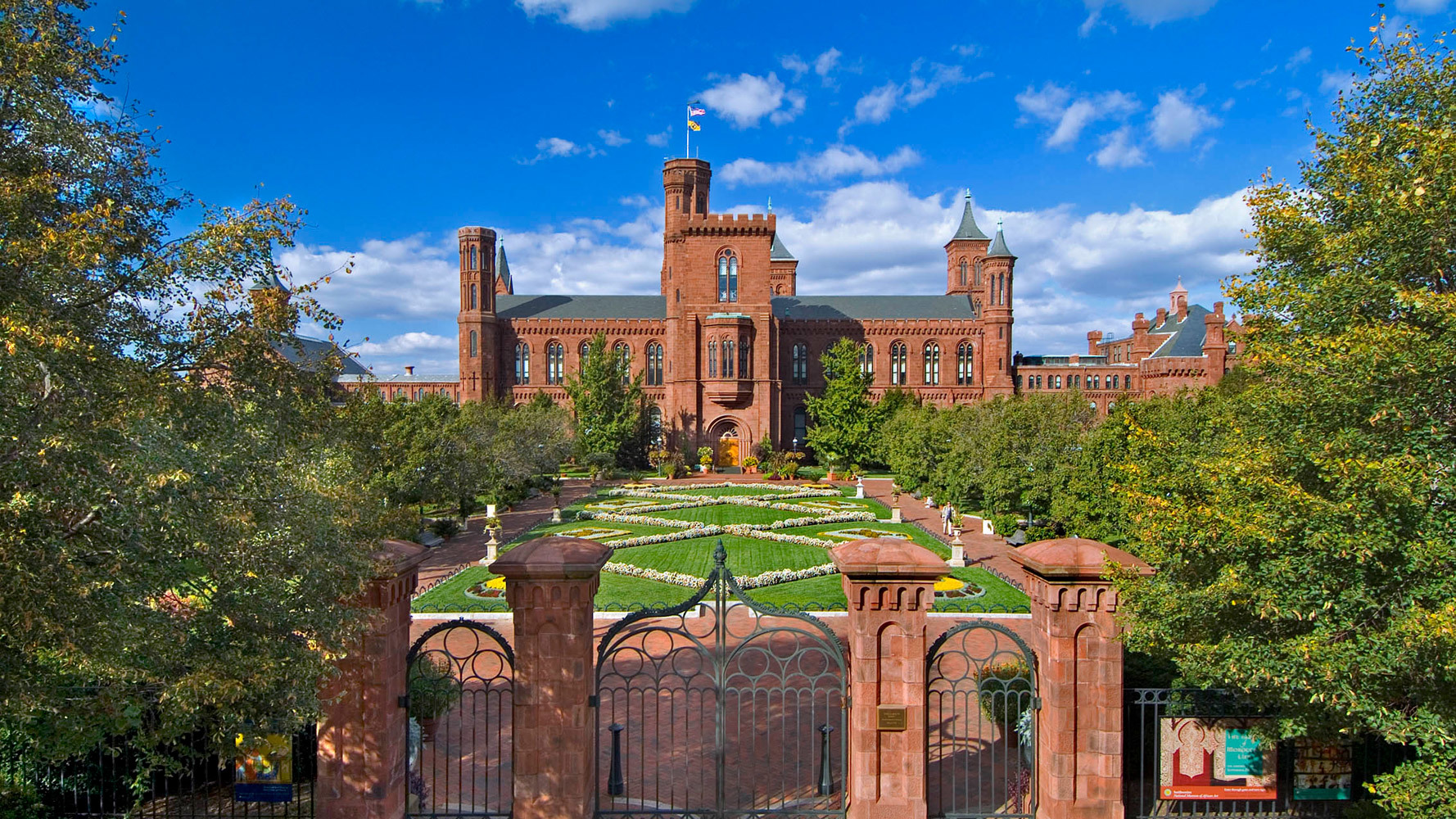
The Smithsonian Institution Building "Castle" is one of the most recognizable buildings in Washington, DC. Completed in 1855, the Castle was the first building constructed for the Smithsonian Institution and has since become the central hub of the Smithsonian Institution which is the world's largest museum and research complex. The Castle predates the McMillan Plan (an urban design plan that aimed to improve the city's public spaces and monumental core by creating new parks and open spaces) and as a result, it protrudes slightly into the elm tree region of the National Mall. The McMillan Plan proposed demolishing the castle, which fortunately did not happen.
The listed coordinates will bring you to the gate posts of the entrance to the Enid A. Haupt Garden, which is located behind the Smithsonian Castle. The gate posts are constructed from Seneca sandstone, which was the same stone used to construct the Smithsonian Castle (which is currently closed for a multi year renovation). However, the same geologic processes can be still observed here at the gate posts. The Seneca sandstone was quarried from Seneca, Maryland.
Geologically, the stone is part of the Upper Triassic Manassas Formation (235-201.3 million years ago). The sandstone was described as lilac gray in color when it was first quarried, but then turned reddish brown over time. Seneca sandstone was chosen because it was more durable than some of the other stones that were being considered at the time and also due to cost. The C&O Canal opened as far as the Seneca quarries in 1831 thereby reducing transportation costs.
Seneca sandstone weathers mainly by granular disintegration and delamination along bedding planes. Bedding planes are horizontal planes in sedimentary rocks that separate different layers of sediment or rock. They indicate changes in the depositional environment over time and can give the rock a layered or stratified appearance. The orientation of sandstone when used in construction is therefore important. Stone oriented in its natural bedding position withstands weathering better. If the stone is facebedded (placed with bedding planes oriented perpendicular to the ground, aka vertically on one side), granular disintegration and delamination become much more apparent. You can think of it as zones of weakness.
If you look closely at some of the sandstone, you may notice blue/black iridescent patches on parts of the stone surface. This has appeared on the stone relatively recently (mid 1990's, and by 2015 it was visible on every face of the building and the gate posts). There has been research performed with portable X-ray fluorescence spectroscopy (basically an x-ray instrument used to perform non-destructive chemical analyses of rocks) has shown that these patches contain high levels of manganese.
These blue/black patches are similar to desert varnish. The exact process by which desert varnish forms is not completely understood, but it is believed to be a result of a combination of physical, chemical, and biological processes. There are several processes that are thought to contribute, one of which is mineral precipitation. As water and other solvents evaporate, minerals that are present in the rock can become concentrated on the surface. Another process is biologic activities. Microorganisms such as bacteria and fungi can colonize the surface of the rock, producing organic compounds that help to bind the mineral particles together and promote the formation of desert varnish. Another process is wind erosion. Wind can scour the surface of the rock, removing loose particles and leaving behind a smooth surface that is more conducive to the formation of desert varnish. Lastly there is chemical weathering, which is result of reactions between minerals in the rock and atmospheric gases which can lead to the formation of new minerals, some of which may contribute to the formation of desert varnish. Further research is still being conducted to find out more about this process and its rate of growth.
Logging Requirements:
- Why do you think the sandstone changed color from lilac gray to reddish brown over time?
- The Seneca sandstone was facebedded for aesthetic reasons. Do you see any signs of delamination? Does it appear to be more common at a certain elevation, and if so, why do you think this is the case?
- How do you think the blue/black iridescent patches were formed? Why do you think these patches did not start appearing until fairly recently?
- Upload a photo with the Enid D. Haupt Garden or the gateposts. The photo MUST be taken near the posted coordinates. You don't have to be in the photo, though it is strongly encouraged.
Sources:
- https://heritagesciencejournal.springeropen.com/articles/10.1186/s40494-016-0093-2