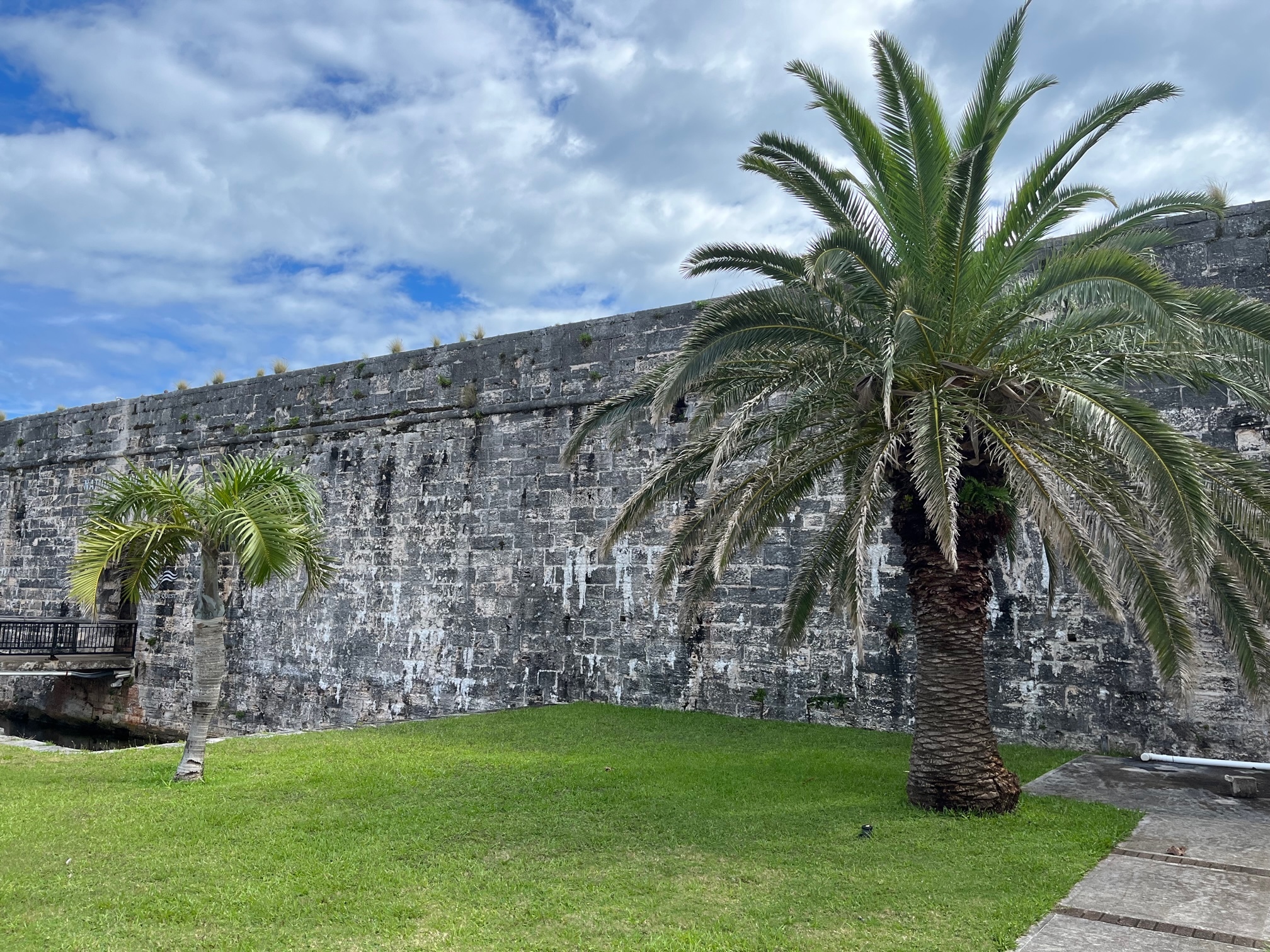
The Royal Naval Dockyards in Bermuda, situated on the western tip of the island, are a significant historical site with a fascinating maritime history. Originally established as a British naval base in the 19th century, these dockyards played a vital role for the Royal Navy in the Atlantic. Today, they offer visitors a chance to explore Bermuda's naval heritage through their impressive architecture, beautiful surroundings, and engaging exhibits. Whether you're wandering along the waterfront, exploring the displays, or simply taking in the restored buildings, the Royal Naval Dockyards provide a captivating glimpse into Bermuda's past as a naval outpost.
The listed coordinates will bring you to a Broad Arrow. The Broad Arrow, or "crow's foot" is the traditional symbol of British military property and is found throughout Bermuda on milestones and boundary stones, several fine examples of which are on display at the Maritime Museum. The Broad Arrow is often accompanied by letters such as WD (War Department) or BM (Bench Mark). Since it was also used as a reference point, it frequently appears with a number. The Broad Arrow appears in many places in the Dockyard; it is set onto many of the bollards and appears in several places on the ramparts as survey reference points. The origins of the Broad Arrow as a mark of Royal ownership lie in the formation of the Royal artillery during Marlborough's wars in the 1690's when Lord Romney was appointed Master General of Artillery and adopted his family's coat of arms, the Broad Arrow as one of the badges of the Ordnance Corps. This symbol has been used for many centuries, even at one time on the clothing of prisoners.
Weathering is the natural process through which rocks and minerals are broken down and transformed by various environmental factors. There are three main types of weathering: mechanical, chemical, and biological.
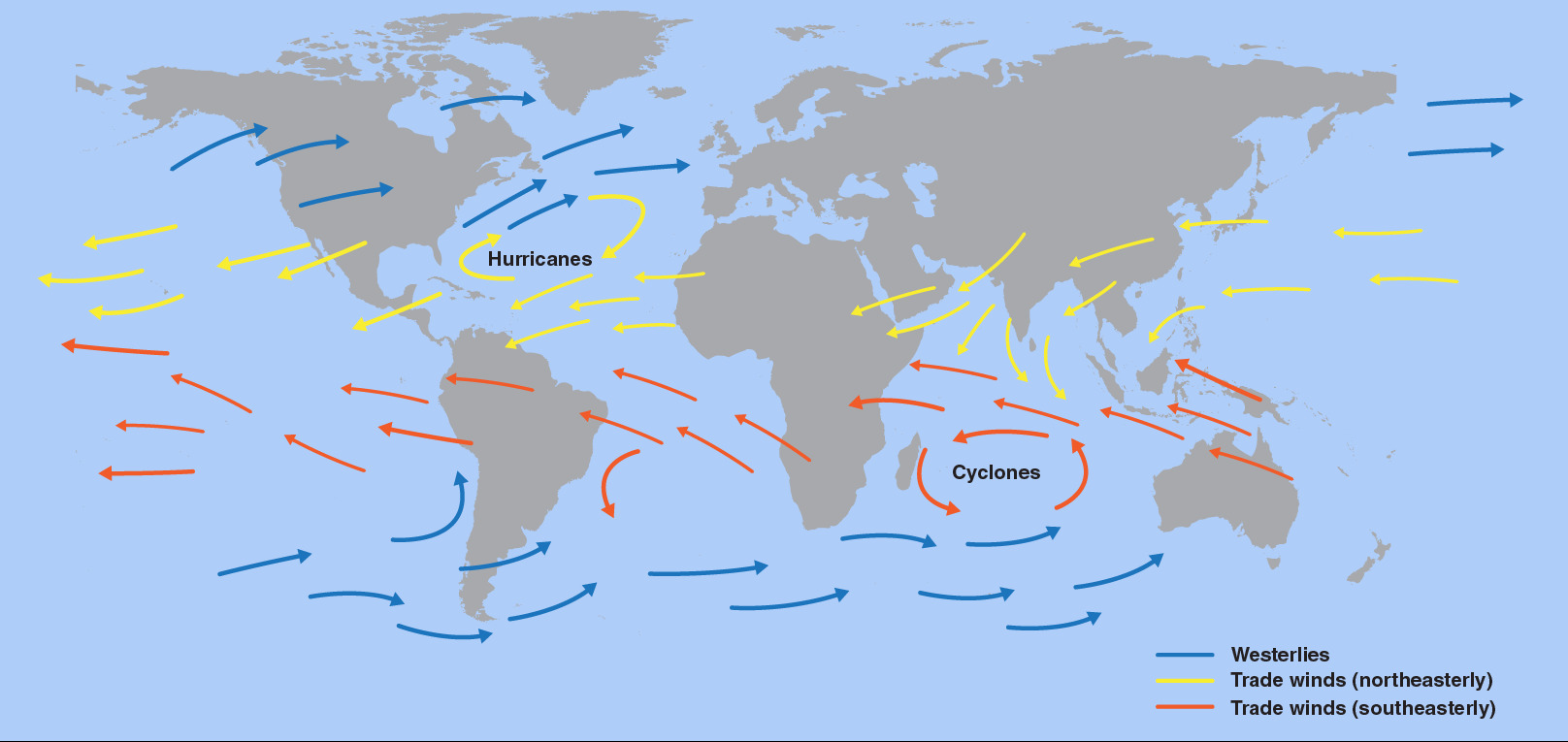
Mechanical weathering involves physical forces that break down rocks. Freeze-thaw weathering is a common example, occurring in cold climates. Water seeps into cracks and crevices, freezes, and expands, exerting pressure that weakens the rock over time. Abrasion is another form of mechanical weathering, where rocks are worn down by the frictional forces of wind, water, or other moving particles. Constant exposure to wind or water currents smooths rough surfaces and shapes rocks. The map above shows the direction of the prevailing winds.
Chemical weathering alters the composition of rocks and minerals through chemical reactions. For example, the oxidation of iron-bearing minerals in the presence of oxygen and water can cause rocks to break down and weaken, a process commonly known as rusting. Dissolution is another example, where certain minerals dissolve due to the reaction with acids. Acidic rainwater, for instance, can dissolve limestone rocks by reacting with the calcium carbonate present in them.
Biological weathering involves the influence of living organisms in the breakdown of rocks. Plant roots exert pressure on rocks as they grow into existing cracks, eventually causing them to break apart. Burrowing animals, like rodents or insects, create openings in the soil and rocks through their tunnels and burrows, facilitating further weathering. Some bacteria and fungi produce organic acids that chemically weather rocks, accelerating their decomposition.
Logging Requirements:
- Examine the Broad Arrow found on the corner of the fort. What form of weathering appears to be most dominant here?
- You'll notice that there are actually two Broad Arrows here, one on either face of the stone (south face and east face). Does one Broad Arrow appear more weathered than the other? If so, why do you think this is the case?
- Upload a photo from the Royal Naval Dockyards. You don't have to be in the photo, though it is strongly encouraged.