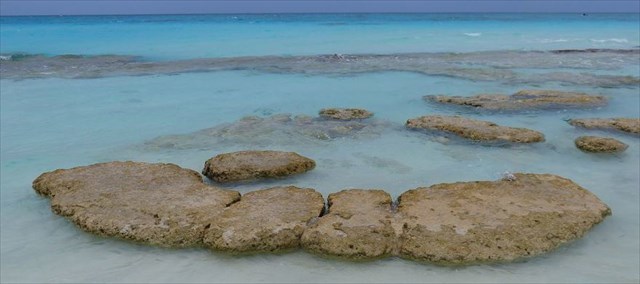
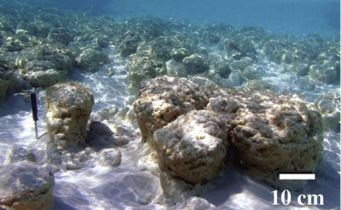
Along the shores of Highborne Cay of the Bahamas, you will find modern Stromatolites in and open marine environment.
After completing this Earthcache you will have a better understanding of:
- What is a Stromatolite
- How are Stromatolites formed
Before traveling towards the posted coordinates please be prepared:
- You will likely need a boat to get to Highborne Cay
- Most of the stromatolites are underwater so goggles and snorkel will be helpful
- More stromatolites will be exposed during low time.
- Link to nearest locations with tide forecasts: Nassau and Eleuthera Island
Definition
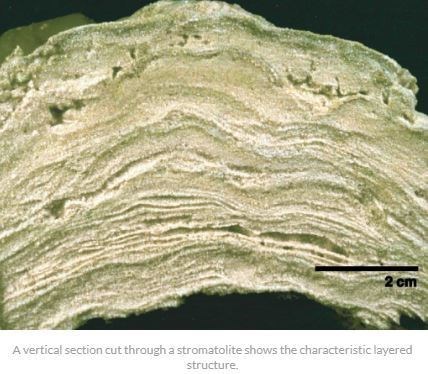
Stromatolites are a unique and special type of reef. The Bahamian stromatolites are living relatives of Earth’s oldest reefs. Unlike most present-day reefs, which are composed of coral, stromatolites are formed by microorganisms. Stromatolites or stromatoliths (from Greek strōma "layer, stratum" and lithos "rock") are layered mounds, columns, and sheet-like sedimentary rocks (often made from limestone) that were originally formed by the growth of layer upon layer of cyanobacteria, a single-celled photosynthesizing microbe. Stromatolites are thought to be the first structures derived on biological activity on Earth and provide records back to the Precambrian (more than 3.5 billion years ago).
Formation
Very scientific explanation: A microbial community organized in an exopolysaccharide matrix (biofilm) represents one prerequisite for the formation of stromatolites. These biofilms usually harbor a basal layer of heterotrophic bacteria with phototrophic cyanobacteria on top, which are embedded together in complex polysaccharide/biopolymer slime.
One aspect of the formation of stromatolites is based on the trapping of sedimentary grains (often Ca2+ ions) by negatively charged atom groups of polymeric matrix compounds.
Second aspect is linked to another prerequisite: the availability of high carbonate concentrations in the surround water. The assimilation of carbon dioxide (CO2) as part of an intense photosynthetic activity results in a decrease of local pH value shifting the equilibrium of dissociation towards carbonate ions. A subsequent reduction of the solubility of calcium carbonate leads to precipitation – and the stromatolite starts growing. Continuous bacterial growth accompanied by further photosynthetic activity enables stromatolite growth on the surface while basal layers die slowly. The reason for its layered structure is not fully understood yet, but maybe connected to a variety of factors, like the rhythm of sun, the availability of sedimentary grains or the chemical composition of water.
Another important aspect for the appearance of stromatolites is found in the absence of biofilm grazing organisms. Therefore many young and recent stromatolite fund sites are found in rather “unfriendly” environments characterized by e.g. high salt concentrations.
My layman's explanation: single-celled micro-organisms form a biofilm slime. This slime is alive and has DNA. The slime needs a couple things to live and grow: Light, high concentration of carbonate, and carbon dioxide (CO2). Through photosynthesis the slime grows towards the light. The waves deposit sand on the layers of slime creating sediment. As lower layers of sand compacted slime die, it grows towards the light and creates another layered structure. Layers accumulate very slowly, Stromatolites grow around 0.3mm per year.
Stromatolites locations
Most Stromatolites in the world are dead, ancient fossils millions of years old. More rare modern / living stromatolite formations are found in hyper-saline environments where there are an abundance of minerals in the following locations: Shark Bay in Western Australia GC6TC93, Pampa del Tamarugal in Chile, and Lagoa Salgada in Brazil.
Open Marine Environment Stromatolites are only found in a few locations including Highborne Cay. Even more rare are fresh water Stromatolites found in Laguna Bacalar in Mexico GC87124 and Lake Salida in Turkey.
Sources
wikipedia.org/Stromatolite
ResearchGate.net
Nature.com
Pubmed.gov
PNAS.org
To qualify for this Earthcache send me an email or message via my geocaching profile with the answers to the following questions. Do not post the answers in your log. Photos are encouraged!
- In your own words, define what Stromatolites are and how they are formed.
- Look for exposed stromatolites above the water, visually inspect the specimen. What colors do you see? Does the stromatolite appear to be rough or smooth? Do you see any layers?
- Knowing that stromatolites grow around 0.3mm per year, How many inches has the stromatolite grown above the sand? How many years do you think this would take?
- Using goggles, observe some stromatolites in the marine environment that are under-water. Do you see grains of sand in the water? How would the waves deposit sand into the biofilm creating sediment?
- Please post a photo proving that you were at the location
You may go ahead and claim "found it" once you have come to ground zero, If I don't receive the information required from you within 24 hours, I will delete your "found it" log.
Click on the image below for link to Extreme Earthcache Collective bookmark list.
Image created using AI
