About SideTracked Caches
This cache belongs to the SideTracked series. It is not designed to take you to a magical place with a breathtaking view. It's a distraction for the weary traveler, but anyone else can go and find it too. More Information can be found at the SideTracked Website.
This cache also qualifies for the Disappearing RR Blues bonus cache. This series highlights the railways of NW Oregon.
About Bull Run Station
Welcome to the former Bull Run Powerhouse of PGE. It was decommissioned in 2008, but it also has a rich rail history.
 The Mt Hood Railway and Power Company began the Bull Run Hydroelectric project in 1906. The Mt Hood Railway started as a steam railway linking Montavilla in East Portland (near Where I-205 and Stark Street is today) to Bull Run. Later it was converted to an electrified Interurban. The Railway's first goal was to provide supplies and workers for the dams and powerhouse for the Bull Run project. The Mt Hood Railway was later absorbed by Portland Railway Light and Power, the forerunner of today's PGE.
The project began by building a dam on the Little Sandy River. A 3.2-mile wooden flume was built from the dam to the man-made Roslyn Lake. This lake fed water to the powerhouse, which opened in 1912. In 1913 a dam was built on the Sandy River, diverting water from the Sandy to the Little Sandy River by canal and tunnel.
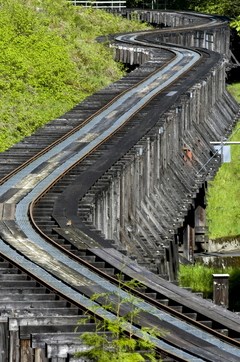
The Wooden Flume was interesting in that it has a railway built on top of it for inspection and maintenance of the flume only. Workers would walk or ride the rails daily, checking for leaks and performing maintenance as necessary.
 The Interurban trains linked Bull Run to Gresham and Montavilla. At Montavilla, you could board a Mt Tabor Streetcar for your journey to Portland or to Linnamon Jct for an interurban to Portland. The line was popular with picnickers on weekends, stopping at what is now Dodge Park. However, auto competition doomed the interurban. The last electric train pulled out of Bull Run in December of 1930. Today MAX operates on the old Mt Hood Line along Burnside Street from 99th to Ruby Junction, then along the private right-of-ray of the old Interurban from there to Gresham.
The Powerhouse and Flume survived until maintenance costs of the Flume started to rise, causing PGE to reconsider keeping the project running. Plus, the dam's fish ladders were ineffective at keeping the salmon runs alive.
PGE decided not to renew its license per agreements with various agencies and environmental groups. The decommissioning of the dams and Roslyn Lake was approved by the Army Corp of Engineers in 2007. Marmot Dam was removed in 2007. The Little Sandy Dam was removed in 2008, which eliminated Roslyn Lake. The Flume was removed over time.
Today there are plans to reopen the powerhouse as a museum. The small worker railcars for the Flume Railway are at the Oregon Electric Railway Museum. Also at the museum is a Mt Hood Railway Interurban Express car, although it does not have running gear.
The cache is at the entrance road to the Powerhouse. Seemed appropriate as the MAX Blue and Orange lines run on former Interurban lines that can trace their lineage to PGE's lineage.