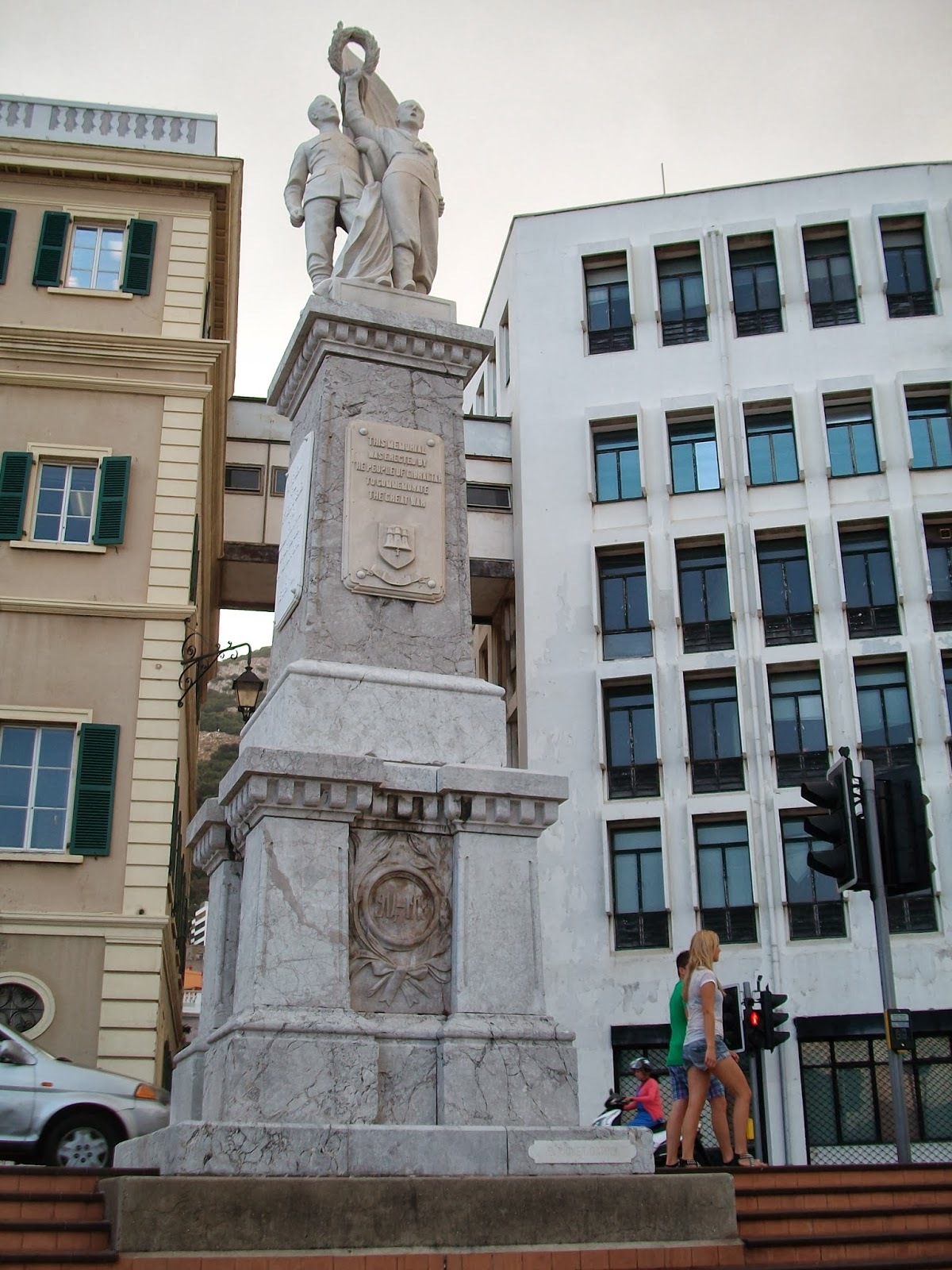
The Gibraltar War Memorial stands as a solemn and dignified tribute to the courageous individuals from Gibraltar who made the ultimate sacrifice during the tumultuous periods of World War I and World War II. Erected in 1923, this stately monument features an imposing column adorned with a statue of a soldier, a poignant symbol of valor and commitment. Inscribed with the names of the fallen, it serves as a tangible reminder of the profound impact of war on this British Overseas Territory and its people.
The Gibraltar War Memorial is constructed from Carrara marble. Carrara marble, originating from the Carrara region in Tuscany, Italy, is a geological wonder celebrated for its exceptional qualities and historical significance. Composed predominantly of calcite, a crystalline form of calcium carbonate, Carrara marble is the result of millions of years of geological processes. This remarkable stone owes its immaculate white color to its remarkable purity; it contains very few impurities, such as clay or iron oxides, making it a prized material for artists and architects. Its formation began when the region was submerged under the ancient seas. Over eons, sediments rich in calcium carbonate, derived from the shells and skeletons of marine organisms, accumulated on the ocean floor. The intense heat and pressure generated by tectonic forces caused these sediments to undergo metamorphism, transforming them into the fine-grained, lustrous Carrara marble we admire today. Its hardness, measured on the Mohs scale, ranks at around 3-4, making it ideal for detailed sculpting while retaining durability. Additionally, its distinctive veining patterns, known as "carrara veins," result from mineral impurities and add to its visual allure.
By examining the stone closely, we can learn more about where and how it was formed. The grain size in marble provides valuable clues about its formation location; finer grains often indicate a deeper formation within the Earth's crust, while coarser grains suggest a shallower origin nearer to the surface. The veining in the stone can also tell us a lot about some of the minerals within the stone. Iron oxide, in its various forms, plays a significant role in shaping the aesthetics of marble by introducing a broad spectrum of colors, including subtle rusty reds, deep earthy browns, and sometimes even hints of orange or yellow, against the stone's typically white or cream-colored background. Graphite, for example, introduces dark gray to black veins, while pyrite, known as "fool's gold," imparts a metallic and brassy appearance. Serpentine minerals contribute shades of green, ranging from pale to deep, while quartz introduces transparent or milky white veins. Tremolite and actinolite can add green or gray hues, and dolomite may influence the marble's crystalline patterns and texture. Additionally, minerals like garnet can create reddish or brownish veining, and mica can add shimmering, reflective qualities. This diverse array of minerals results in a breathtaking spectrum of colors and patterns.
Logging Requirements:
- Describe the color, texture, and grain size of the marble. Based on your observations, do you think the stone was formed deep inside the Earth, or close to the surface?
- Is the color of the veining within the stone consistent, or does it vary? Based on the description, what minerals are present?
- Is the veining oriented in the same direction (i.e. they run parallel), or does it vary?
- Why do you think Carrara marble was chosen for this memorial?
- Upload a photo with either yourself or a personal object taken with the memorial. No group photos, each person must upload his/her own photo.