Skip to content

La Brecha de Rolando EarthCache

Hidden : 1/13/2024
Difficulty:
2 out of 5
Terrain:
4.5 out of 5

Size: Size:   other (other)

Join now to view geocache location details. It's free!

Watch

How Geocaching Works

Please note Use of geocaching.com services is subject to the terms and conditions in our disclaimer.

Geocache Description:


Brecha de Rolando


Español


Para registrar este earthcache, enviame um correo eletrónico com la respuesta a las seguintes preguntas:

  1. ¿Que tipo de rocas forman el entorno de la brecha?¿A que formacion pertenencen?¿En que periodo se formaron estas rocas?
  2. Estas rocas son duras o blandas. ¿Cual fue el origen geologico de la brecha,? ( ¿por que se formo aquí? )
  3. Describe la roca que forma la pared de la Brecha a un metro de altura, ( Color, textura, brillo o no, etc )
  4. Añade una fotografia tuya en el local, u otra en la que se pueda ver algún objeto, o tu nick en un papel

 
-Si crees que as concluido con exito los objetivos de este Earth Cache, y me ha enviado todas las respuestas solicitadas, puede hacer el log. Luego yo comprobaré que son correctas, y si hay cualquier problema me pondre en contacto para arreglarlo.
  -Logs sin respuestas enviadas previamente, seran borrados sin aviso


Localización

La brecha de Rolando (brèche de Roland en francés) es un estrecho collado de 40 metros de ancho y 100 metros de altura, situado a una altitud de 2804 metros en el macizo de Monte Perdido. Según una leyenda local, fue abierta por Rolando, el sobrino de Carlomagno, mientras intentaba destruir su espada Durandal golpeándola contra la roca al final de la batalla de Roncesvalles. En realidad se trata de una bella excursión en los Altos pirineos accesible desde Francia (Gavarnie) y desde España por el parque nacional de Ordesa y Monte Perdido (valle de Ordesa), bien a través del refugio de Góriz o ascendiendo por el circo de Carriata o bien por el de Cotatuero

Origen


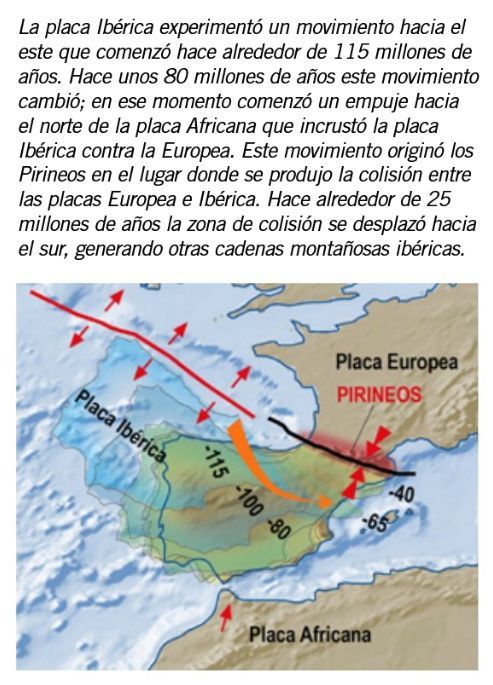
Aunque hoy día los Pirineos constituyen una gran cordillera montañosa de la Península Ibérica y una barrera geográfica que separa España de Francia, su origen es -geológicamente hablando- relativamente "reciente". El lugar ocupado hoy por las montañas constituía un mar hasta hace unos 35 millones de años. Testimonios de este proceso son los restos fósiles de organismos que vivían en los fondos marinos y que hoy encon- tramos en las rocas que constituyen las cimas más elevadas del Parque Nacional, como en Monte Perdido, a más de 3.300 metros sobre el nivel del mar. El proceso de formación de la cordillera se desarrolló a lo largo de 250 millones de años. Durante la primera parte de este periodo se produjo la acumulación de sedimentos en una cuenca marina que, más tarde, fue levantada hasta formar la cordillera pirenaica.

En otros puntos del Parque por debajo de las rocas que forman las paredes de estos tres valles hay rocas más antiguas, como en el valle de La Larri, donde bajo los estratos del Cretácico Superior encontramos areniscas de color rojo depositadas durante los periodos Pérmico y Triásico, y más abajo rocas estratificadas intensamente plegadas depositadas durante la era paleozoica. Así, podemos hacer un recorrido de los distintos episodios de la historia de la Tierra en este sector del Pirineo fijándonos atentamente en las rocas del Parque Nacional.

En toda la banda norte del mapa geológico, ya fuera de los límites del Parque Nacional, encontramos afloramientos de rocas intensamente plegadas. Se trata de rocas mucho más antiguas que los estratos de los valles de Ordesa y Añisclo. Se depositaron entre hace 470 y 350 millones de años en la era Paleozoica y fueron deformadas al formarse una gran cadena montañosa: la Cadena Varisca durante el período Carbonífero. Esta cadena sufrió una gran erosión y fue totalmente arrasada antes de la formación de los Pirineos. El hecho de que hoy encontremos estas rocas en la superficie formando el núcleo de los Pirineos se debe a su levantamiento durante la orogenia Alpina

Hace 200 millones de años la gran cordillera varisca se estaba erosionando rápidamente. En ese momento en el área de los Pirineos existían extensas áreas aluviales y fluviales en donde se depositaron sedimentos de colores rojos


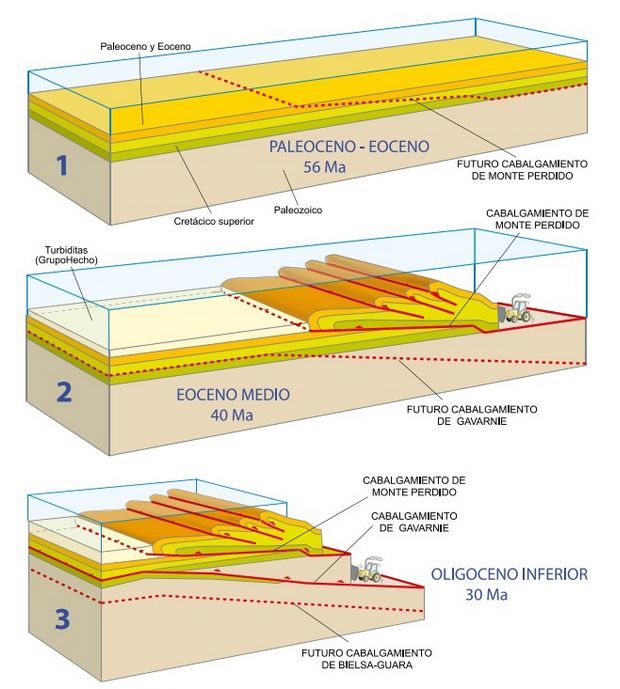
1. Estado inicial a finales del Paleoceno.
2. En el Eoceno medio las pequeñas unidades tectónicas (escamas) que componen la U. de Monte Perdido ya se habían emplazado, y ahora se está desplazando toda la U. de monte Perdido sobre su cabalgamiento inferior, que corta los estratos hacia arriba.
3. Durante el Oligoceno inferior se desplaza la unidad de Gavarnie: la Unidad de Monte Perdido ya está inmóvil y por debajo de ella, la compresión tectónica provoca la rotura y creación de un nuevo cabalgamiento, que ya corta a las unidades del zócalo paleozoico. Este último es el Cabalgamiento de Gavarnie, que en su movimiento transporta sobre sí a cuestas la U. de Mte. Perdido que se pliega como consecuencia del abombamiento

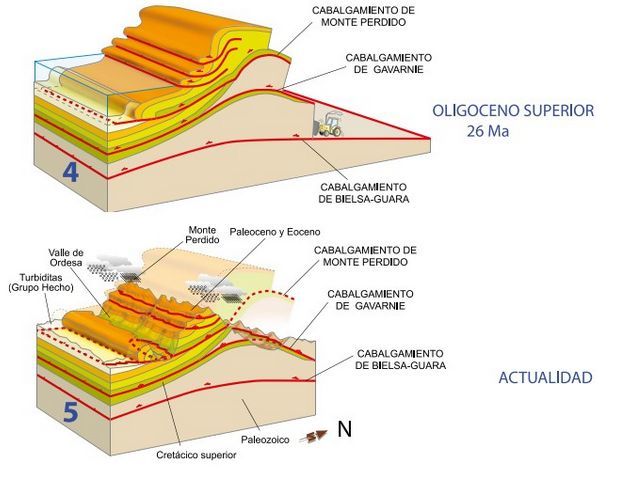
4. En este episodio se forma un nuevo cabalgamiento más profundo por debajo de todos los anteriores, el Cabalgamiento de Bielsa-Guara, que transporta sobre sí a los anteriores. Al igual que sucede con el C. de Gavarnie, su desplazamiento provoca el volcado hacia el sur de todas las unidades emplazadas previamente.
5. Situación actual: la intensa erosión de los Pirineos ha dejado al descubierto la estructura tectónica: en el profundo valle de Gavarnie ha salido a la luz el Cabalgamiento que recibe su nombre y que rodea todo el valle constituyendo una denominada “ventana tectónica”.

LAS UNIDADES TECTÓNICAS DEL PARQUE

El macizo del Monte Perdido es un gran edificio rocoso constituido por el apilamiento de muchas unidades de rocas repetidas unas sobre otras hasta constituir esta gran mole. Las distintas piezas que lo componen -unidades tectónicas-, se emplazaron a lo largo de 80 millones de años. Sin embargo, contra lo que pueda parecer son las unidades que se encuentran más altas en el edificio las que primero se colocaron. De este modo fueron progresivamente empujadas hacia arriba y deformadas por las que se colocaron después bajo ellas levantándolas hasta su posición actual


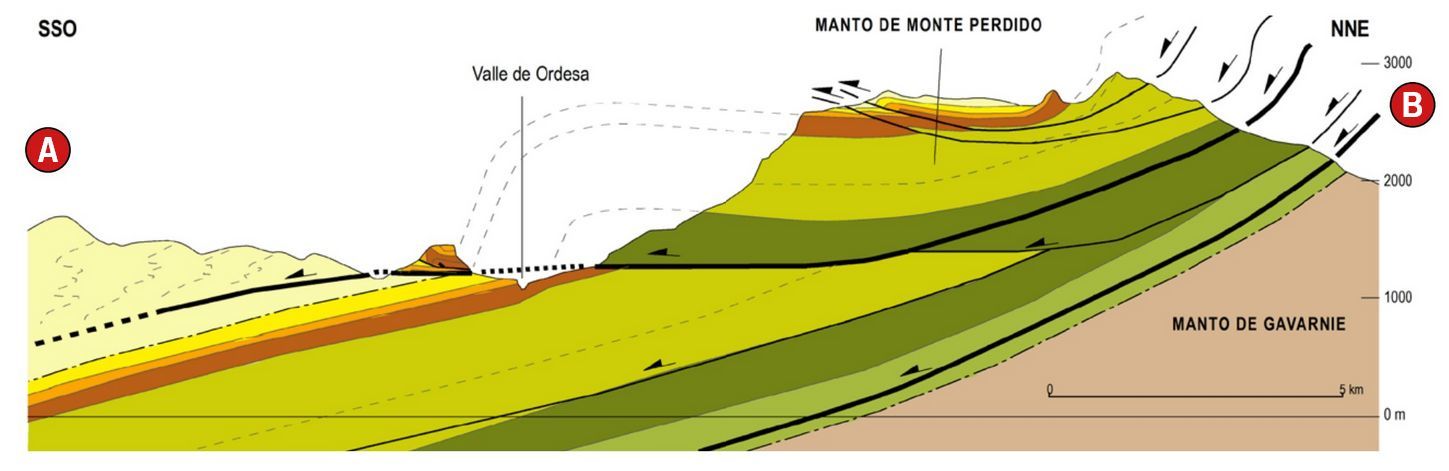
Cortes geológicos a través del Parque Nacional que muestran las unidades estructurales. Las cimas del Monte Perdido y Mondarruego corresponden al manto del Monte Perdido constituido por varios cabalgamientos menores.


La Brecha de Roland

La Brecha de Rolando es, sin duda, uno de los iconos del Parque Nacional. Se trata de un lugar muy frecuentado por su valor paisajístico y porque sirve para comunicar las vertientes española y francesa.
Situada a poco más de 2.800 metros de altitud, es una profunda entalladura de alrededor de cien metros de alto que interrumpe el escarpe fronterizo entre España y Francia, formado en este tramo por calizas de la parte inferior de la Formación Gallinera (T1).
Estas rocas son muy resistentes a la erosión y por eso forman una cresta; sin embargo en el lugar de la Brecha, una serie de fracturas la hicieron más débil propiciando la formación de este paso de montaña; los restos de estos desprendimientos son los grandes bloques que tapizan la ladera.
En las proximidades de la Brecha pueden realizarse varias observaciones geológicas interesantes.

Por un lado, destacan los heleros del Taillón y de la Brecha y las numerosas morrenas situadas al pie del escarpe. Por otro lado, mirando hacia el Casco (dirección Este), pueden observarse varios cabalgamientos que delatan la compleja estructura tectónica del sector (fig. 15).
De hecho, desde la parada anterior hasta esta se cortan varios planos de cabalgamiento, a menudo delatados por la repetición de las rojizas areniscas de Marboré


English

To log this earthcache, send me an email with the answer to the following questions:

 
1. What type of rocks form the environment of the breccia? To what formation do they belong? In what period were these rocks formed?
 2. These rocks are hard or soft. What was the geological origin of the gap? (why was it formed here?)
 3. Describe the rock that forms the wall of the Gap at a height of one meter, (Color, texture, brightness or not, etc.)
 4. Add a photograph of you in the premises, or another in which you can see an object, or your nick on a piece of paper
 

If you believe you have successfully completed this Earth Cache goals and has already sent to me all the requirements as requested, Please, feel free to log it as found. Later i will verify the requirements sent and, if necessary, contact you in order to make the necessary corrections to your log.


Location


The Roland Gap (brèche de Roland in French) is a narrow pass 40 meters wide and 100 meters high, located at an altitude of 2804 meters in the Monte Perdido massif. According to local legend, it was opened by Roland, Charlemagne's nephew, while trying to destroy his sword Durandal by striking it against the rock at the end of the Battle of Roncesvalles. In reality, it is a beautiful excursion in the High Pyrenees accessible from France (Gavarnie) and from Spain through the Ordesa and Monte Perdido national park (Ordesa valley), either through the Góriz refuge or ascending the Carriata cirque or by Cotatuero

Origin


Although today the Pyrenees constitute a large mountain range of the Iberian Peninsula and a geographical barrier that separates Spain from France, its origin is -geologically speaking- relatively "recent". The place occupied today by the mountains constituted a sea until about 35 million years ago. Testimony of this process are the fossil remains of organisms that lived on the seabed and that today we find in the rocks that constitute the highest peaks of the National Park, such as Monte Perdido, at more than 3,300 meters above sea level. . The formation process of the mountain range took place over 250 million years. During the first part of this period, sediments accumulated in a marine basin that was later uplifted to form the Pyrenean mountain range.

In other parts of the Park, below the rocks that form the walls of these three valleys, there are older rocks, such as in the La Larri valley, where under the Upper Cretaceous strata we find red-colored sandstones deposited during the Permian and Triassic periods. , and below it intensely folded stratified rocks deposited during the Paleozoic era. Thus, we can take a tour of the different episodes in the history of the Earth in this sector of the Pyrenees, paying close attention to the rocks of the National Park.

In the entire northern band of the geological map, already outside the limits of the National Park, we find outcrops of intensely folded rocks. These are rocks much older than the strata of the Ordesa and Añisclo valleys. They were deposited between 470 and 350 million years ago in the Paleozoic era and were deformed when a large mountain range was formed: the Variscan Chain during the Carboniferous period. This chain suffered great erosion and was completely destroyed before the formation of the Pyrenees. The fact that today we find these rocks on the surface forming the core of the Pyrenees is due to their uplift during the Alpine orogeny.

200 million years ago the great Variscan mountain range was rapidly eroding. At that time in the area of ??the Pyrenees there were extensive alluvial and fluvial areas where red colored sediments were deposited.


1. Initial state at the end of the Paleocene.
2. In the middle Eocene, the small tectonic units (flakes) that make up the U. of Monte Perdido had already been emplaced, and now the entire U. of Monte Perdido is moving on its lower thrust, which cuts the strata upwards.
3. During the lower Oligocene, the Gavarnie unit moves: the Monte Perdido Unit is already immobile and below it, the tectonic compression causes the rupture and creation of a new thrust, which already cuts the units of the Paleozoic base. The latter is the Gavarnie Thrust, which in its movement carries on its back the U. de Mte. Lost that folds as a result of bulging


4. In this episode, a new deeper thrust is formed below all the previous ones, the Bielsa-Guara Thrust, which carries the previous ones on itself. As with the C. de Gavarnie, its displacement causes the overturning of all the units previously placed to the south.
5. Current situation: the intense erosion of the Pyrenees has exposed the tectonic structure: in the deep Gavarnie valley, the thrust that receives its name has come to light and surrounds the entire valley, constituting a so-called "tectonic window".


THE TECTONIC UNITS OF THE PARK

The Monte Perdido massif is a large rocky building constituted by the stacking of many units of rocks repeated one on top of the other until constituting this great mass. The different pieces that compose it -tectonic units-, are
emplaced over 80 million years. However, contrary to what it may seem, it is the units that are highest in the building that are placed first. In this way they were progressively pushed up and
deformed by those that were later placed under them by raising them to their current position


Geological sections through the National Park showing the structural units. The peaks of Monte Perdido and Mondarruego correspond to the mantle of Monte Perdido, made up of several minor thrusts.


Roland's Gap


The Rolando Gap is, without a doubt, one of the icons of the National Park. It is a very frequented place due to its scenic value and because it serves to connect the Spanish and French sides.
Located at just over 2,800 meters above sea level, it is a deep notch about one hundred meters high that interrupts the border escarpment between Spain and France, formed in this section by limestone from the lower part of the Gallinera Formation (T1).
These rocks are very resistant to erosion and that is why they form a ridge; However, in the place of the Gap, a series of fractures made it weaker, leading to the formation of this mountain pass; The remains of these landslides are the large blocks that cover the slope.
Several interesting geological observations can be made in the vicinity of the Gap.

On the one hand, the Taillón and Brecha glaciers and the numerous moraines located at the foot of the escarpment stand out. On the other hand, looking towards the Casco (east direction), several thrusts can be observed that reveal the complex tectonic structure of the sector (fig. 15).
In fact, from the previous stop to this one, several thrust planes are cut, often revealed by the repetition of the reddish Marboré sandstones.


Fuentes:

Guia geologica de Ordesa y Monte Perdido


Additional Hints (No hints available.)