¡Música maestro!
 Ataúlfo Argenta
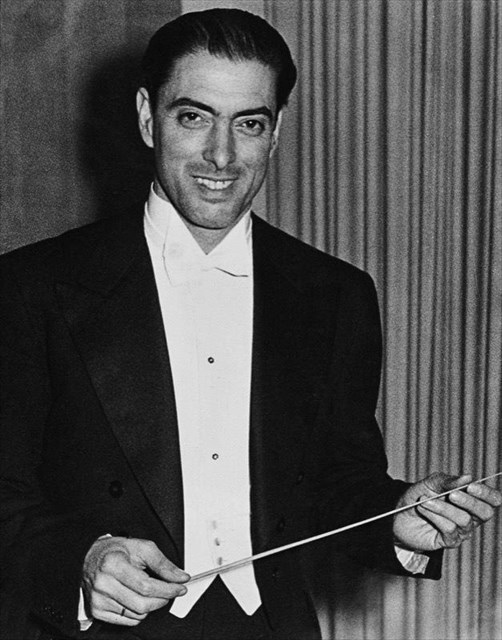 Ataúlfo Argenta fue un pianista y director de orquesta español nacido en Castro-Urdiales en 1913. Alumno precoz, recibió clases de solfeo, piano y violín en el Círculo Católico de su pueblo. En 1925 toda la familia se marchó a Madrid y Ataúlfo comenzó a estudiar música en el Real Conservatorio de Madrid como alumno de Manuel Fernández Alberdi. Allí destacó rápidamente como pianista. Tras obtener el premio extraordinario de fin de carrera en la disciplina pianística, viajó en 1931 a Bélgica para continuar con su formación de piano, estudiando en Liège con el afamado músico Armand Marsick.
En 1941, tras un largo periplo dirigiendo orquestas menores y los fosos teatrales madrileños, consiguió una beca para estudiar en Kassel y Berlín con el profesor Winfred Wolff. Pese al conflicto mundial, Argenta prosiguió su meteórica carrera como concertista de piano, además de aprovechar su estancia en tierras germánicas para conocer al afamado director de orquesta Karl Schuricht.
Ataúlfo Argenta regresó definitivamente a España a finales de 1943, cuando la guerra iniciaba su fase final. Mediante oposiciones obtuvo el puesto de profesor titular de piano de la Orquesta Nacional de España. Sin embargo, será a partir de 1947 cuando ocupe el puesto de director de esta formación, trampolín para su fructífera carrera entre atriles y batuta.
La carrera de Ataúlfo Argenta fue breve pero intensa. Fue un inigualable intérprete de la música de su país: sus interpretaciones de Manuel de Falla, por ejemplo, preservadas por las grabaciones, siguen siendo insustituibles, así como sus numerosas incursiones en el campo de la zarzuela. Director invitado de la Sociedad de Conciertos de París y de la Orquesta de la Suisse Romande, su brillante trayectoria se vio truncada de forma prematura y trágica por un absurdo accidente.
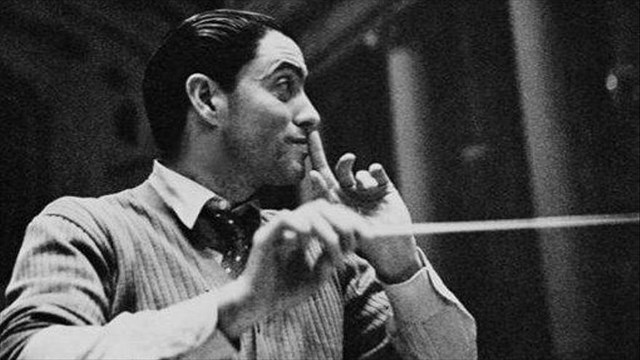 Argenta murió en 1958, con tan solo 44 años de edad, en su casa de Madrid. Allí se había citado secretamente con su alumna de piano, una francesa de 23 años para pasar la noche. Como había nevado, encendió la chimenea y mientras se caldeaba la casa la pareja bajó al garaje y esperó dentro del coche con el motor encendido. El monóxido de carbono, gas venenoso inoloro e incoloro que emitía su coche le produjo la muerte.
El 31 de enero, diez días después de su fallecimiento, la Orquesta se presentó por primera vez al público sin su director. Los músicos, en pie, interpretaron el coral de la Cantata 140, de Johann Sebastian Bach, escuchada por el público también en pie y en silencio. Ataúlfo Argenta es considerado como el más sobresaliente director musical de las décadas centrales del siglo XX español.
Para registrar el caché como encontrado:
1.- Haz una foto con Ataúlfo Argenta y con tu nickname, avatar o cualquier otra cosa que haga identificable a tu equipo de Geocaching. Después sube esta foto en tu log.
2.- Siéntate en un banco del parque y cierra los ojos. Oirás una melodía dirigida por Ataúlfo Argenta. ¿Cuál es? (Si no la reconoces puedes utilizar alguna app de reconocimiento de canciones) OJO: Música sujeta a horario.
3.- Busca el apellido del escultor como figura en la estatua de Ataúlfo Argenta.
Mándame las respuestas 2 y 3. Los registros que no cumplan estos requisitos podrán ser borrados sin previo aviso.
Horario
La música del jardín está operativa todos los días del año de 11-15h y de 17-20h. El acceso al jardín musical es libre pero tienes que ceñirte a este horario para poder responder las preguntas de este Virtual.
Recompensas Virtuales 4.0 - 2024-2025
Este Caché Virtual forma parte de una edición limitada de Virtuales creados entre el 17 de enero de 2024 y el 17 de enero de 2025. Únicamente 4000 propietarios de caché en todo el mundo tuvieron la oportunidad de esconder un Caché Virtual. Más información sobre Virtual Rewards 4.0 en el Blog de Geocaching.
**🎵*****🎵*****🎵*****🎵*****🎵*****🎵*****🎵*****🎵*****🎵*****🎵*****🎵*****🎵*
 Ataúlfo Argenta
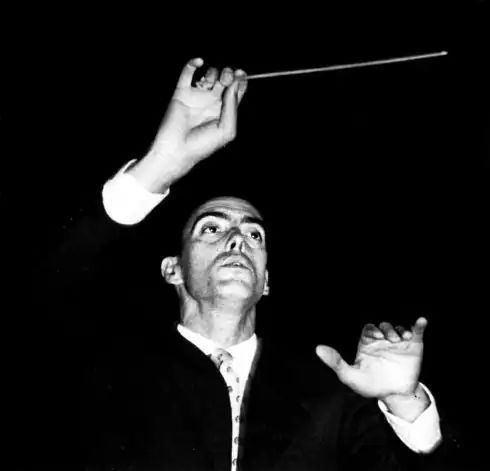 Ataúlfo Argenta was a Spanish pianist and conductor born in Castro-Urdiales in 1913. A precocious student, he received music theory, piano and violin lessons at the Catholic Circle in his home town. In 1925 the whole family moved to Madrid and Ataúlfo began to study music at the Royal Conservatory of Madrid as a student of Manuel Fernández Alberdi, where he quickly stood out as a pianist. After obtaining the extraordinary final prize in the piano discipline, he traveled to Belgium in 1931 to continue his piano training, studying in Liege with the famous musician Armand Marsick.
In 1941, after a long time directing minor orchestras and theater pits in Madrid, he obtained a scholarship to study in Kassel and Berlin with Professor Winfred Wolff. Despite the world conflict, Argenta continued his meteoric career as a concert pianist in Germany, where he even met the famous conductor Karl Schuricht.
Ataúlfo Argenta returned to Spain at the end of 1943, when the war began its final phase. Through competitive examinations he obtained the position of professor of piano at the National Orchestra of Spain, and from 1947 onwards he became the director of this orchestra, a springboard for his fruitful career.
Ataúlfo Argenta's career was brief but intense. He was an unrivaled interpreter of the music of his country. For instance, his interpretations of Manuel de Falla, preserved by recordings, remain irreplaceable, as well as his numerous forays into the field of zarzuela. Guest conductor of the Paris Concert Society and the Orchester de la Suisse Romande, his brilliant career was cut short prematurely and tragically by an absurd accident.
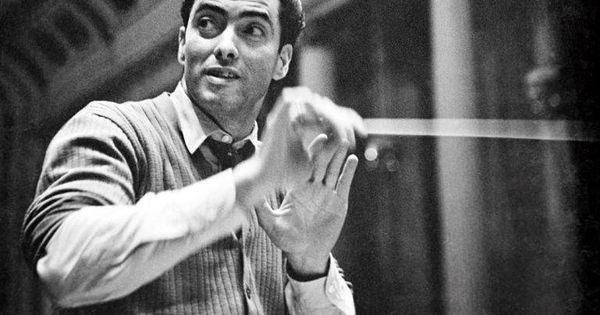 Argenta died in 1958, at the age of 44, in his house in Madrid, where he had secretly met his piano student, a 23-year-old French woman, to spend the night. Since it had snowed, she lit the fireplace and while the house was warming up the couple went down to the garage and waited inside the car with the engine running. Carbon monoxide, an odorless and colorless poisonous gas emitted by his car, caused his death.
On January 31, ten days after his death, the Orchestra was presented to the public for the first time without its conductor. The musicians, standing, performed the chorale of Cantata 140 by Johann Sebastian Bach, with the audience also standing and in silence. Ataúlfo Argenta is considered the most outstanding musical director of the central decades of the Spanish 20th century.
To log this cache as found:
1.- Make a picture with Ataúlfo Argenta and your nickname, avatar or any other thing which makes your Geocaching team identifiable. Then upload this picture to your log
2.- Sit on a park bench and close your eyes. You will hear a melody directed by Ataúlfo Argenta. Which is it? (If you don't recognize it, you can use a song recognition application) NOTE: Music subject to schedule.
3.- Look for the sculptor's last name as it appears on the statue of Ataúlfo Argenta.
Send me answers 2 and 3. Logs which do not meet this requirements might be deleted without any notice.
Schedule
The garden music is operational every day of the year from 11am-3pm and 5pm-8pm. Access to the musical garden is free but you have to stick to these schedule to be able to answer the questions in this Virtual.
Virtual Rewards 4.0 - 2024-2025
This Virtual Cache is part of a limited release of Virtuals created between January 17, 2024 and January 17, 2025. Only 4,000 cache owners were given the opportunity to hide a Virtual Cache. Learn more about Virtual Rewards 4.0 on the Geocaching Blog.