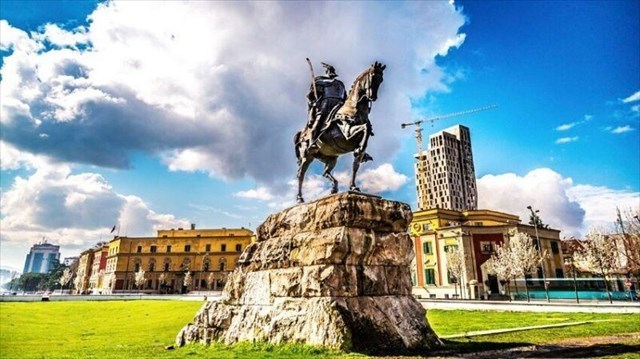
The Skanderbeg Monument is an equestrian statue at the heart of the Skanderbeg Square (Sheshi Skënderbej). The statue represents the Albanian national hero George Kastrioti Skanderbeg riding his horse in battle, commemorating his bravery against the Ottoman Empire, as leader of the federation of the League of Lezhë.
This Skanderbeg Monument was designed by Odhise Paskali, one of the most acclaimed Albanian sculptors. The monument is 11 metres tall made from Limestone rock. It was inaugurated in 1968 on the 500th commemoration of the death of Skanderbeg.
Igneous rocks are “fire-born,” meaning that they are formed from the cooling and solidification of molten (melted) rock. The word igneous derives from ignis, the Latin word for “fire.” Molten rock material is known as magma until it is erupted onto the surface when it then is termed lava.
Sedimentary rocks are formed from pre-existing rocks or pieces of once-living organisms. They form from deposits that accumulate on the Earth's surface. Sedimentary rocks often have distinctive layering or bedding.
Metamorphic rocks started out as some other type of rock, but have been substantially changed from their original igneous, sedimentary, or earlier metamorphic form. Metamorphic rocks form when rocks are subjected to high heat, high pressure, hot mineral-rich fluids or, more commonly, some combination of these factors.
Limestone is sedimentary rock, which together with the dolomite forms four-fifths of all sediments on the Earth's surface. Most (over 80%) consists of calcium carbonate (CaCO3), whether in the form of calcite, or pure limestone aragonite is white. Various impurities are stained in silk, red (iron oxides), especially when they are exposed to moisturizing. Features The limestone, since it is composed of calcite, has quite similar properties: approximately the same hardness, good acid solubility for CO2 release. It is also dissolved in water containing CO2 to form calcium bicarbonate (Ca (HCO3) 2). This phenomenon is the cause of karst phenomena, such as caves, shafts, stunts and others. Formation The process of limestone formation is several stages and runs in different environments ranging from surface to deeper. When converting calcite mud into limestone, six basic processes are carried out: cementation, micritisation, neomorphosis, dissolution, compacting and dolomitization. Changes begin immediately after storage or even during storage, and may take place both in the marine and terrestrial environment. The absolute majority of limestones are of biochemical or organic origin.
Weathering of Limestone Limestone is largely made up of calcium carbonate in the form of the mineral calcite. Limestone weathers by the solution of this calcite. This occurs along the joints and bedding planes which are present due to the sedimentary nature of the rock.
What effects weathering? A rock's composition has a great effect on its rate of weathering. Rocks that are softer and less weather-resistant tend to wear away quicker than those that are crystalline (igneous rock) or have been subjected to more heat and pressure (metamorphic rock). When the more weather-resistant rock is left behind, this process is called differential weathering.
A rock's exposure to the weathering elements and its surface area can affect its rate of weathering. Rocks that are constantly bombarded by running water, wind, and other erosion agents, will weather more quickly. Rocks that have a large surface area exposed to these agents will also weather more quickly. As a rock goes through chemical and mechanical weathering, it is broken into smaller rocks. As you can imagine, every time the rock breaks into smaller pieces its surface area or part exposed to weathering is increased.
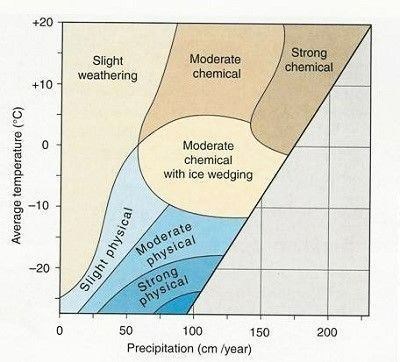
The above graph, a Peltier diagram, shows how weathering is affected by temperature and rainfall (precipitation). Loius Peltier, an American physicist in 1950 and climatologist in 1950, predicted the rate and type of weathering that would occur from mean annual temperatures and mean annual rainfall.
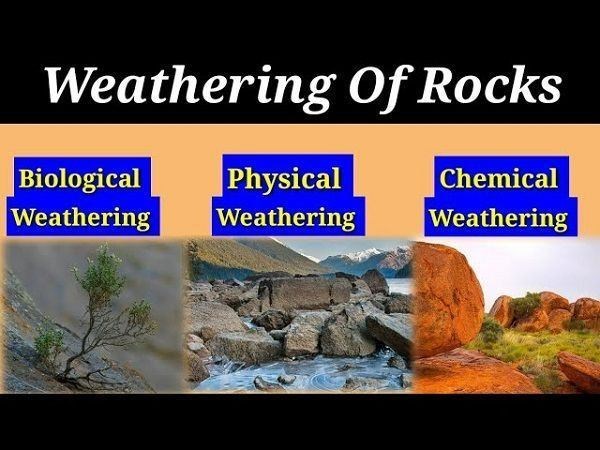
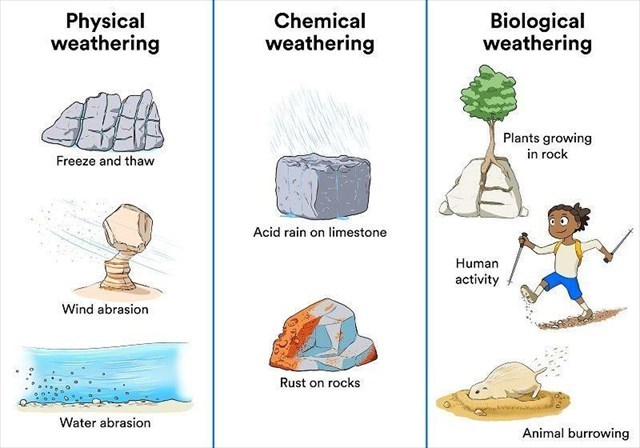
3 major types of weathering: physical, chemical, and biological.
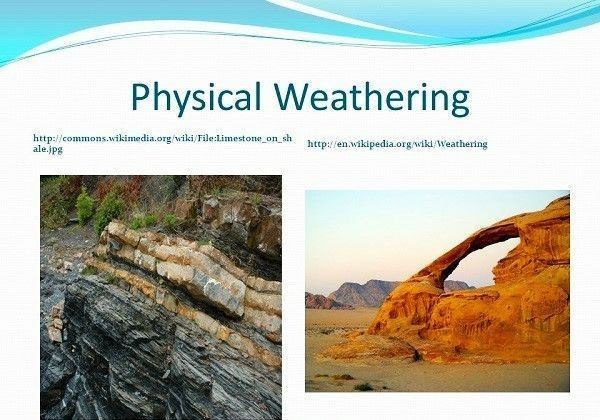
1. Physical weathering is the breakdown of minerals, which remain the same; there are 5 major subtypes:
a. Block or Granular disintegration results in blocks of the parent material falling from the cliff and often increases the surface area susceptible to attack.
b. Freeze-thaw action can effect water in the cracks in rocks, freezing and expanding in volume by around 10% (in fact 9.05%) where diurnal temperature variations include crossing freezing point.
c. Exfoliation happens when there are changes in temperatures with a diurnal range of 50 to 70 °C which is very possible in deserts. Because rocks are relatively bad conductors of heat, only the outside few millimetres are affected. Also known as ‘onion skin’ weathering or differential expansion as different colour minerals expand and contract at different rates.
d. Dilation is the expansion of rocks (doming) by removal of overburden such as happens when ice sheets melt.
e. Salt weathering happens in the presence of saline solutions and causes crystals to grow, particularly in shady conditions. This causes flaking of surface or in small weathering pits and is faster in marine locations.
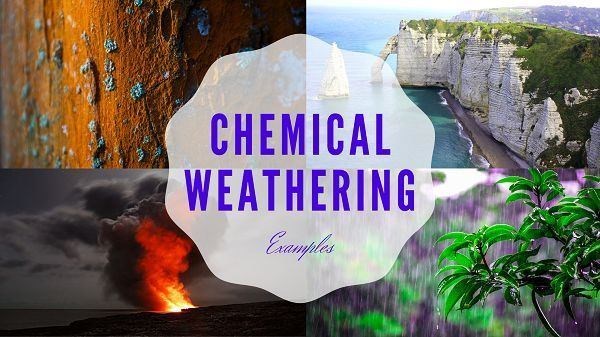
2. Chemical weathering is most intense in warm, wet climates. High temperatures promote chemical reactions and heavy rainfall provides the necessary moisture. This results in the alteration of the chemical composition of the weathered material due to a reaction which alters:
a. the composition of rock minerals
b. the volume of the rock
c. the strength and coherence of the rock
It tends to be concentrated at the rock surface or along joints and bedding planes. Block weathering and granular disintegration can also be the result of chemical weathering.
There are 3 major products if chemical weathering:
a. secondary minerals
b. resistant minerals e.g quartz
c. soluble products
The result of weathering is often known as regolith and is often composed mainly of unweathered and/or insoluble residues such as quartz sand and pebbles.
Chemical weathering is capable of penetrating more deeply into the rock than physical weathering and is particularly effective where rock is alternately wetted then dried. An example of this can be where there is seasonal fluctuation in the water table. Another example is Carbonation. This particularly affects limestone as it is altered to calcium bicarbonate which is taken into solution and re-precipitated as tufa, or calcite to form stalactites, stalagmites and helictites.
A key element in weathering is the presence of water. Solution/dissolution obviously occur, also acts as a medium for transporting acids etc. Hydration affects rock minerals which have the capacity to take up water. They increase in volume, which sets up stresses within the rock e.g conversion of iron oxides to iron hydroxides. This can cause surface flaking, similar to salt weathering. Hydrolysis is a complex reaction affecting minerals in igneous or metamorphic rocks e.g feldspar in granite – known as rotting – and produces potassium hydroxide and alumio-silicic acid. The former is carbonated and removed in solution. The alumio-silicic acid breaks down into clay minerals, notably kaolinite (china-clay) and is removed in solution. This is also known as spheroidal weathering, as it rounds off corners and affects statues, gargoyles etc. Chemist Jacobus Henricus van 't Hoff said that the speed of a reaction increases by 2½ times when the temperature rises by 10°C, so chemical weathering is greater in humid tropical climates in the main.

3. Biological weathering is the effect of living things such as tree roots: as a tree grows, its roots extend into the ground. As they grow and thicken, rocks are prised apart. Ivy growing on a building can loosen the bricks. It also occurs on a slower, smaller scale where mosses and lichens overlay rock.
a. Decomposition produces humic acid and this can result in the process of Chelation, the break down of rock minerals by organic acids. Humic acid can also be produced by excreta, especially where large areas rock are occupied by large colonies of seabirds such as gannets
b. Respiration by plant roots increases carbon dioxide in soil and assists the formation of weak acid as rainwater filters through the soil. Trees extract water from soil which can lead to shrinkage and ground subsides.
c. Burrowing animals such moles break up the rock and bring material to the surface where it is exposed to chemical weathering. Crustaceans on rocks at the coast bore holes in rocks and secretions of shellfish increase rate of weathering
d. Trampling - elephants trampling vegetation in game reserves in Zambia and Namibia have led to soil erosion which exposes bedrock which is then affected by weathering.

How to log this cache:
To log this cache, take a picture of monument made from the limestone rock at the coordinates. You also need to answer the following questions and answers send me to email in the profile:
1. What is the difference between sedimentary rocks and igneous rocks? Is limestone sedimentary or igneous rock (explain your opinion)?
2. What structure and color does a limestone at Monument? Is it affected by weathering?
3. Using the Peltier diagram above, find out what type of weathering is most likely to be affecting the limestone monument and why you think this is the type of weathering seen here?
4. Do you see any evidence of physical weathering at limestone? If yes, what do you see?
5. Do you see any evidence of chemical weathering at limestone? If yes, what do you see?
6. Do you see any evidence of biological weathering at limestone? If yes, what do you see?
7. Please post a photo of yourself, or GPS with the limestone rock from the monument.
Feel free to log this cache. You do not need to wait for permission to log. If your answers are not correct, incomplete, I will contact you by e-mail. But if your e-mail is not coming to me within 3 days from your log, I will delete your log without notice.

Si të regjistroni këtë cache:
Për të regjistruar këtë memorie, bëni një fotografi të monumentit të bërë nga shkëmbi gëlqeror në koordinatat. Ju gjithashtu duhet t'u përgjigjeni pyetjeve dhe përgjigjeve të mëposhtme më dërgoni në email në profil:
1. Cili është ndryshimi midis shkëmbinjve sedimentarë dhe shkëmbinjve magmatikë? A është guri gëlqeror sedimentar apo shkëmb magmatik (shpjegoni mendimin tuaj)?
2. Çfarë strukture dhe ngjyre ka një gur gëlqeror në Monument? A ndikohet nga moti?
3. Duke përdorur diagramin Peltier më sipër, zbuloni se çfarë lloj klime ka më shumë gjasa të ndikojë në monumentin gëlqeror dhe pse mendoni se ky është lloji i motit që shihet këtu?
4. A shihni ndonjë dëshmi të motit fizik në gur gëlqeror? Nëse po, çfarë shihni?
5. A shihni ndonjë dëshmi të motit kimik në gur gëlqeror? Nëse po, çfarë shihni?
6. A shihni ndonjë dëshmi të motit biologjik në gur gëlqeror? Nëse po, çfarë shihni?
7. Ju lutem postoni një foto të vetes ose GPS me shkëmbin gëlqeror nga monumenti.
Mos ngurroni të regjistroni këtë memorie të fshehtë. Nuk keni nevojë të prisni për leje për t'u regjistruar. Nëse përgjigjet tuaja nuk janë të sakta, të paplota, do t'ju kontaktoj me e-mail. Por nëse e-mail-i juaj nuk më vjen brenda 3 ditëve nga regjistri juaj, unë do ta fshij regjistrin tuaj pa paralajmërim.
Used sorces: