|

🇵🇱 Pomnik Polującej Diany we Wrocławiu ma swoją tajemnicę geologiczna. Witamy w moim kolejnym EarthCache. 🇬🇧 The Hunting Diana monument in Wrocław has its own geological secret. Welcome to my next EarthCache! 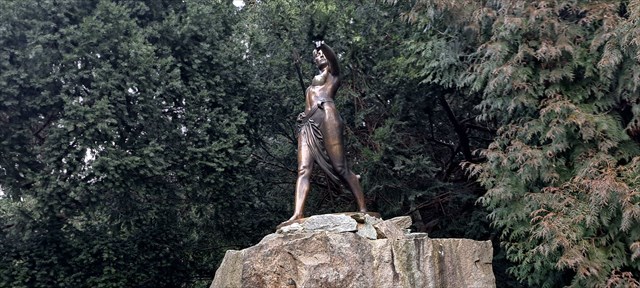
Polująca Diana / Hunting Diana Memorial
🇵🇱 Polująca Diana, rzymska bogini łowów i przyrody, powróciła do Parku Szczytnickiego – na skwer Zbyszka Cybulskiego, gdzie do 1945 roku stał jej pomnik. Rekonstrukcji pomnika podjęli się wspólnie Towarzystwo Miłośników Wrocławia, Polski Związek Łowiecki i miasto Wrocław. Swój wkład mieli także mieszkańcy, którzy wsparli projekt dobrowolnymi datkami.
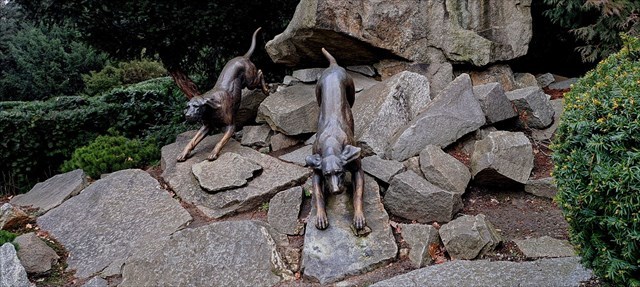
Pomnik Diany, a właściwie Grupa Diany (Dianegruppe), jak nazywano przed wojną pomnik, stał w parku Szczytnickim u zbiegu ulic Mickiewicza i Wróblewskiego. Antyczna bogini trzymała w ręku włócznię i towarzyszyły jej dwa psy myśliwskie. Wbiegała na cokół ułożony z głazów, które imitowały górski krajobraz. Wokół zasadzono drzewa iglaste i roślinność alpejską. Tę cześć parku nazywano nawet Ogrodem Diany. Pomnik autorstwa rzeźbiarza Ernsta Segera odsłonięto w sierpniu 1898 roku. Seger (1868-1939) urodził się w Nysie, studiował we Wrocławskiej Szkole Sztuki, a później w Paryżu. Jest współautorem wrocławskiej fontanny Alegorii Walki i Zwycięstwa na pl. Jana Pawła II. Spod jego dłuta wyszły postaci przedstawiające walkę i zwycięstwo.
🇬🇧 Hunting Diana, the Roman goddess of hunting and nature, returned to Szczytnicki Park - to Zbyszek Cybulski Square, where her monument stood until 1945. The reconstruction of the monument was undertaken jointly by the Society of Wrocław Lovers, the Polish Hunting Association and the city of Wrocław. Residents also contributed and supported the project with voluntary donations. The Diana Monument, or rather the Diana Group (Dianegruppe), as the monument was called before the war, stood in Szczytnicki Park at the corner of Mickiewicza and Wróblewskiego Streets.
The ancient goddess held a spear in her hand and was accompanied by two hunting dogs. She ran onto a pedestal made of boulders that imitated a mountain landscape. Coniferous trees and alpine plants were planted around. This part of the park was even called Diana's Garden. The monument by sculptor Ernst Seger was unveiled in August 1898. Seger (1868-1939) was born in Nysa, studied at the Wrocław School of Art, and later in Paris. He is the co-author of the Allegory of Struggle and Victory fountain in Wrocław on pl. John Paul II. Figures depicting struggle and victory were created by him.
Granit / Granite
🇵🇱 Granit, to skała naturalna powstała z głęboko osadzonej lawy wulkanicznej. W dużej mierze stanowi trwałe warstwy skorupy ziemskiej. Jest znacznie twardszy od marmuru, jego twardość wynosi od 6 do 7 stopni na skali Mohsa. Granit charakteryzuje się dużą gęstością i odpornością. Składa się z różnych minerałów, z których kwarc (35%) i skalenie (40%) stanowią główne składniki. Rodzaj skalenia obecnego w granicie wpływa na jego kolor. Zazwyczaj granit jest szary z niebieskim odcieniem, ale może mieć też odcienie różowego, żółtego lub czerwonego. Charakterystyczną cechą granitu jest ziarnistość, która może być gruba, średnia lub drobna.
Skały wulkaniczne, w tym granit, powstają przez krystalizację i częściowo przez wylewanie magmy w postaci szklistego krzepnięcia. W miarę stopniowego schładzania się magmy krystalizują poszczególne minerały tworząc skały magmowe. Charakter skały wytworzonej z magmy zależy nie tylko od składu magmy, ale często także od warunków fizycznych w środowisku, w którym zachodzi proces krzepnięcia magmy. W głębszych warstwach skorupy ziemskiej magma krzepnie powoli, co prowadzi do powstawania skał z wyraźnymi i często już makroskopowo rozpoznawalnymi minerałami.
Kiedy jednak magma rozlewa się na powierzchnię ziemi lub dno morskie, szybko ulega schłodzeniu. W rezultacie brakuje czasu na wykształcenie makroskopowo widocznych minerałów, co prowadzi do powstawania minerałów zazwyczaj o mikroskopowych rozmiarach lub nawet o strukturze szklistej. Gdy magma przenika do szczelin i pęknięć w skorupie ziemskiej, krzepnie w nich w formie tzw. żył.
🇬🇧 Granite is a natural rock formed from deep-seated volcanic lava. It largely constitutes the permanent layers of the earth's crust. It is much harder than marble, its hardness is 6 to 7 degrees on the Mohs scale. Granite is characterized by high density and resistance. It consists of various minerals, of which quartz (35%) and feldspar (40%) are the main components. The type of feldspar present in granite affects its color. Typically, granite is gray with a blue tint, but it can also have shades of pink, yellow or red. A characteristic feature of granite is its grain size, which can be coarse, medium or fine. Volcanic rocks, including granite, are formed by crystallization and partly by the outpouring of magma in the form of glassy solidification. As the magma gradually cools, individual minerals crystallize, forming igneous rocks. The nature of a rock formed from magma depends not only on the composition of the magma, but often also on the physical conditions in the environment in which the magma solidification process takes place. In the deeper layers of the Earth's crust, magma solidifies slowly, which leads to the formation of rocks with distinct and often macroscopically recognizable minerals. However, when magma spills onto the earth's surface or seabed, it cools quickly. As a result, there is no time for the formation of macroscopically visible minerals, which leads to the formation of minerals usually of microscopic size or even with a glassy structure. When magma penetrates into fissures and cracks in the earth's crust, it solidifies in them in the form of the so-called lived.
Ksenolity / Xenolites
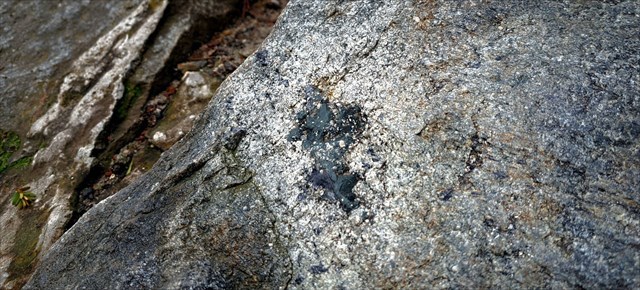
🇵🇱 Ksenolit, co oznacza "obcy kamien," wywodzi się od greckich słów "xenos" (obcy) i "lithos" (kamien). Ksenolit to fragment obcej skały znajdujący się wewnątrz skały gospodarza. Ksenolity różnią się od skały, w której się znajdują. Jeśli są podobne pod względem natury, nazywa się je autolitami lub pokrewnymi inkluzjami.
Prawdziwe ksenolity są zawsze starsze od skał gospodarza, ponieważ musiały istnieć jako stałe fragmenty skały, gdy wokół nich zastygała magma lub lawa. Ksenolit często jest skałą, która została włączona do magmy podczas jej ochładzania. Magma to stopiona skała pod skorupą ziemską. Jeśli magma wypływa na powierzchnię Ziemi, na przykład w wyniku erupcji wulkanicznej, staje się lawą, co jest równoważnikiem powierzchniowym magmy.
Skały wulkaniczne formują się z magmy i lawy, które stopniowo się ochładzają. Ksenolity stanowią różne rodzaje skał, które często są włączane do skał wulkanicznych. W zależności od obcego materiału skalnego, składu magmy lub lawy, temperatur, dostępnego czasu i wielu innych czynników, ksenolit ulega procesom chemicznego oddziaływania z otaczającą skałą w różnym stopniu. Ksenolity są zazwyczaj łatwo rozpoznawalne, ponieważ często różnią się składem, gęstością i kolorem od otaczającej skały. Zazwyczaj są one małe w porównaniu do całego ciała skały. Jednak ich rozmiar może się różnić od pojedynczych kryształów do fragmentów skał o długości kilku metrów.
🇬🇧
Xenolith, which means "foreign stone," comes from the Greek words "xenos" (foreign) and "lithos" (stone). A xenolith is a fragment of foreign rock found inside a host rock. Xenoliths are different from the rock in which they are found. If they are similar in nature, they are called autoliths or related inclusions. True xenoliths are always older than the host rocks because they must have existed as solid pieces of rock as magma or lava solidified around them. Xenolith is often a rock that has been incorporated into magma as it cools. Magma is molten rock beneath the Earth's crust. If magma flows to the Earth's surface, for example in a volcanic eruption, it becomes lava, which is the surface equivalent of magma. Volcanic rocks are formed from magma and lava that gradually cool. Xenoliths are different types of rocks that are often incorporated into volcanic rocks. Depending on the foreign rock material, the composition of magma or lava, temperatures, available time and many other factors, xenolite undergoes chemical interaction processes with the surrounding rock to varying degrees. Xenoliths are usually easily recognizable because they often differ in composition, density and color from the surrounding rock. They are usually small compared to the entire body of the rock. However, their size can vary from single crystals to rock fragments several meters long. 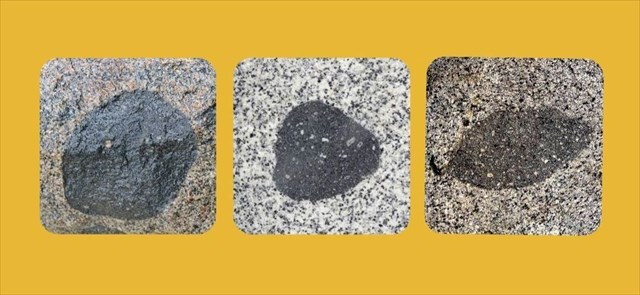
🇵🇱 Aby zalogować się jako „Found it”, prześlij mi odpowiedzi na te pytania za pośrednictwem mojego profilu:
1) Jak powstają skały magmowe i czym są ksenolity?
2) Znajdź niewypolerowany ksenolit, taki jak ten na zdjęciu i opisz, czym różni się kolorem i fakturą od skały macierzystej, granitu.
3) Zbadaj także inne ksenolity na pomniku. Ile widzisz takich podobnych?
4) Wrzuć do logu zdjęcie swoje lub swojego GPS z pomnikiem. 🇬🇧
For log as "found it" please send me answers for those questions via my profile:
1) How are igneous rocks formed and what are xenoliths?
2) Find an unpolished xenolith like the one in the photo and describe how it differs in color and texture from the parent rock, granite.
3) Also examine other xenoliths on the monument. How many similar ones do you see?
4) Post a photo of yourself or your GPS with the monument in the log.
🇵🇱 Zaloguj się od razu po wysłaniu odpowiedzi, jeśli coś pójdzie źle, odezwę się. 🇬🇧
Log in as soon as the answers are sent, if there's anything wrong, I'll answer.
Photos by DanielKotmel, 2024. Sources-
https://www.spektrum.de/lexikon/
geowissenschaften/xenolith/18433. 12.07.2024.
https://www.mineralienatlas.de/lexikon/
index.php/Xenolith?lang=de. 12.07.2024.
Grafics: https://www3.nd.edu/~cneal/
planetearth/Chapt-6-Marshak.pdf. 12.07.2024.

|