English version below
Mit diesem Earthcache werden wir das Phänomen der Mafic Multigranular Enclaves (MMEs) erforschen, mehr über den Prozess der Magma Mixing und Mingling erfahren und die Ergebnisse dieser Prozesse auf dem Gestein am Earthcache-Standort beobachten.
Bitte beachte, dass je nach Wasserstand im See möglicherweise ein Betreten des Wassers erforderlich ist. Es sollte jedoch flach sein und nicht tiefer als bis zum Knie
Fragen:
1. Betrachte den Stein aus allen möglichen Richtungen genau. Wie groß und welche Form haben die dunkelsten MMEs, die Du gefunden hast?
2. Wie groß und welche Form haben die hellsten MMEs, die Du gefunden hast?
3. Findest Du mehr von dunkelen oder von hellen MMEs?
4. Vergleiche die Mineralgröße zwischen den Enklaven und der Matrix des Wirtsgesteins. Welche Schlussfolgerungen kannst Du daraus ziehen?
5. Welche Beweise zeigen, dass sowohl eine Magma Mixing ls auch Magma Mingling stattgefunden hat?
Bitte beim Loggen des Caches ein Foto hochladen. Es reicht aus, dass auf dem Foto ein Gegenstand von Euch zu sehen ist, damit es klar ist, dass ihr den Earthcache besucht habt.
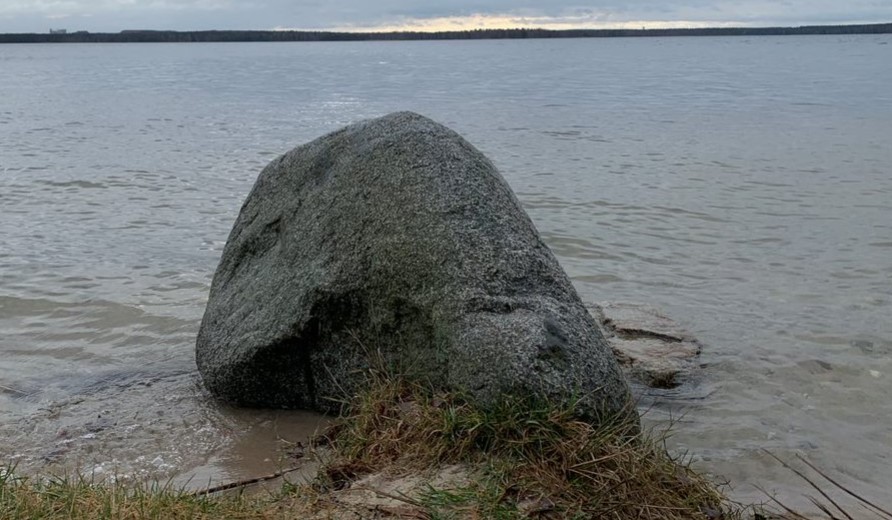
Quelle: Eiegene Foto
Am Ufer des Senftenberger Sees finden wir einen sehr interessanten Stein, auf dem wir interessante geologische Merkmale beobachten können. Wenn wir diesen Stein von allen Seiten betrachten, werden wir feststellen, dass er nicht einheitlich ist und wir an vielen Stellen Verfärbungen und Einschlüsse unterschiedlicher Farbintensität bemerken. Bevor wir uns diesen Stein genauer ansehen, lass uns zunächst den Gesteinstyp identifizieren und feststellen welche Strukturmerkmale für uns sichtbar sind.
Granodiorit
Wir haben hier mit Granodiorit zu tun. Granodiorit ist ein magmatisches Tiefengestein, das eine Zusammensetzung zwischen Granit und Diorit aufweist. Es besteht hauptsächlich aus felsischen Mineralien Plagioklas-Feldspat und Quarz sowie mafischen Biotit- oder Amphibol-Mineralien. Das Verhältnis von mafischen zu felsischen Mineralien ist mehr oder weniger ausgegliechen. Diese Mineralzusammensetzung sagt uns dass das Magma vor seiner Erstarrung eine nahezu mittlere Zusammensetzung zwischen felsischen und mafischen Mineralien aufwies.
Was sind mafische mikrogranulare Einschlüsse (MMEs) und wie entstehen sie?
Wenn wir die Oberfläche unseres Steins betrachten, werden wir viele Unregelmäßigkeiten, Einschlüsse, Flecken und Verfärbungen erkennen. Diese Unregelmäßigkeiten werden mafische mikrogranulare Enklaven (MME) genannt. Mafische mikrogranulare Einschlüsse (MMEs) entstehen durch die Magmenmischung von zwei Arten von Magma. Allerdings müssen wir hier vorsichtig sein. Der deutsche Begriff „Magmenmischung“ kann eigentlich zwei verschiedene Prozesse beschreiben, die im Englischen heißen: Magma Mingling und Magma Mixing. Wissenschaftliche Studien, die den Ursprung von Grandiorit mit signifikanten Ungleichgewichtstexturen und -merkmalen wie MMEs untersuchten, legen nahe, dass MMEs durch beide Prozesse entstehen können: Magma Mingling und Magma Mixing.
Magma Mingling
Magma Mingling findet statt, wenn sich Magma aus zwei Magmakammern mit unterschiedlichen Arten von Magma treffen und das Magma aufgrund von Druck und anderen Faktoren von einer Magmakammer in die andere eindringt. Wobei bei Magma Mingling findet keine chemische Reaktion statt. Es findet nur physischer Kontakt statt. Das umgebende felsische Magma ist kühler im Vergleich zum mafisch eindringenden Magma. Dies führt zu einer schnellen Abkühlung des mafischen Magmas, das relativ schnell erstarrt. Dadurch weisen die Enklaven eine feinkörnige Textur und eine intensivere dunkle, fast schwarze Farbe, die für mafische Mineralien typisch ist, auf.
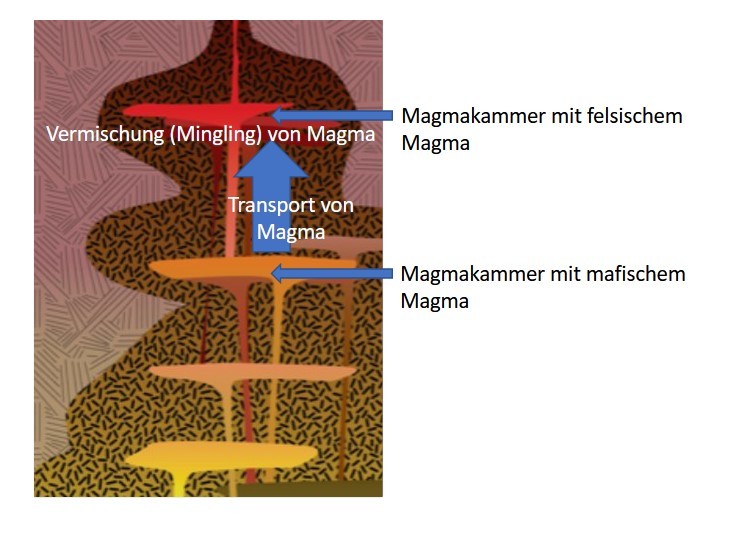
Quelle: Eigene Arbeit
Magma Mixing
Andererseits kommt es zu einer Magma Mixing. Wenn die beiden Magmaarten aufeinandertreffen, kann es auch dazu kommen, dass aufgrund von Temperatur und Druck beide Magmaarten anfangen, chemisch miteinander zu reagieren. Insgesamt ändert sich die chemische und mineralogische Zusammensetzung des Magmas. Wenn der Magma Mixing Vorgang vollständig abgeschlossen ist, erhalten wir eine gleichmäßige Textur des Gesteins ohne Unregelmäßigkeiten, ohne Flecken oder ohne MMEs. Allerdings kann es auch vorkommen, dass der bereits begonnene Magma-Mixingvorgang nicht zu Ende geführt wird. Dies kann in unterschiedlichem Ausmaß geschehen. Der Grad des Magma-Mixingprozesses erstreckt sich über ein Kontinuum von der Mingling bis zur vollständigen Hybridisierung. Dies hängt von den Anfangs- und Randbedingungen, den Magmaeigenschaften, den Antriebskräften und der für die Vermischung (Mixing) verfügbaren Zeit ab. Das Ergebnis dieses Prozesses kann von uns beobachtet werden. Wir werden blasse, weniger unterscheidbare Kleckse oder MMEs auf der Oberfläche des Gesteins sehen.
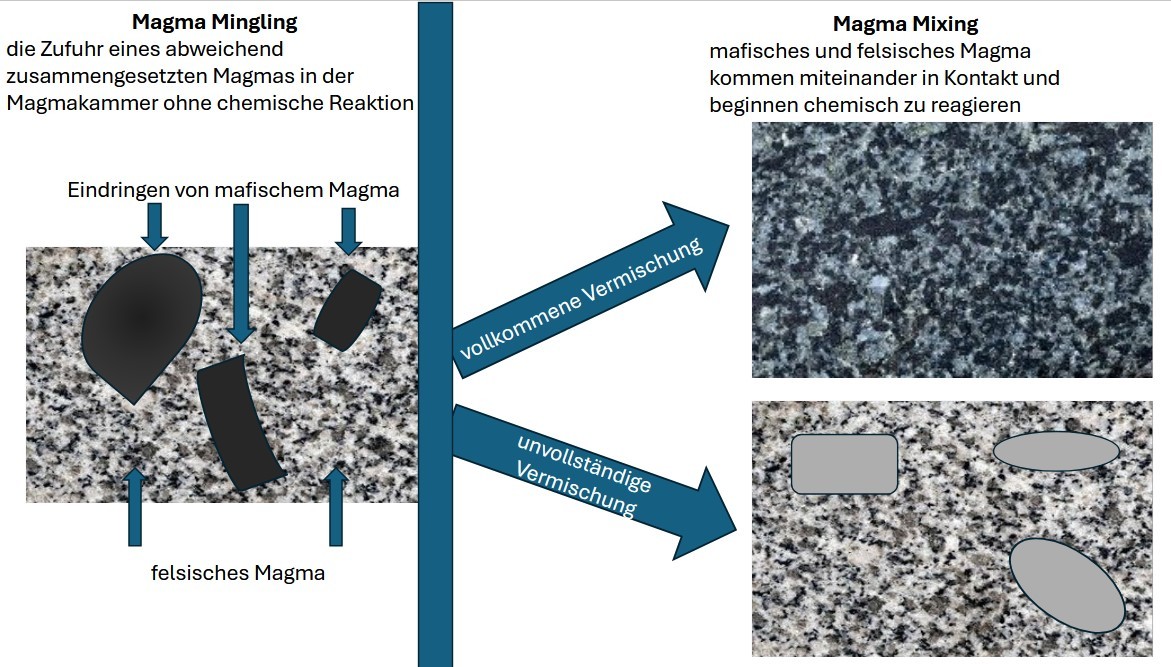
Quelle: Eigene Arbeit
Quellen:
Frank J. Spera, Jason S. Schmidt, Wendy A. Bohrson, Guy A. Brown, 2016, Dynamics and thermodynamics of magma mixing: Insights from a simple exploratory model, American Mineralogist, Volume 101, pages 627–643
De-zi, Wang & Lei, Xie. (2008). Magma Mingling: Evidence from Enclaves. Geological Journal of China Universities.
A. Ersoy, M.D. Waller, 1996, Textural characterisation of rocks, Engineering Geology Volume 39, Issues 3–4, June 1995, Pages 123-136
Baxter, Sadhbh & Feely, Martin. (2003). Field and petrographic evidence for magma mixing and mingling in granitoids: examples from the Galway Granite, Connemara, Ireland.. Abstracts with Programmes, Geological Society of America,NE Section.
Qi, H.; Lu, S.; Yang, X.; Deng, J.; Zhou, Y.; Zhao, L.; Li, J.; Lee, I. The Role of Magma Mixing in Generating Granodioritic Intrusions Related to Cu–W Mineralization: A Case Study from Qiaomaishan Deposit, Eastern China. Minerals 2020, 10, 171. https://doi.org/10.3390/min10020171
https://magma.geol.ucsb.edu/papers/AM101/AM101P0627.pdf
https://www.sciencedirect.com/science/article/abs/pii/S0024493717303067
https://opentextbooks.uregina.ca/geolmanual/chapter/overview-of-igneous-rocks/
https://geologyistheway.com/igneous/magma-mingling-and-mixing/
Vielen Dank an TrueGeo, der mich dazu inspiriert hat, diese Earthcache zu erstellen, und der mir die notwendigen Hinweise gegeben hat, wie MMEs aussehen und was sie sind.
ENGLISH VERSION
With this Earthcache we will explore the phenomenon of Mafic Microgranular Enclaves (MMEs), learn more about the process of magma mixing and mingling, and observe the results of these processes on the rock at the Earthcache coordinates.
Please note that depending on the water level in the lake, entering the water may be necessary, but it should be shallow and no deeper than knee deep.
Questions:
1. Look closely at the rock from all possible directions. What is the size and shape of the darkest MMEs you have found?
2. What is the size and shape of the lightest MMEs you have found?
3. Have you found more dark or light MMEs?
4. Compare the mineral size between the enclaves and the matrix of the host rock. What conclusions can you draw from this?
5. What evidence shows that both magma mixing and magma mingling have occurred?
Please upload a photo when logging the cache. It is sufficient that an object is visible in the photo so that it is clear that you have visited the Earthcache.
Source: Own photo
On the shore of Senftenberg Lake we find a very interesting stone on which we can observe interesting geological features. If we look at this stone from all sides, we will notice that it is not uniform and in many places we notice discolorations and inclusions of different color intensities. Before we take a closer look at this stone, let's first identify the type of rock and determine which structural features are visible to us.
Granodiorite
We are dealing with granodiorite here. Granodiorite is a plutonic igneous rock that has a composition between granite and diorite. It consists mainly of felsic minerals plagioclase feldspar and quartz as well as mafic biotite or amphibole minerals. The ratio of mafic to felsic minerals is more or less balanced. This mineral composition tells us that the magma had an almost intermediate composition between felsic and mafic minerals before it solidified.
What are mafic microgranular inclusions (MMEs) and how do they form?
If we look at the surface of our stone, we will see many irregularities, inclusions, spots and discolorations. These irregularities are called mafic microgranular enclaves (MMEs). Mafic microgranular inclusions (MMEs) are formed by the mixing of two types of magma. Scientific studies that investigated the origin of grandiorite with significant disequilibrium textures and features such as MMEs suggest that MMEs can be formed by both processes: magma mingling and magma mixing.
Magma Mingling
Magma mingling occurs when magma from two magma chambers containing different types of magma meet and the magma intrudes from one magma chamber into the other due to pressure and other factors. There is no chemical reaction in magma mingling. Only physical contact occurs. The surrounding felsic magma is cooler compared to the mafic intruding magma. This leads to rapid cooling of the mafic magma, which solidifies relatively quickly. This gives the enclaves a fine-grained texture and a more intense dark, almost black color typical of mafic minerals.
 Source: Own work
Magma Mixing
On the other hand, magma mixing occurs. When the two types of magma meet, it can also happen that due to temperature and pressure, both types of magma start to react chemically with each other. Overall, the chemical and mineralogical composition of the magma changes. When the magma mixing process is fully completed, we get a uniform texture of the rock with no irregularities, no patches, or no MMEs. However, it can also happen that the magma mixing process that has already started is not completed. This can happen to varying degrees. The degree of the magma mixing process spans a continuum from mingling to complete hybridization. This depends on the initial and boundary conditions, the magma properties, the driving forces, and the time available for mixing. The result of this process can be observed by us. We will see pale, less distinguishable blobs or MMEs on the surface of the rock.

Source: Own work
Sources:
Frank J. Spera, Jason S. Schmidt, Wendy A. Bohrson, Guy A. Brown, 2016, Dynamics and thermodynamics of magma mixing: Insights from a simple exploratory model, American Mineralogist, Volume 101, pages 627–643
De-zi, Wang & Lei, Xie. (2008). Magma Mingling: Evidence from Enclaves. Geological Journal of China Universities.
A. Ersoy, M.D. Waller, 1996, Textural characterisation of rocks, Engineering Geology Volume 39, Issues 3–4, June 1995, Pages 123-136
Baxter, Sadhbh & Feely, Martin. (2003). Field and petrographic evidence for magma mixing and mingling in granitoids: examples from the Galway Granite, Connemara, Ireland.. Abstracts with Programmes, Geological Society of America,NE Section.
Qi, H.; Lu, S.; Yang, X.; Deng, J.; Zhou, Y.; Zhao, L.; Li, J.; Lee, I. The Role of Magma Mixing in Generating Granodioritic Intrusions Related to Cu–W Mineralization: A Case Study from Qiaomaishan Deposit, Eastern China. Minerals 2020, 10, 171. https://doi.org/10.3390/min10020171
https://magma.geol.ucsb.edu/papers/AM101/AM101P0627.pdf
https://www.sciencedirect.com/science/article/abs/pii/S0024493717303067
https://opentextbooks.uregina.ca/geolmanual/chapter/overview-of-igneous-rocks/
https://geologyistheway.com/igneous/magma-mingling-and-mixing/
Many thanks to TrueGeo for inspiring me to create this Earthcache and for giving me the necessary clues about what MMEs look like and what they are.