


click
on the flag to reach the translation
Una
Earthcache
Questa non è una cache fisica. Per
accedere a questa cache, devi prima leggere la sua descrizione
didattica della geologia, quindi osservare il sito in cui ti trovi e
infine rispondere alle domande che verranno poste. Un livello di
difficoltà Earthcache più alto
richiederà risposte più avanzate.
Potrai quindi accedere a "Trovato" senza aspettare, ma devi inviarmi
contemporaneamente le tue risposte contattandomi tramite e-mail nel mio
profilo o tramite la messaggistica di geocaching.com (Centro messaggi),
e io ti contatterò in caso di problemi. I log registrati
senza risposte o senza foto verranno eliminati.

Un
po' di geologia
◊ Graniti e lave:
rocce magmatiche
I graniti sono rocce plutoniche, mentre le lave sono
rocce vulcaniche. Provengono tutti dal raffreddamento di un
magma
ma la loro
formazione è avvenuta in due contesti completamente diversi:
- o i magmi vengono fermati in profondità e lì
cristallizzano molto lentamente e gradualmente: si formano allora rocce
plutoniche;
- o i magmi affiorano alla superficie della Terra nel fenomeno del
vulcanismo: nascono così le rocce vulcaniche.
Ad ogni roccia plutonica corrisponde una roccia vulcanica, avente la
stessa composizione chimica e minerale, ma diversa nella tessitura,
tuttavia la loro distribuzione geografica e quantitativa non
è affatto la stessa sulla superficie della Terra.
Alcune delle principali tessiture delle rocce eruttive sono:
- la tessitura granulosa (grani visibili ad occhio nudo) per le rocce
plutoniche;
- la tessitura microlitica (cristalli microscopici) per le rocce
vulcaniche.
Le rocce eruttive sono classificate e denominate in base alla loro
composizione e ad altri parametri. Parlando solo della composizione, i
principali minerali che consentono questa classificazione in base alla
loro presenza o assenza sono:: quarzo,
feldspati alcalini, plagioclasio e altri minerali come miche, anfibolo,
pirosseno o olivina.
◊
Granito : una roccia granulosa
Il granito è la roccia plutonica più
diffusa. Il suo nome deriva dal fatto che è formato da grani
visibili ad occhio nudo, in media da 2 a 5 mm. Quando i cristalli sono
più grandi si parla di pegmatite. Quando sono più
piccoli la struttura è microgranulosa.
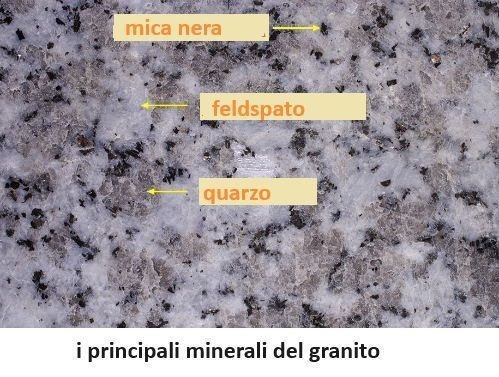
I principali minerali che costituiscono un granito sono: quarzo,
feldspati alcalini, feldspati plagioclasici e altri minerali come miche
o anfiboli. L'equivalente vulcanico del granito è la
riolite, una roccia più rara.
◊
MESSA
A FUOCO
♦
Alcuni graniti presentano una tessitura molto particolare con
predominanza di fenocristalli di ortoclasio.
I fenocristalli sono cristalli la cui dimensione è superiore
a un centimetro. La presenza di questo tipo di cristalli permette al
granito di essere definito porfiroide.
L'ortoclasio è un feldspato potassico alcalino. L'ortoclasio
si presenta in cristalli spesso bianchi, eventualmente rosa (legati
alla presenza di ossido di ferro), raramente rossi, che disegnano sulla
superficie della roccia rettangoli abbastanza regolari, talvolta
arrotondati.
Quando tutti i fenocristalli di feldspato ortoclasio sono orientati
parallelamente tra loro, ciò indica che quando
cristallizzarono mentre erano in un fluido: il magma
“animato” da una corrente molto rettilinea
♦ I cristalli di K-feldspato sono spesso orientati.
Questo allineamento suggerisce che questi minerali precedentemente
cristallizzati siano stati portati via dal flusso di magma.
L'orientamento preferenziale dei minerali si verifica anche quando il
magma ancora viscoso viene compresso: i cristalli sono orientati
perpendicolarmente all'appiattimento, e la roccia presenterà
quindi un flusso planare. Quando si verifica la cristallizzazione di
massa, la disposizione dei minerali viene fossilizzata.
♦ A volte si possono osservare enclave arrotondate
di rocce cristalline scure. Potrebbero trattarsi di "gocce" di magma
basico sfuggito alla miscelazione con il magma acido

Domande
Un'attenta lettura della descrizione della cache,
così
come l'osservazione delle caratteristiche del terreno e una piccola
deduzione sono normalmente sufficienti per rispondere alle domande in
questa EarthCache. I log registrati senza risposte o senza foto
verranno eliminati. Un livello di difficoltà Earthcache
più alto richiederà risposte più
avanzate.
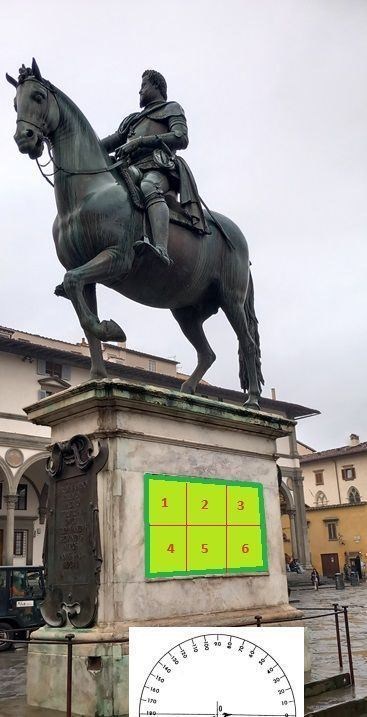
Domanda
0 - Scatta una foto di te, o del tuo oggetto
geocacher distintivo, o del tuo soprannome scritto su un pezzo di carta
o che hai in mano... con
la statua sullo sfondo, e allegala al tuo registro o alle
tue risposte
Domanda
1 - Quanti tipi di feldspato osservate in questo
granito e con quali differenze sostanziali?
Domanda 2 - Quali
termini ti sembrano appropriati osservando questa roccia: granuloso,
microlitico, porfiroide, fenocristalli, ferro, anfibolo
Domanda 3 - Osservate
un orientamento in questo granito? Se sì, qual è
l'orientamento del flusso di magma (dato dal goniometro
sull'immagine). In caso contrario, come si chiama questo tipo di
cristallizzazione?
Domanda 4 - In
quale zona (vedere la griglia numerata sulla foto) si può
osservare la
singolarità del magma basico mescolato al flusso di
raffreddamento.
Une
Earthcache
Il ne s’agit pas d’une cache
physique. Pour loguer
cette cache, vous devez dans un premier temps prendre connaissance de
sa description éducative en matière de
géologie,
puis d’observer le site sur lequel vous êtes, et
enfin de
répondre aux questions qui vous seront posées.
Une
cotation plus élevée de la difficulté
de
l'earthcache nécessitera des réponses plus
avancées.
Vous pourrez alors loguer en "Found it" sans attendre mais vous devez
me faire parvenir vos réponses en même temps en me
contactant soit par mail dans mon profil, soit via la messagerie
geocaching.com (Message Center), et je vous contacterai en cas de
problème. Les logs enregistrés sans
réponses ou
sans photo seront supprimés.
Un
peu de géologie
◊ Granites et laves :
des
roches magmatiques
Les granites sont des roches magmatiques plutoniques, alors que les
laves sont des roches magmatiques volcaniques. Toutes proviennent du
refroidissement d’un magma mais leur formation
s’est effectuée dans deux contextes totalement
différents :
- soit les magmas sont stoppés en profondeur et y
cristallisent très lentement et progressivement : il se
forme alors des roches plutoniques ;
- soit les magmas viennent s’épancher à
la surface de la Terre dans le phénomène du
volcanisme : ainsi naissent des roches volcaniques.
Pour chaque roche plutonique, il existe une roche volcanique
correspondante, ayant la même composition chimique et
minérale, mais différente par la texture,
cependant leur répartition géographique et
quantitative n’est pas du tout la même à
la surface de la Terre.
Les principales textures des roches éruptives sont :
- la texture grenue (grains visibles à
l’œil nu) pour les roches plutoniques ;
- la texture microlitique (cristaux microscopiques) pour les roches
volcaniques.
Les roches éruptives sont classées et
dénommées en fonction de leur composition. Les
principaux minéraux qui permettent cette classification par
leur présence ou leur absence sont : le quartz, les
feldspaths alcalins, les plagioclases et d’autres
minéraux comme les micas, l’amphibole, le
pyroxène ou l’olivine.
◊ Le
granite à
grains
Le granite est la roche magmatique plutonique la plus
répandue. Son nom vient du fait qu’il est
constitué de grains visibles à
l’œil nu, de 2 à 5 mm en moyenne. Quand
les cristaux sont plus grands, on parle de pegmatite. Quand ils sont
plus petits, la structure est microgrenue.

Les principaux minéraux qui constituent un granite sont : le
quartz, les feldspaths alcalins, les feldspaths plagioclases et
d’autres minéraux comme les micas ou
l’amphibole. L’équivalent volcanique du
granite est la rhyolite, une roche plus rare.
◊
FOCUS
♦
Certains granites présentent une texture
très particulière avec une
prédominance de phénocristaux
d'orthose.
On appelle phénocristaux des cristaux dont la
taille est supérieure au centimètre. La
présence de ce type de cristaux permet de donner le
qualificatif de porphyroïde au granite.
L'orthose est un feldspath alcalin potassique.
L'orthose se présente en cristaux fréquemment
blancs, éventuellement roses (lié à la
présence d'oxyde de fer), rarement rouges, dessinant
à la surface de la roche, des rectangles assez
réguliers, parfois arrondis.
Lors que tous les phénocristaux de feldspath
orthose sont orientés parallèlement les uns aux
autres, cela indique que lorsqu’ils ont
cristallisé alors qu'ils se trouvaient dans un fluide : le
magma « animé » par un courant bien
rectiligne
♦ Les cristaux de feldspath potassique sont souvent
orientés. Cet alignement suggère que ces
minéraux précédemment
cristallisés ont été
entrainés par l'écoulement du magma.
L'orientation préférentielle des
minéraux se produit aussi lorsque le magma encore visqueux
est comprimé : les cristaux s'orientent perpendiculairement
à l'aplatissement, et la roche présentera alors
un débit planaire. Lorsque la cristallisation en masse
intervient, la disposition des minéraux est
fossilisée.
♦ On peut parfois observer des enclaves arrondies de
roches sombres cristallines. Il pourrait s'agir de "gouttes" de magma
basique qui ont échappé au mélange
avec le magma acide
Questions
La lecture attentive du descriptif de la cache,
ainsi qu'une observation des éléments de terrain
et un peu de déduction sont normalement suffisants pour
répondre aux questions de cette EarthCache. Les logs
enregistrés sans réponses ou sans photo seront
supprimés. Une cotation plus élevée de
la difficulté d'une earthcache nécessitera des
réponses plus avancées.
Question
0 - Prenez une photo de vous, ou de votre objet
distinctif de géocacheur, ou de votre pseudo
écrit sur une feuille de papier ou dans votre main... avec la statue
arrière-plan,
et
joignez-là à votre log ou
à vos réponses
Question
1 - Combien observez-vous de types de feldspath
dans ce granite, avec quelles différences majeures ?
Question 2 - Quels
termes vous semblent appropriés en observation cette roche :
grenu, microlitique, porphyroïde, phénocristaux,
fer, amphibole
Question 3 - Observez-vous
une orientation dans ce granite ? Si oui, quelle est
l’orientation du flux magmatique (donnée par le
rapporteur sur l’image). Si non, comment appelle-t-on ce type
de cristallisation ?
Question 4 - Dans
quelle zone (cf grille numérotée sur la
photo) pouvez-vous observer la
singularité de magma basique s’étant
mêlé au flux refroidissant.
An
Earthcache
It is not a physical cache. To log this cache, you
must first
learn about its educational description in geology, then observe the
site on which you are, and finally answer the questions that will be
asked. A higher difficulty rating of the earthcache will require more
advanced answers.
You can then log in "Found it" without waiting but you must send me
your answers at the same time by contacting me either by mail in my
profile, or via the messaging geocaching.com (Message Center), and I
will contact you in case of problem. Saved logs without answers nor
photo will be deleted.
A
little of geology
◊ Granites
and lavas:
magmatic rocks
Granites are plutonic magmatic rocks, while lavas are volcanic magmatic
rocks. All come from the cooling of a magma but their formation took
place in two totally different contexts:
- either the magmas are stopped in depth and crystallize there very
slowly and gradually: plutonic rocks are then formed;
- or the magmas spread on the Earth’s surface in the
phenomenon of volcanism: thus volcanic rocks are born.
For each plutonic rock, there is a corresponding volcanic rock, having
the same chemical and mineral composition, but different in texture,
however their geographical and quantitative distribution is not at all
the same at the surface of the Earth.
Some of main textures of eruptive rocks are:
- grainy texture (visible to the naked eye) for plutonic rocks;
- microlitic texture (microscopic crystals) for volcanic rocks.
Eruptive rocks are classified and named according to their composition
and to other parameters. Speaking about composition only, the main
minerals that allow this classification by their presence or
absence are: quartz, alkaline feldspars, plagioclases and other
minerals such as micas, amphibole, pyroxene or olivine.
◊ The
grain granite
Granite is the most common plutonic magmatic rock. Its name comes from
the fact that it consists of grains visible to the naked eye, from 2 to
5 mm on average. When the crystals are larger, we talk about pegmatite.
When they are smaller, the structure is micrograined.

The main minerals that make up a granite are: quartz, alkaline
feldspars, plagioclase feldspars and other minerals such as micas or
amphibole. The volcanic equivalent of granite is rhyolite, a rarer rock.
◊
FOCUS: The texture of
granite
♦ Some granites have a very particular texture with a
predominance of orthoclase phenocrysts.
Phenocrystals are crystals whose size is greater than one centimeter.
The presence of this type of crystal allows granite to be called
porphyroid.
Orthoclase is an alkali potassium feldspar. Orthoclase occurs in
crystals that are frequently white, possibly pink (linked to the
presence of iron oxide), rarely red, drawing fairly regular rectangles
on the surface of the rock, sometimes rounded.
When all the orthoclase feldspar phenocrysts are oriented parallel to
each other, this indicates that when they crystallized while they were
in a fluid: the magma “animated” by a very
rectilinear current
♦ K-feldspar crystals are often oriented. This
alignment suggests that these previously crystallized minerals were
carried away by magma flow. The preferential orientation of minerals
also occurs when the still viscous magma is compressed: the crystals
are oriented perpendicular to the flattening, and the rock will then
present a planar flow. When mass crystallization occurs, the
arrangement of minerals is fossilized.
♦ Rounded enclaves of dark crystalline rocks can
sometimes be observed. These could be "drops" of basic magma which
escaped mixing with the acidic magma
Questions
Careful reading of the description of the cache, as
well as an observation of the terrain features and a little deduction
are normally sufficient to answer the questions of this EarthCache.
Logs recorded without answers or without a photo will be deleted. A
higher difficulty rating of an earthcache will require more advanced
answers.
Question
0 - Take a
picture of yourself, or your distinctive geocacher object, or your
nickname written on a sheet of paper or in your hand... with the statue in the
background, and attach it to your log or your answers
Question
1 - How many types of feldspar do you observe in
this granite, with what major differences?
Question 2 - What
terms seem appropriate to you when observing this rock: grainy,
microlitic, porphyroid, phenocrysts, iron, amphibole
Question 3 - Do you
observe an orientation in this granite? If yes, what is the orientation
of the magma flow (given by the protactor on the image). If not, what
is
this type of crystallization called?
Question 4 - In which
area (refer to number grid on the photo) can you observe the
singularity of basic magma having mixed with the cooling flow.