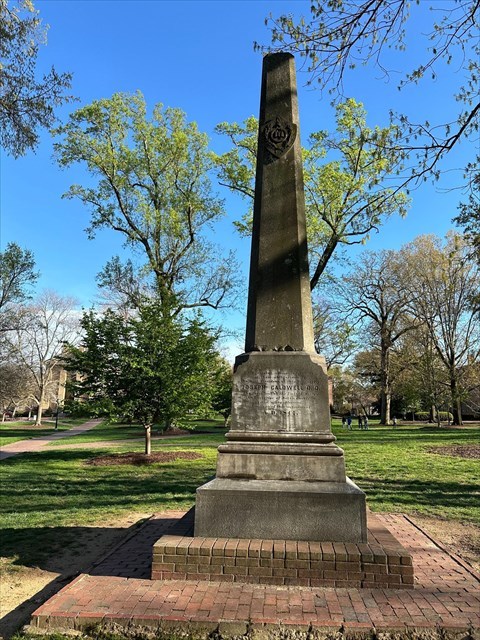
The Joseph Caldwell Monument stands as a tribute to one of the most influential figures in the history of the University of North Carolina at Chapel Hill. Joseph Caldwell was the university's first president and played a pivotal role in its establishment and early development. The monument symbolizes his enduring legacy and contributions to education in North Carolina. It serves as a reminder of the university's rich history and the dedication of those who have shaped its path.
At first glance, it might be hard to believe but the monument you see in front of you is actually constructed from marble, which is formed through the metamorphism of limestone, a sedimentary rock primarily composed of calcium carbonate. Over thousands of years, intense heat and pressure within the Earth's crust alter the mineral composition and crystal structure of limestone, resulting in the creation of marble. Despite its durability, marble is vulnerable to the corrosive effects of acid rain. Acid rain is a result of sulfur dioxide and nitrogen oxides reacting with moisture in the atmosphere and it can slowly dissolve the calcium carbonate present in marble. Over time, this chemical reaction weakens the structure of the marble, causing it to deteriorate and lose its aesthetic appeal. The acidic nature of rainwater exacerbates this process, leading to etching, pitting, and discoloration of the marble surface. The Joseph Caldwell Monument was raised in 1847, and formally dedicated on June 2, 1858. The monument has been exposed to the elements for the past 160 years, which are responsible for giving it the weathered appearance you see in front of you.
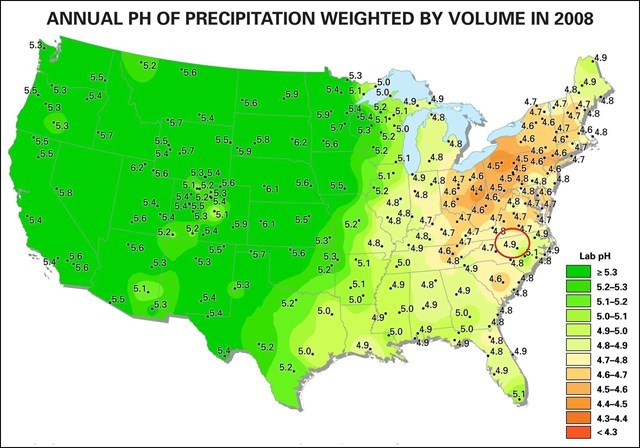
The map above shows the average pH of rainwater around the United States. The Chapel Hill area has been circled. Acid rain has been, and still is a major issue along the east coast. In the South in particular, it is partly due to the prevalence of coal fired power plants and manufacturing facilities. These industries emit significant amounts of sulfur dioxide and nitrogen oxides, which react with atmospheric moisture to form acidic compounds. Coal combustion, in particular, releases large quantities of sulfur dioxide, while manufacturing processes can emit nitrogen oxides. The South's heavy reliance on these industries for energy and economic growth exacerbates the problem. Historically, acid rain has been a more severe problem in the past, especially during the second half of the 20th century when industrial activity was less regulated. Emissions from coal fired power plants and manufacturing facilities were largely uncontrolled, leading to widespread acid deposition and environmental damage. However, in recent decades, there have been efforts to reduce emissions of sulfur dioxide and nitrogen oxides through regulatory measures such as the Clean Air Act in the United States. As a result, there has been some improvement in air quality and a reduction in the severity of acid rain in many regions, including the South.
| Visual Weathering Class |
Visual Indicators of Class |
| 1 |
Lettering sharp and distinct. No evidence of change. |
| 2 |
Lettering slightly rounded showing evidence of some removal of grains. Still legible and cleat though. |
| 3 |
Lettering rounded. Edges clearly being removed and some original edges removed completely. Still legible and clear. |
| 4 |
Lettering rounded. All or most original edges removed, but lettering still legible, but increasingly becoming indistinct from the surface of stone. |
| 5 |
Lettering disintegrating. Lettering still just about legible, but now almost indistinguishable from the surface of the stone. |
| 6 |
What lettering? Lettering virtually disappeared. Need to be able to make out date to be able to date period over which lettering has disappeared. |
One of the issues associated with acid rain is that carvings may be negatively affected. Over time, the lettering becomes progressively roughened and difficult to read. The edges of the carved surface become less distinct as granular disintegration occurs. Next, the whole letter begins to merge into the surface of the stone as the surface of the stone is removed by erosion. Eventually the lettering becomes almost indistinguishable from the surface of the stone itself. The weathering of carvings made in stone can be classified into 6 Visual Weathering Classes, as shown in the table above.
Logging Requirements:
- Examine the surface of the Joseph Caldwell Monument. How would you classify the condition of the carvings, based on the Visual Weathering Class scale? Do all four sides appear equally weathered or is one side more weathered than the others?
- Next, proceed to the Memory of the Founding Trustees Monument, which also is constructed from marble. This monument was erected in 1995. How would you classify the condition of the carvings, based on the Visual Weathering Class scale? Compare what you see here to the Joseph Caldwell Monument. How do you think the rate of weathering of the carvings will change over the next 100 years?
- Upload a photo taken with the Joseph Caldwell Monument. You don't have to be in the photo, though it is strongly encouraged.
Sources:
- https://docsouth.unc.edu/commland/monument/201/
- http://www.envf.port.ac.uk/geo/inkpenr/graveweb/methods.htm