Rappel concernant les « Earthcaches »
ATTENTION, il n'y a pas de conteneur à rechercher ni de logbook à renseigner. Il suffit de se rendre sur les lieux d'observations puis de réaliser les conditions de validation ci-dessous.
Une Earthcache ayant comme objectif de mettre en pratique une leçon de géologie par des observations de terrain, il est conseillé de lire le descriptif afin de vous aider à répondre aux questions.
Questions pour valider la cache géologique
- Question 0 : Prenez une photo de vous ou votre pseudo devant une des mosaïques de l'île Penotte.
Cette photo devra au choix nous être transmise avec les réponses ou être ajoutée à votre log.
Vous voici à l'angle des rues d'Assas et Trompeuse. Observez les zones A, B, C et D de la photo WP1.
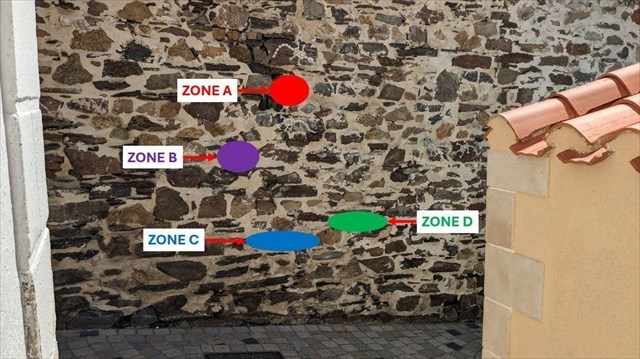
- Question 1 : Associez chaque zone à une des roches décrites dans le descriptif ci-dessous en expliquant votre réponse par vos observations.
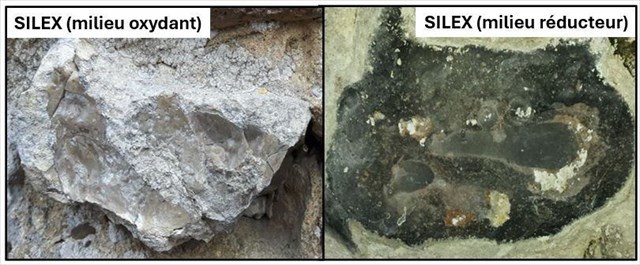
- Question 2 : Pour le bloc étant un silex, vous pouvez noter deux zones (centrale et distale) avec 2 couleurs distinctes. Quelle zone s'est formée dans des conditions réductrices ?
- Question 3 : Pour le bloc étant un schiste, quel minéral est responsable de sa variation de couleur
en surface ?
Vous pouvez vous loguer sans attendre notre confirmation,
mais vous devez nous envoyer les réponses en même temps soit par mail via notre profil (
fafahakkai), soit via la messagerie geocaching.com (Message Center).
S'il y a des problèmes avec vos réponses nous vous en ferons part.
Les logs enregistrés sans réponse seront supprimés.
Et en théorie, cela donne quoi ?
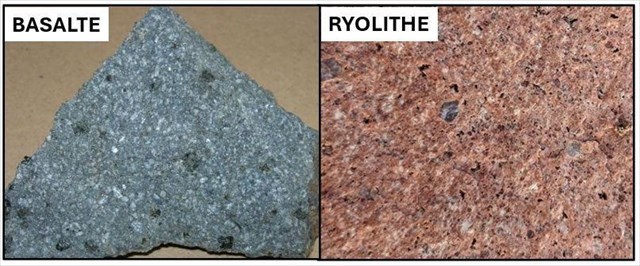
► Rhyolite ou Basalte, roches magmatiques volcaniques
Les roches volcaniques se caractérisent par une cristallisation rapide du magma donnant une matrice à texture très fine (cristaux majoritairement invisibles à l'œil nu).
Ces roches sont cristallines, très dures, sans aucune orientation (pas de litage ou de couches).
Selon la composition chimique, on obtient deux roches différentes :
- Si le magma est acide (riche en silice), cela donne de la rhyolite, une roche claire de couleur rouge profond car riche en hématite (cristal à forte teneur en fer oxydée).
- Si le magma est basique (riche en ferromagnésiens), cela donne du basalte de couleur sombre.
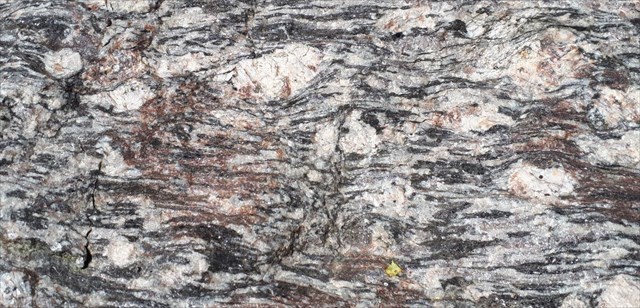
► Orthogneiss oeillé, roche métamorphique d'origine granitique
Cette roche est litée et sa foliation se caractérise par une linéation (structure linéaire apparaissant au sein d'une roche soumise à une déformation).
Les minéraux du granite se transforment et se regroupent par phase :
- Les phénocristaux de feldspaths se dispersent en lignes parallèles à la linéation formant des yeux qui s'allongent dans le sens de l'étirement.
- Le quartz forme des rubans gris translucides qui s'amincissent en plaquettes.
- La biotite (cristal noir en lamelles) se transforme en files de cristaux émiettés.
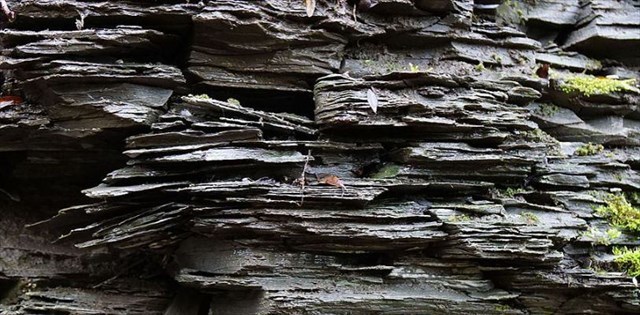
► Schiste, roche métamorphique litée
C'est une roche métamorphique à texture très fine (invisible à l'œil nu) dont les minéraux vont s'organiser en feuillets très fins parallèles entre eux.
La roche ressemble à un mille-feuilles qui peut avoir des plis.
Riche en ferromagnésiens, la roche saine est sombre puis à l'air libre prend en surface une teinte rouille (oxydation du fer).
► Silex, roche sédimentaire siliceuse
Le silex provient de la transformation des reste d'un plancton marin possédant un squelette siliceux et non calcaire. Sous la pression, la boue se transforme en un cristal siliceux.
Ce sont des roches très dures car formées de silice (comme le quartz), brillante, à texture très fine (grains invisibles) et à cassure esquilleuse.
Sa coloration dépend du milieu oxydant ou réducteur ou s'est faite la silicification (plus le silex est sombre, plus le milieu est réducteur).

A reminder about Earthcaches
ATTENTION, there is no container to look for or logbook to fill in. All you have to do is go to the observation sites and complete the validation conditions below.
As the aim of a geology cache is to put a geology lesson into practice by making observations in the field, you are advised to read the description to help you answer the questions.
Questions to validate the Earthcache
- Question 0 : Take a photo of yourself or your nickname in front of one of the mozaiques on Penotte Island.
This photo can either be sent to us with your answers or added to your log.
You are now at the corner of rue d'Assas and rue Trompeuse. Look at areas A, B, C and D in photo WP1.
- Question 1 : Associate each area with one of the rocks described in the description below, explaining your answer with your observations.
- Question 2 : For the block that is a flint, you can note two zones (central and distal) with 2 distinct colours. Which zone formed under reducing conditions?
- Question 3 : For the block that is a shale, which mineral is responsible for its colour variation
on the surface ?
You can log this cache without waiting for our confirmation,
but you must send us the answers at the same time, by e-mail via our profile (
fafahakkai) or by the system of Message Center of geocaching.com.
If there is a problem with your answers we will notify you.
The logs recorded without answers will be deleted.
What does this mean in theory?
► Rhyolite or Basalt, magmatic volcanic rocks
Volcanic rocks are characterised by the rapid crystallisation of magma, resulting in a very fine-textured matrix (crystals that are mostly invisible to the naked eye).
These rocks are crystalline, very hard, with no orientation (no bedding or layers).
Depending on the chemical composition, we obtain two different types of rock:
- If the magma is acidic (rich in silica), it gives rhyolite, a clear rock with a deep red colour because it is rich in haematite (a crystal with a high oxidised iron content).
- If the magma is basic (rich in ferromagnesium), it gives dark-coloured basalt.
► Eyed orthogneiss, metamorphic rock of granitic origin
This rock is bedded and its foliation is characterised by lineation (linear structure appearing within a rock subjected to deformation).
Granite minerals are transformed and grouped by phase:
- Feldspar phenocrysts disperse in lines parallel to the lineation, forming eyes that lengthen in the direction of stretching.
- Quartz forms translucent grey ribbons that taper into platelets.
- Biotite (black crystal in lamellae) transforms into rows of crumbled crystals.
► Schist, bedded metamorphic rock
This is a metamorphic rock with a very fine texture (invisible to the naked eye), in which the minerals are organised into very fine parallel layers.
The rock resembles a mille-feuilles which may have folds.
Rich in ferromagnesium, healthy rock is dark and then, in the open air, takes on a rusty hue on the surface (iron oxidation).
► Flint, siliceous sedimentary rock
Flint comes from the transformation of the remains of a marine plankton with a siliceous, non-calcareous skeleton. Under pressure, the mud is transformed into a siliceous crystal.
These are very hard rocks because they are formed from silica (like quartz), are shiny, have a very fine texture (invisible grains) and have an indented fracture.
Its colour depends on the oxidising or reducing environment in which silicification took place (the darker the flint, the more reducing the environment).
► Sources bibliographiques / Bibliographical sources