This is a multi cache. You must visit the 2 posted locations to gather information to solve the puzzle. The final cache is located within the Lynn Valley library. It is a small cache, but has room for small trackables.
Permission has kindly been granted for placement. Access is restricted to opening hours.
Free 3 hour parking is available in the Lynn Valley Village parkade (enter off Mountain Hwy).
I have made this a difficulty 3 due to the steps involved and the puzzle. Stage 1 and 2, as well as the final cache are wheelchair accessible.
History:
The nickname “Shaketown” was used due to the fact that Lynn Valley was known for logging and specifically for shingle mills. Shake is another term for a shingle. The Lynn Valley Lumber Co. Shingle Mill was located at Harold Road and Mountain Highway.
Houses across the North Shore and Vancouver were built using cedar shingles made in Lynn Valley and people flocked to the region in the late 19th and early 20th centuries for work. One of the area’s early settlers was Walter Draycott.
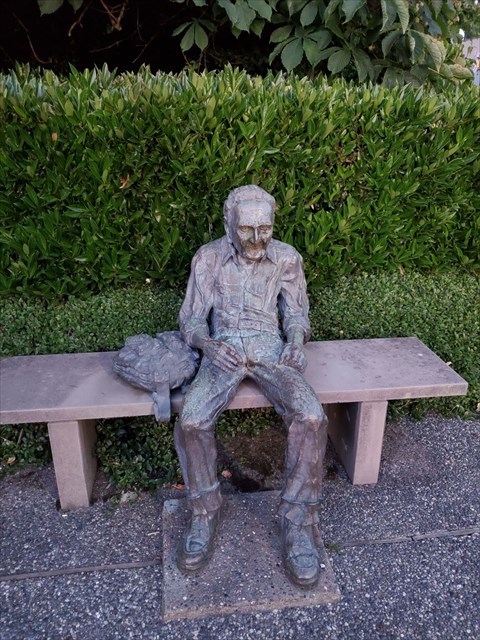
Born in England, Walter Draycott bought property in Lynn Valley in 1911 and built his house on what is now Draycott Road. He was a talented artist as well as an author and local historian, and served as a sketch artist for the Canadian military during the First World War. He died in 1985 at the age of 102. His bronze statue now sits on a bench in Pioneer Square.
This corner of Lynn Valley Rd & Mountain Hwy is today a very busy intersection and much different from years gone by. Lynn Valley Road used to be called “Pipeline Road” when Lynn Valley was known as “Shaketown”. Mill operations in Lynn Valley wound down in the 1920s, marking the end of the Shaketown era. By then, land had been cleared, roads built, and residents had built up the community.
The Fromme Block (the row containing Canada Trust and Waves coffee) is the only original structure that remains at the intersection. For years it housed a hardware store on the ground floor. An interesting piece of my own family history is my grandparents did the painting and interior decorating inside this building in 1930.
The Lynn Valley Library branch evolved thru several small locations, starting in 1964. A permanent location was established in the late 1960’s in a small 2 storey building located behind the Esso Station on Mountain Hwy. Significant growth in borrowed material, and creation of a new integrated library system, meant a new larger location would be required. After many years of planning, selecting a new site, and having funding approved, the new Lynn Valley Main Library was built and opened on November 26, 2007. The new library is double the size, and has made a successful transition from a traditional library to a vibrant town centre and gathering place.
To find the cache, you must first go to the posted coordinates at Stage 1 and Stage 2 and gather information from 2 different sign boards.
You will need this information to use for the final stage. You can do Stage 1 and 2 in any order. Check the hint if you need extra help. Keep track of your one word answers as you proceed and the letter it corresponds to.
Stage 1:
All the information that you need is in the three paragraphs on the sign titled “The Lynn Valley Water Trough”.
B = 3, 1, 6
D = 1, 4, 3
G = 2, 3, 1
Stage 2:
All the information that you need is on the sign titled “Lynn Valley Link Route”.
Under Photo of “Original Municipal Hall” (2 paragraphs)
C = 1, 4, 1
Under Photo of “Church and School” (2 paragraphs)
A = 2, 2, 10
Under “Early Days in Lynn Valley” (4 paragraphs)
F = 1, 2, 5
E = 4, 5, 6
Now that you have gathered all the answers, use them to select the right choices and get the code. Find the cache in the library using the code. Remember to check opening hours.
A. R=7 L=3 V=9
B. F= 6 D= 7 T= 4
C. F= 0 S= 5 T= 8
D. M= 2 H= 5 B= 1
E. M= S P= H H= T
F. L= E C= A F= P
G. B= S C= Q F= L
Code:
(A) (B) (C) . (D)
(E) (F) (G)
Once you've gotten this far, it should be a very straightforward find inside the library.
More History about Walter Draycott... excerpts from a 2025 article written by Patricia Barnes and appearing in the “Neighbours of Lynn Valley” magazine.
Walter Mackay Draycott – Soldier, Artist, Pioneer
When the First World War broke out, Walter was recruited into the newly formed Princess Patricia’s Canadian Light Infantry, where his talent for sketching set him apart.
Appointed regimental topographer and sketcher, he produced detailed maps, panoramic sketches and charts of enemy positions. His work guided officers and saved lives, though it came at significant personal risk.
Walter and his comrades endured weeks in mud-filled trenches wearing clothes and boots soaked in rain, dirt, and blood. He was wounded three times and gassed twice, but it was the unrelenting shelling, the ceaseless threat of snipers, and the ever-present possibility of a slow, painful death hanging over them all that caused the worst pain.
In January 1915, he was struck by shrapnel during the bombardment and evacuated to England. Seven months later, he returned to the front, witnessing the infamous Second Battle of Ypres, where poison gas was unleashed for the first time. His diary says:
“Large shell holes cover the fields…everywhere is ruin and desolation. Not a house habitable. Convent of St. Maria in ruins.”
Promoted to corporal and serving as regimental topographer, Walter often sketched under fire. His maps were used to plan attacks and direct artillery fire with deadly precision. At the Battle of Mount Sorrel, he briefly set aside his drawing to act as a dispatch runner, carrying messages through fierce bombardment.
In April 1917, after a period of leave, Walter took part in the historic Canadian assault on Vimy Ridge. Ordered to follow closely behind the advancing troops, he recorded the thunder of artillery as “a regular hell on earth”.
On May 4, he inhaled poison gas and later wrote, “It was akin to swallowing finely broken, sharp pieces of glass”.
In 1918, carrying the physical and emotional scars of battle, Walter returned to Lynn Valley, where he published a local history, designed a war memorial for St. Clement’s, and became a trusted guide, leading hikes into the valleys and forests he so loved. His modest home was filled with books, fossils, stamps, minerals and specimens. He contributed to scientific journals and produced detailed notes on North Shore geology.
Walter Draycott’s influence stretched far beyond his military service. He left behind diaries spanning nearly eight decades, thousands of photographs, sketches, and charts, as well as two published histories of Lynn Valley. His personal accounts of trench life remain among the most vivid Canadian records of the First World War.