This is an Earthcache – as such, there is no physical cache. Instead after reading the lesson and examining the boulder at the posted coordinates, you will then answer 3 earth science questions and message me the answers. This earthcache is located in Red Bank Battlefield Park with permission. The park is open daily from dawn to dusk.
On a recent visit to this park I noticed this large boulder of Ironstone next to a 1941 plaque dedicated to Frank H. Stewart. I looked him up when I got home and learned that Stewart was a historian and business man who developed a trust in his will to preserve treasured lands and history in south New Jersey. He was also instrumental in preserving this park that you are standing in.

I also looked up Ironstone and found that it is a sedimentary rock that is common throughout the Coastal Plain of New Jersey. It is not considered an ore (Ores are rocks that consist of one or more minerals that can be extracted for valuable profit) because it contains too much sand and very little iron. Ironstone is made up mainly of quartz sand cemented together by iron minerals. Chemical and bacterial processes allow these minerals to form when iron dissolved in acidic water is deposited. If ironstone consisted of more iron, it would be considered a bog iron ore, but since it is made up of more sand, it is considered a Sandstone.
Sandstones are formed by groundwater depositing minerals between the particle grains. This process causes sand grains to CEMENT together. High temperatures and pressure that occur thousands of feet underground are responsible for creating most of New Jersey’s sandstone formations. New Jersey's sandstones were formed about 210 million years ago, dating back to the Late Triassic Period (when dinosaurs were around). It was formed in a desert environment from sand deposited by rivers.
The grains of sand in sandstone have been reduced to their sand size through weathering, and they are transported and deposited via water, wind, or glacial action. Sandstone may contain larger sized grains, such as granules, but the rock would still be classified as sandstone if the primary component is sand-sized grains. Sedimentary rocks are grouped according to grain size and what they are made of. Solid rock fragments in sediment are defined by the class size of the fragments (largest to smallest): BOULDERS, COBBLES, PEBBLES, SAND, SILT, and CLAY.
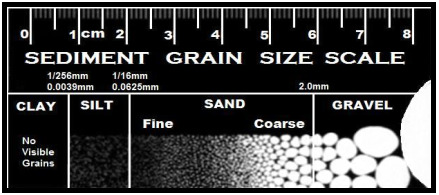
Sedimentary rocks that are made up of grains smaller than 2mm and above .0625 mm are known as sandstones. If the grains are smaller than .0625 mm it is considered a mudstone. Clastic sedimentary rocks in which a significant proportion of the clasts are larger than 2 mm are known as conglomerates. The difference in the composition between a sandstone and a conglomerate is that sandstone is composed of uniformed fine sand grains, while a conglomerate is mostly composed of large pebbles.
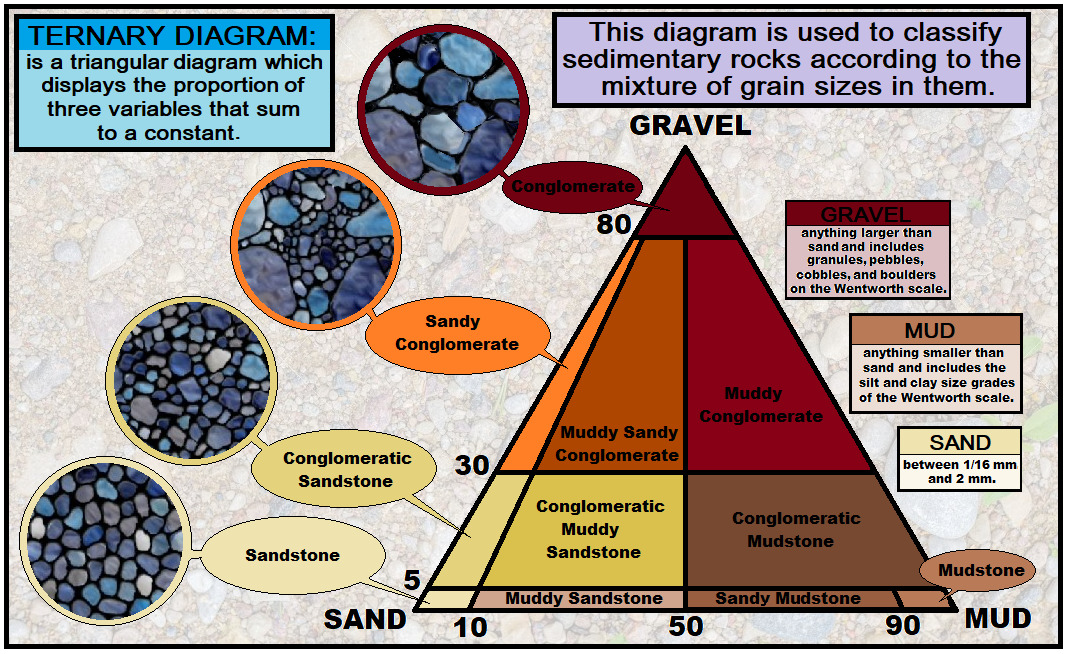
If a rock has gravel sized particles then one can use a ternary diagram to identify it's composition. Depending on the different amounts of gravel, sand, and silt the rocks condition changes. See graph below:
LOGGING REQUIREMENTS:
To log this Earthcache: Read the geology lesson above. Answer all three questions posted below. Answers can be sent via e-mail or messenger contacts on my Geocaching profile within a reasonable time. Group answers are fine, but do not post the answers to the questions in your logs.
QUESTION 1. Gently rub your hand on the boulder. Do the grains in this rock feel tightly cemented together, or do the particles brush off easily?
QUESTION 2. Iron in rocks tends to be red. Do you see a lot of red in this boulder?
QUESTION 3.Of these three compositions, which one best describes this boulder?
A) Sandstone: This rock is has totally made up of even sand grains
B) Conglomeratic Sandstone: It's mostly made of sandstone, but there are portions of it where there is a lot of pebble sized stones.
C) Sandy Conglomerate: There is a lot of sand sized particles, pebble particles, and a bunch of gravel sized stones all mixed together!
OPTIONAL PHOTO: Posting a photo that readily indicates that you (and anyone else logging the find) are at the location.
 Awesnap has earned GSA's highest level:

REFERENCES:
1. The Rocks and Sediments of New Jersey, New Jersey Department of Environmental Protection, pdf, dep.nj.gov
2. Gloucester County Pays Tribute to Historian Frank H. Stewart The Morning Courier-Post, Camden NJ, October 20,1941, Page 3, Newspaper, newspapers.com
3. The Geology of New Jersey J.Lewis & H.Kummel, Geological Survey of New Jersey, Bulletin 14, 1915, PDF, nj.gov