Welcome to the Vale of Pickering in North Yorkshire.
How to log this EarthCache
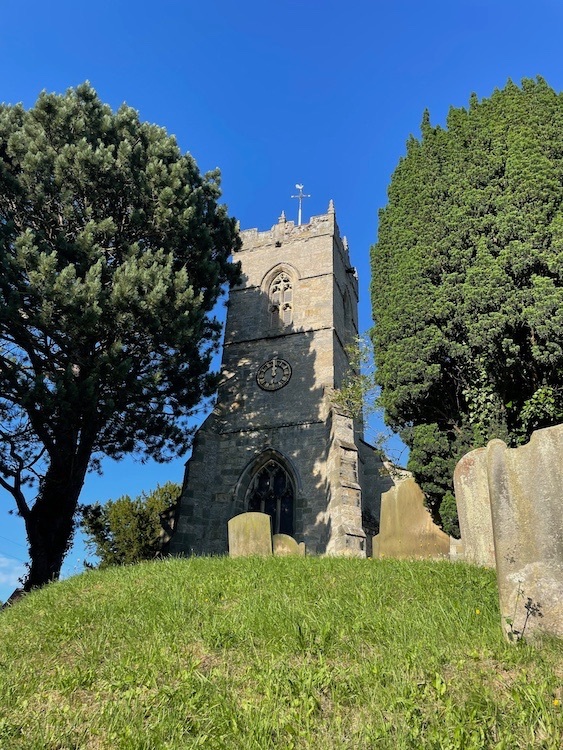
In order to log your find, please provide the answers to the below questions. The answers can be found by visiting the listed coordinates which is the porch of the church, reading the below description, and taking observations in the field. My apologies to wheelchair users; there are at least three steps up to the porch.
- Look at the main body of the church from the outside. What discolouration to the stone can be seen, and what do you think has caused it?
- Now look at the porch and compare it to the main body of the church. What differences in weathering can you see, and why do you think this is?
- Inside the porch, at the base of the arch above the main door, are two stone carvings. Please describe the weathering that has occurred to these carvings.
- On the inside East wall of the porch, please tell me the name of the Rector (1857-1899).
 You may optionally want to upload photos of your visit, of course I would love to see them! I will respond to your answers as soon as I can.
The Vale of Pickering
 The Vale of Pickering is a low-lying flat area of land in North Yorkshire, England, and is roughly extends from Pickering in the North to Malton in the South, and from Helmsley in the West to Scarborough in the East. The landscape is rural with scattered villages and small market towns, like Thornton-le-Dale where this cache is located.
The Vale of Pickering is a drainage basin for the surrounding hills. There used to be a post-glacial lake here called Lake Pickering. Following the last glaciation Lake Pickering gradually drained away leaving a complex of rivers and marshes which humans have gradually tamed.
Types of Weathering
Wind is a major geological force. Wind weathers the Earth's surface and buildings around us by deflation (the removal of loose, fine-grained particles by the turbulent action of the wind) and by abrasion (the wearing down of surfaces by the grinding action and sandblasting of windborne particles).
A process called chemical weathering may cause the color of rocks to change. For example, rocks containing iron impurities tend to rust when they come into contact with oxygen or water. When they begin to rust, they turn reddish-brown. Copper impurities can cause the rocks to turn green, because copper oxide is this colour (think of the Statue of Liberty).
Surface Discolouration
Over time, stones used for building can become discoloured. The three main reasons for this are biological soiling, particle soiling and staining. Stone can become biologically stained when organisms such as algae, lichen and bacteria begin to grow on, and in the stone. Particle soiling occurs when pollution, fumes etc accumulate on the stone, discolouring the surface. Finally, staining occurs when darker minerals present in the rock gradually reach the surface.