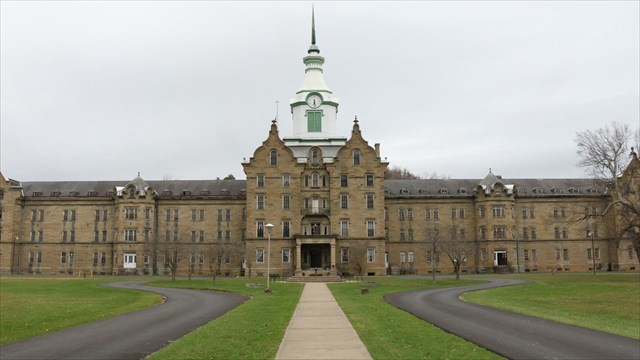
The Trans-Allegheny Lunatic Asylum is a historic psychiatric hospital that opened in 1864. Designed by architect Richard Andrews, it is one of the largest hand cut stone masonry buildings in the United States (and the second largest sandstone building in the world, behind the Kremlin). Initially intended to house 250 patients, it became severely overcrowded in the early 20th century, housing over 2,400 patients at its peak. The asylum was closed in 1994 due to changes in mental health treatment and reports of poor conditions. Today, it serves as a tourist attraction offering historic and paranormal tours.

The Trans-Allegheny Lunatic Asylum (or TALA for short) is constructed from blue sandstone that was originally quarried in Mount Clare (about 15 miles north of here). Construction of the asylum began in 1858, and although the hospital opened its doors in 1864, the building was not completed until 1881. Eventually, the blue sandstone used for the structure was later quarried on site. The image above is a geologic map of West Virginia, with the red arrow pointing to where Weston is located (you can click on the image to see it in higher resolution).
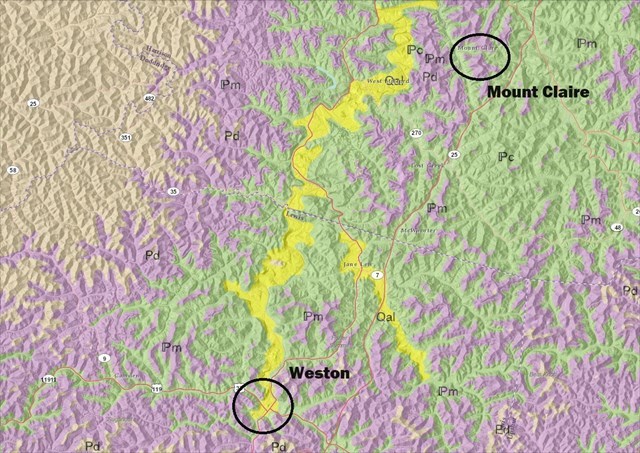
Now let's dive a little deeper into the local geology. The West Virginia Geological and Economic Survey (WVGES) has created an interactive map showing the bedrock geology of the state, and in the screenshot above, I've circled where Weston and Mount Claire are located. There are three main geologic units found in both of these areas. The first is Quaternary Alluvium, which is shown in yellow. It is from the Cenozoic Era (which is the most recent 66 million years of Earth's geologic history). This formation is alluvial (relating to flowing water) deposits of sand, gravel, silt, and clay. If you are somewhat familiar with the area, you'll notice that this formation is primarily found along the West Fork River in the low lying areas. Next is the Conemaugh Group which is shown in green. It is from the Upper Pennsylvanian Period (323.2-298.9 million years ago). It is mostly made up of mudstone that is interbedded with other sedimentary rocks such as coarser grained clastic rocks (rocks made up of broken pieces of older rocks) like sandstone or conglomerate. However alternating layers or red and gray shale, siltstone, and sandstone, along with thin layers of limestone and coal may also be found. Lastly there is the Monongahela Group, shown in purple, which is also from the Upper Pennsylvanian Period (323.2-298.9 mya). It is made up mostly of sandstone that is interbedded with other sedimentary rocks that locally may include conglomerates and finer grained clastic rocks such as mudstones, carbonates (rock made up of carbonate minerals), and coal. Based on the shear size of the building (242,000 square feet of floor area), it is likely that the sandstone used was from the Monongahela Formation, which would have been able to supply the quantities of stone needed.
This EarthCache can be completed from the exterior of the building, and there is no fee to explore the grounds in front. However, an entrance fee is required if you wish to take a historic tour of the building's interior.
Logging Requirements:
- Describe the color, texture, or any other unique characteristics of the sandstone. Is the grain size or color consistent or does it vary slightly from stone to stone? Why do you think the stone is described as being 'blue sandstone' even though the color you see is noticeably different?
- Since the stone used in this building was first quarried about 15 miles north before being sourced directly on site, can you see any visible differences (such as color) that indicate this change? Based on your answer, what can this tell us from a geological perspective?
- Upload a photo with the Trans-Allegheny Lunatic Asylum. You don't have to be in the photo, though it is strongly encouraged.
Sources:
- https://elkinsdepot.com/blog/trans-allegheny-lunatic-asylum-tells-the-history-of-mental-health-in-the-united-states/
- https://www.kirkbridebuildings.com/buildings/weston/
- https://atlas2.wvgs.wvnet.edu/portal/apps/webappviewer/index.html?id=ab47a1fc20e4417aa47af96b4c83be28