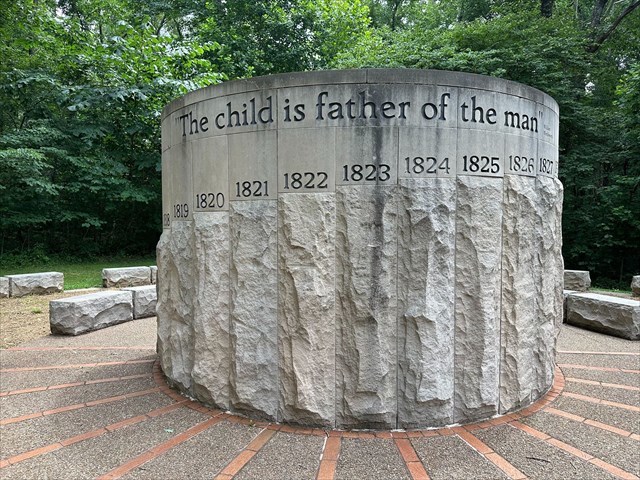
The Abraham Lincoln Bicentennial Plaza is located in Lincoln State Park, and serves as a tribute to the nations 16th President. The plaza consists of eight pillars, each 6 feet 4 inches tall, which is the same height as Lincoln when he left Indiana. The plaza highlights key aspects of Lincoln's development during his formative years, from ages 7 to 21. The plaza is designed not only as a tribute to Lincoln's legacy but also as an educational space, encouraging visitors to reflect on the enduring impact of his leadership and ideals. It illustrates how a young man from southern Indiana, with no special advantages, developed the knowledge, skills, and attitudes that led to his remarkable success and service to the nation.
The Abraham Lincoln Bicentennial Plaza is constructed from Indiana Limestone, also known as Salem Limestone, which was quarried at the Empire Quarry in Oolitic, IN; the same quarry that supplied stone for the Empire State Building! This limestone was formed approximately 300 million years ago during the Mississippian Period, when a shallow inland sea covered what is now southern Indiana. The sea was abundant in marine life, such as brachiopods, bryozoans, and crinoids, which produced calcium carbonate through their shells and skeletal structures. As these organisms died, their remains accumulated on the sea floor, forming thick layers of carbonate-rich sediment. Over time, additional sediments added pressure, compacting the underlying layers and initiating the lithification process. This process involved the gradual compaction of sediments, reducing pore spaces and squeezing out water, while the calcium carbonate dissolved in seawater reprecipitated, cementing the sediments into solid rock. The calm, stable marine conditions allowed for consistent sedimentation, resulting in the dense, homogenous limestone we see today.
Indiana Limestone is characterized by several key properties that make it an ideal building material. It has a fine uniform grain and a high calcium carbonate content which typically exceeding 97%. These properties contributes to its strength and durability. Compared to other limestones, it is relatively soft, making it easier to cut and shape while still maintaining high resistance to weathering and erosion. Its uniformity in texture and color, typically a light to medium gray or buff, allows for consistent finishes in architectural applications. One other thing worth mentioning is it is considered oolitic, meaning it is composed of small, rounded grains called ooids, which form from the accumulation of calcium carbonate around a nucleus in warm, shallow marine environments.
Logging Requirements:
- Describe the characteristics (color, texture, ...etc) of the Indiana Limestone from which the monument is composed from. Looking closely at the stone, are you able to see the oolitics?
- Do you see any signs of weathering? Based on your observations, do you think Indiana Limestone was a good choice as a building material for the monument? Explain your answer.
- Upload a photo taken with Abraham Lincoln Bicentennial Plaza. You don't have to be in the photo, though it is strongly encouraged.
Sources:
- https://www.in.gov/lincoln/pdfs/ALplaza_brochure.pdf