
The First Lincoln Memorial, located at Abraham Lincoln's birthplace in Hodgenville, Kentucky, is a modest yet historically significant structure. Dedicated in 1909, it commemorates the centennial of Lincoln's birth and stands near the site of his humble log cabin birthplace. Designed by architect John Russell Pope, the memorial is a classical style building that houses a replica of the original log cabin, which symbolizes Lincoln's origins and the values of humility and resilience associated with his life.
The First Lincoln Memorial is constructed from Stony Creek Milford Pink Granite, which was quarried by the Dodds Granite Company in Milford, Massachusetts. The town is famous for the pink variety of stone, which has been used in the American Museum of Natural History as well as Baltimore Penn Station and New York Penn Station (before it was torn down). Before we delve deeper into the stone, let's first understand what granite is. Granite is a coarse grained igneous rock that forms from the slow crystallization of magma beneath the Earth's surface. This slow crystallization process allows large mineral grains to develop. In contrast, igneous rocks that form at or above the Earth's surface tend to cool quickly and as a result have smaller crystals. Stony Creek Milford Pink Granite is from the Proterozoic Eon (2.5 billion to 541 million years ago), and the stone has been dated to approximately 606 million years old. Geologically, the formation covers approximately 39 square miles in Massachusetts, and it is sometimes referred to as Braggville Granite, due to the quarries located within the village of Braggville.
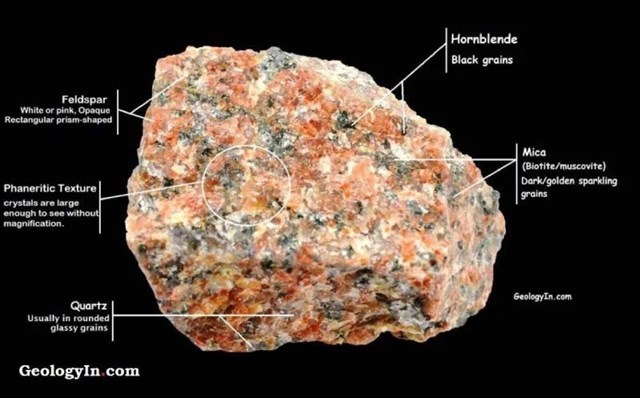
Now let's learn about some of the minerals that are found in granite, and how they impact the visual and physical properties of the stone. The image above shows some of the common minerals that are found in granite. While the piece of granite in the photo does have a pink color, it is NOT Stony Creek Milford Pink Granite. The five most common minerals found in granite (in decreasing abundance) are orthoclase feldspar, quartz, plagioclase feldspar, micas, and amphibole. There are two feldspars, and they are the most abundant mineral in the Earth's crust. You may sometimes here orthoclase feldspar referred to as potassium feldspar, and it is usually a pink or red color. In contrast, plagioclase feldspar is usually black or gray but the color can vary. Next there is quartz, which is usually clear or white and has a glassy luster. It is highly resistant to weathering and erosion. Next there are micas, which tend to form think flexible sheets. There are two types: biotite and muscovite. Biotite is black or dark brown color while muscovite is light colored or clear and may have a slight yellow or green tint. The reason that the two micas are usually grouped together (unlike orthoclase and plagioclase feldspars) is because they have a similar crystal structure as well as similar chemical compositions. Lastly there is amphibole (hornblende) which is a dark green to black color and indicates the presence of water during the formation of the rock.
Logging Requirements:
- Describe the color, texture, and grain size of the stone. Are you able to identify any minerals within the stone? Which mineral do you think is responsible for giving it its distinctive pink color? Lastly, are the minerals evenly distributed or do you see any signs of them being localized in certain spots, and if so, why do you think this is the case?
- Stony Creek Milford Pink Granite has been described as sometimes being foliated, which is when minerals are arranged in parallel layers or bands. Do you see any foliation within the stone?
- Upload a photo taken with the First Lincoln Memorial. You don't have to be in the photo, though it is strongly encouraged.
Sources:
- https://www.nps.gov/parkhistory/online_books/abli/abli_mem_hsr.pdf
- https://www.geo.umass.edu/stategeologist/Products/Bedrock_Geology/Milford_Draft/mil_bedrock_sheet1.pdf