Deutsch
Allerheiligen-Wasserfälle
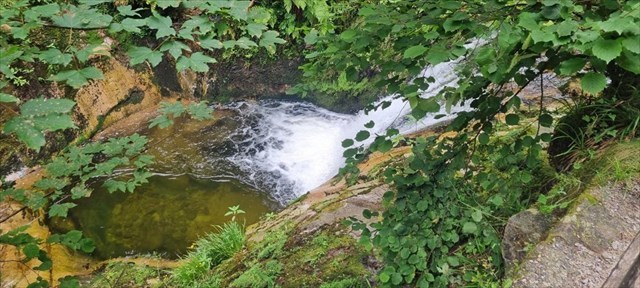
Der Lierbach hat südlich vom ehemaligen Kloster Allerheiligen im Seebachgranit durch Erosion eine tiefe und enge Schlucht geschaffen.
Durch die steile Felsschlucht stürzt der Lierbach auf einer Bachlänge von 300 Meter in sieben Stufen in rund 100 Meter in die Tiefe. Die Wasserfälle zählen zu den höchsten naturbelassenen Wasserfälle Deutschlands.

Entstehung
Ein Tosbecken ist ein geomorphologisches Merkmal, das häufig an der Basis eines Wasserfalls zu finden ist. Es entsteht durch die erosive Kraft des herabstürzenden Wassers. Hier ist eine Erklärung, wie sich ein Tosbecken bildet:
- Kraft des Wassers: Wenn das Wasser über den Rand eines Wasserfalls stürzt, fällt es mit hoher Geschwindigkeit und Energie in den darunter liegenden Bereich. Diese kinetische Energie wird beim Aufprall auf die Wasseroberfläche und den darunterliegenden Fels oder Boden übertragen.
- Hydraulische Erosion: Das herabfallende Wasser erzeugt starken Druck auf den Untergrund. Dieser Druck führt zur Erosion des Gesteins oder Sediments am Fuße des Wasserfalls. Die ständige Bewegung des Wassers und die mitgeführten Sedimente verstärken diesen Erosionsprozess.
- Bildung einer Vertiefung: Mit der Zeit vertieft sich der Bereich, in den das Wasser fällt, und es entsteht eine Vertiefung oder ein Becken. Diese Vertiefung ist das Tosbecken. Die Tiefe und Größe des Tosbeckens hängen von verschiedenen Faktoren ab, wie der Höhe des Wasserfalls, der Menge des herabfallenden Wassers, der Härte des Gesteins und der Dauer des Erosionsprozesses.
- Wirbel und Turbulenzen: Im Tosbecken selbst entstehen durch die Kraft des herabfallenden Wassers starke Strömungen, Wirbel und Turbulenzen. Diese verstärken die Erosion und vertiefen das Becken weiter.
- Materialtransport: Das erodierte Material wird durch das Wasser abtransportiert, wodurch das Tosbecken kontinuierlich sauber bleibt und weiter erodiert werden kann. Größere Partikel können sich am Rand oder am Ausgang des Tosbeckens ablagern.
Zusammengefasst ist ein Tosbecken das Ergebnis der intensiven erosiven Prozesse, die durch die Kraft des herabstürzenden Wassers an der Basis eines Wasserfalls stattfinden. Diese Prozesse führen zur Bildung einer tiefen, oft schüsselartigen Vertiefung im Untergrund.
Hier ist eine Darstellung eines Wasserfalls und der Bildung eines Tosbeckens:
Diese Illustration zeigt die grundlegenden Merkmale und Prozesse, die zur Bildung eines Tosbeckens führen.

- Wasserfall: Das Wasser stürzt von oben herab.
- Fallendes Wasser: Das Wasser fällt vom Wasserfall hinunter.
- Tosbecken: An der Basis des Wasserfalls entsteht eine Vertiefung, das Tosbecken, durch die erosive Kraft des herabfallenden Wassers.
- Fluss: Das Wasser fließt weiter in den Fluss.
Logbedingungen
Beantwortet folgende Fragen richtig und sendet mir eure Antworten.
Ihr dürft direkt loggen. Sollte etwas an den Antworten nicht korrekt sein, melde ich mich bei euch.
- Erkläre in eigenen Worten, anhand der 5 Punkte, die Entstehung eines Tosbeckens?
- Ist hier ein ausgeprägtes Tosbecken vorhanden? Wenn ja, wie tief schätzt du es?
- Ein Foto von euch (einem Blatt mit eurem Geocaching-Namen oder eurem GPS), vor Ort, mit den Wasserfällen im Hintergrund ist erforderlich.
English
Allerheiligen waterfalls
South of the former Allerheiligen monastery, the Lierbach stream has created a deep and narrow gorge in the Seebach granite through erosion.
The Lierbach plunges through the steep rocky gorge in seven stages over a length of 300 metres, falling around 100 metres. The waterfalls are among the highest natural waterfalls in Germany.
Formation
A stilling basin is a geomorphological feature that is often found at the base of a waterfall. It is formed by the erosive force of falling water. Here is an explanation of how a stilling basin is formed:
- Force of water: as water cascades over the edge of a waterfall, it falls with high velocity and energy into the area below. This kinetic energy is transferred on impact to the water surface and the rock or soil below.
- Hydraulic erosion: The falling water creates strong pressure on the ground. This pressure leads to erosion of the rock or sediment at the base of the waterfall. The constant movement of the water and the sediment carried along intensify this erosion process.
- Formation of a depression: Over time, the area into which the water falls deepens and a depression or basin is formed. This depression is the stilling basin. The depth and size of the stilling basin depend on various factors, such as the height of the waterfall, the amount of water falling, the hardness of the rock and the duration of the erosion process.
- Eddies and turbulence: In the stilling basin itself, the force of the falling water creates strong currents, eddies and turbulence. These intensify erosion and further deepen the basin.
- Material transport: The eroded material is transported away by the water, which means that the stilling basin remains continuously clean and can be eroded further. Larger particles can be deposited on the edge or at the exit of the stilling basin.
To summarise, a stilling basin is the result of the intense erosive processes that take place at the base of a waterfall due to the force of the falling water. These processes lead to the formation of a deep, often bowl-like depression underground.
Here is an illustration of a waterfall and the formation of a stilling basin:
This illustration shows the basic features and processes that lead to the formation of a stilling basin.
- Waterfall: The water cascades down from above.
- Falling water: The water falls down from the waterfall.
- Stilling basin: A depression, the stilling basin, is formed at the base of the waterfall by the erosive force of the falling water.
- River: The water continues to flow into the river.
Log conditions
Answer the following questions correctly and send me your answers.
You can log directly. If there is anything wrong with the answers, I will get back to you.
- Explain in your own words, based on the 5 points, the formation of a stilling basin?
- Is there a pronounced stilling basin here? If so, how deep do you estimate it to be?
- A photo of you (a sheet with your geocaching name or your GPS), on site, with the waterfalls in the background is required.
Français
Chutes d'Allerheiligen
Au sud de l'ancien monastère Allerheiligen, le Lierbach a créé par érosion une gorge profonde et étroite dans le granit du Seebach.
À travers la gorge rocheuse abrupte, le Lierbach se précipite en sept étapes d'une centaine de mètres sur une longueur de ruisseau de 300 mètres. Les chutes d'eau comptent parmi les plus hautes chutes d'eau naturelles d'Allemagne.
Formation
Un bassin de tos est une caractéristique géomorphologique que l'on trouve souvent à la base d'une chute d'eau. Il est formé par la force érosive de l'eau qui tombe. Voici une explication de la formation d'un bassin en tos :
- Force de l'eau : lorsque l'eau se précipite sur le bord d'une cascade, elle tombe avec une grande vitesse et une grande énergie dans la zone située en dessous. Lors de l'impact, cette énergie cinétique est transmise à la surface de l'eau et à la roche ou au sol sous-jacent.
- Érosion hydraulique : la chute d'eau génère une forte pression sur le sous-sol. Cette pression entraîne l'érosion de la roche ou des sédiments au pied de la chute d'eau. Le mouvement constant de l'eau et les sédiments entraînés renforcent ce processus d'érosion.
- Formation d'une dépression : avec le temps, la zone dans laquelle l'eau tombe s'approfondit et forme une dépression ou un bassin. Cette dépression est le bassin de tos. La profondeur et la taille du bassin de tos dépendent de différents facteurs, tels que la hauteur de la chute d'eau, la quantité d'eau qui tombe, la dureté de la roche et la durée du processus d'érosion.
- Formation d'une dépression : avec le temps, la zone dans laquelle l'eau tombe s'approfondit et forme une dépression ou un bassin. Cette dépression est le bassin de tos. La profondeur et la taille du bassin de tos dépendent de différents facteurs, tels que la hauteur de la chute d'eau, la quantité d'eau qui tombe, la dureté de la roche et la durée du processus d'érosion.
- Les tourbillons et les turbulences : Dans le bassin de tos lui-même, la force de la chute d'eau provoque de forts courants, des tourbillons et des turbulences. Ceux-ci renforcent l'érosion et approfondissent encore le bassin.
- Transport de matériaux : les matériaux érodés sont évacués par l'eau, ce qui permet au bassin de tos de rester propre en continu et de continuer à s'éroder. Les particules plus grosses peuvent se déposer sur le bord ou à la sortie du bassin de tos.
En résumé, un bassin de tos est le résultat des processus érosifs intenses qui se produisent à la base d'une chute d'eau sous l'effet de la force de l'eau qui tombe. Ces processus entraînent la formation d'une profonde dépression dans le sous-sol, souvent en forme de cuvette.
Voici une représentation d'une chute d'eau et de la formation d'un bassin en tos :
Cette illustration montre les caractéristiques et les processus de base qui conduisent à la formation d'un bassin en tos.
- Chute d'eau : l'eau tombe d'en haut.
- Chute d'eau : l'eau tombe de la chute d'eau.
- Bassin en tos : Une dépression, le bassin en tos, se forme à la base de la chute d'eau sous l'effet de la force érosive de l'eau qui tombe.
- Rivière : l'eau continue à s'écouler dans la rivière.
Conditions de log
Répondez correctement aux questions suivantes et envoyez-moi vos réponses. Vous pouvez directement loguer la cache. Si les réponses ne sont pas correctes, je vous contacterai.
- Explique avec tes propres mots, à l'aide des 5 points, la formation d'un bassin de tos ?
- Existe-t-il ici un bassin de tos prononcé ? Si oui, à quelle profondeur l'estimez-vous ?
- Une photo de vous (une feuille avec votre nom de géocaching ou votre GPS), sur place, avec les chutes d'eau en arrière-plan est nécessaire.
Quelle – Source
Infotafel und Darstellung eines Wasserfalls durch Copilot.
Information board and illustration of a waterfall by Copilot.
Panneau d'information et représentation d'une chute d'eau par Copilot.
